On eBird ↗
American Kestrel
Live sightings near you, the range map, bar charts of when it is seen, and Macaulay Library photos and recordings.
American Kestrel
Falco sparverius
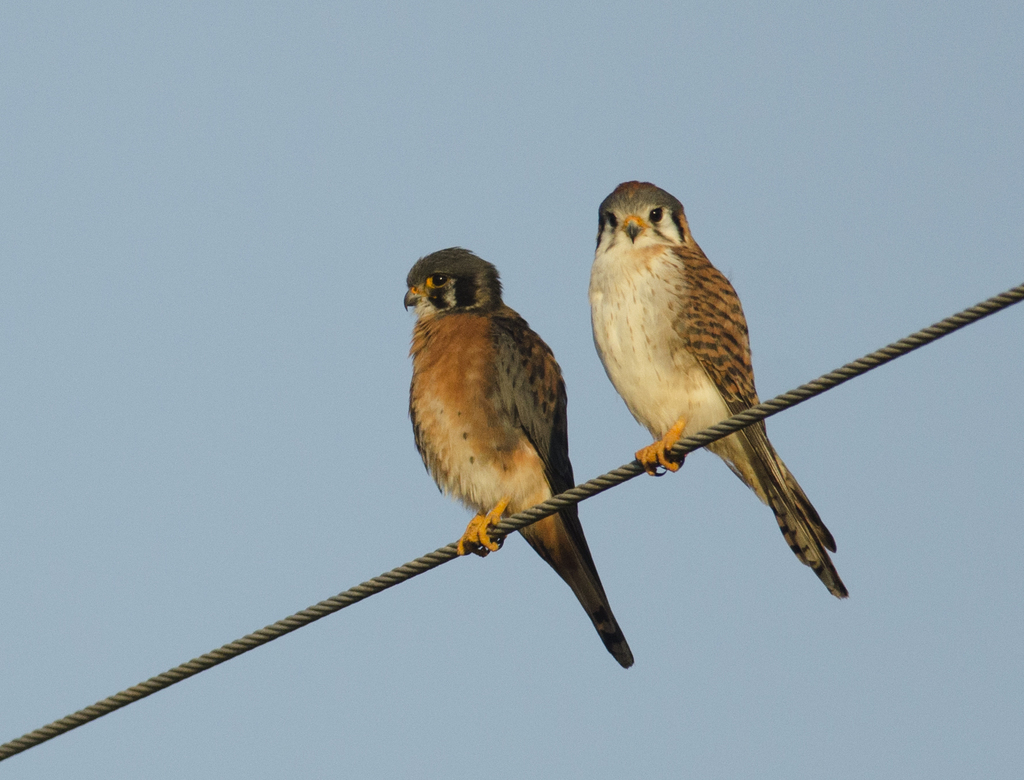
The American kestrel (Falco sparverius) is the smallest and most common falcon in the Americas. Though it has been called the American "sparrow hawk", this now obsolete vernacular name is a misnomer; the American kestrel is a true falcon, while neither the Eurasian sparrowhawk nor the other species called sparrowhawks are in the family Falconidae, hence only very distantly related to the American kestrel. It has a roughly two-to-one range in size over subspecies and sex, varying in size from about the weight of a blue jay to a mourning dove. It is a very successful species, occurring almost throughout North and South America except for the Arctic fringes of North America, and the densest tropical Amazon rainforest areas; it has evolved into 17 subspecies adapted to different environments and habitats throughout the region. It exhibits sexual dimorphism in size (females being moderately larger) and plumage, although both sexes have a rufous back with noticeable barring. Its plumage is colorful, and juveniles are similar in plumage to adults.
The American kestrel usually hunts in an energy-conserving fashion by perching and scanning the ground for prey to ambush, though it also hunts from the air. It sometimes hovers in the air with rapid wing beats while homing in on prey. Its diet typically consists of grasshoppers and other insects, lizards, mice, and small birds (e.g. sparrows). This broad diet has contributed to its wide success as a species. It nests in cavities in trees, cliffs, buildings, and other structures.
From the article American kestrel on Wikipedia (CC BY-SA), quoted section by section
Description
Under traditional terminology, the American kestrel is the smallest raptor in the Americas, though the South American spot-winged falconet is almost as small. The American kestrel is sexually dimorphic, although there is some overlap in plumage coloration between the sexes. The bird ranges from 22 to 31 cm (8.7 to 12.2 in) in length with a wingspan of 51–61 cm (20–24 in). The female kestrel is larger than the male, though less so than larger falcons, being typically about 10% to 15% larger within a subspecies. The more northern subspecies tend to larger sizes (northern hemisphere), with a large northern female being about twice the size of a small southern male. The male typically weighs 80–143 g (2.8–5.0 oz), and the female 86–165 g (3.0–5.8 oz). In standard measurements, the wing bone is 16–21 cm (6.3–8.3 in) long, the tail is 11–15 cm (4.3–5.9 in) and the tarsus is 3.2–4 cm (1.3–1.6 in). Physically, American kestrels are leaner and less muscular than larger falcons. The pectoral flight muscles of the American kestrel make up only about 12% of its body weight, as compared to about 20% for the strongest flying falcons such as the peregrine falcon. The wings are moderately long, fairly narrow, and taper to a point. …
What it does
American kestrels are found in a wide variety of habitats, including grasslands, meadows, deserts and other open to semi-open regions. They can also be found in both urban and suburban areas. A kestrel's habitat must include perches, open space for hunting, and cavities for nesting (whether natural or man-made). The American kestrel is able to live in very diverse conditions, ranging from above the Arctic Circle, to the tropics of Central America, to elevations of over 4,500 m (14,800 ft) in the Andes Mountains. The bird is distributed from northern Canada and Alaska to the southernmost tip of South America, Tierra del Fuego. It is the only kestrel found in the Americas, though as mentioned above this classification is genetically inaccurate. It has occurred as a vagrant in the UK, Denmark, Malta and the Azores.
American kestrels in Canada and the northern United States typically migrate south in the winter, some of them converging with resident kestrels of smaller size in Mexico, sometimes going as far as Central America and the Caribbean. Birds that breed south of about 35° north latitude are usually year-round residents. Migration also depends on local weather conditions. …
Wikipedia: “Ecology and behavior”
In human culture
The genus name is from Late Latin falco meaning "falcon". The specific epithet sparverius is Medieval Latin for a "sparrowhawk". Until the sixth edition of the AOU Checklist of North American Birds was published by the American Ornithologists' Union in 1983, the most commonly used name for the American kestrel was the sparrow hawk. This was due to a mistaken connection with the Eurasian sparrowhawk in the genus Accipiter. The sixth edition of the AOU Checklist corrected this, officially renaming the bird American kestrel. Several other colloquial names for the kestrel are also in use, including grasshopper hawk, due to its diet, and killy hawk, due to its distinct call.
Wikipedia: “Etymology”
Listen
Looking for field recordings…
Where it lives
Recorded sightings
—
geo-referenced records in GBIF, from museums, herbaria and field observers.
Drag the globe to turn it. Dots are where records exist, not a range map; darker means more records.
In the stacks
Searching the stacks…
Every page naming Falco sparverius in the Biodiversity Heritage Library →
This page is assembled live from iNaturalist, GBIF, Wikipedia, the Source Library and the Internet Archive. It is not yet part of the hand-edited codex. iNaturalist taxon 4665.