- Animals
- ›Chordates
- ›Vertebrates
- ›Birds
- ›Shorebirds and Allies
- ›Gulls, Terns, and Skimmers
- ›True Terns
- ›Sterna
On eBird ↗
Antarctic Tern
Live sightings near you, the range map, bar charts of when it is seen, and Macaulay Library photos and recordings.
Antarctic Tern
Sterna vittata
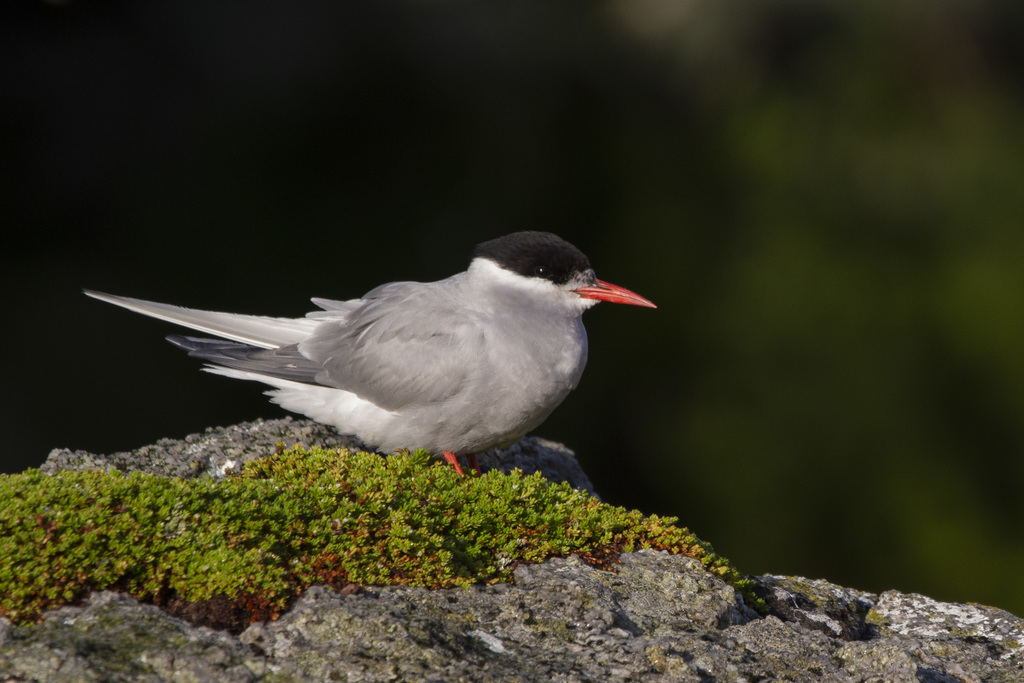
The Antarctic tern (Sterna vittata) is a seabird in the family Laridae. It ranges throughout the southern oceans and is found on small islands around Antarctica as well as on the shores of the mainland. Its diet consists primarily of small fish and crustaceans. It is very similar in appearance to the closely related Arctic tern, but it is stockier, and it is in its breeding plumage in the southern summer, when the Arctic tern has shed old feathers to get its non-breeding plumage. The Antarctic tern does not migrate like the Arctic tern does, but it can still be found on a very large range. This tern species is actually more closely related to the South American tern.
Gulls, skuas and jaegers are the primary predators of the bird's eggs and young.
From the article Antarctic tern on Wikipedia (CC BY-SA), quoted section by section
Description
The Antarctic tern is a medium-sized tern ranging from 35 to 40 cm (14 to 16 in) in length with a wingspan of 74 to 79 cm (29 to 31 in). It weighs between 150 and 180 g (5.3 and 6.3 oz) but it tends to be heavier during the winter months. In breeding plumage, the tern has light grey body and wings. Its deeply forked tail, lower back just above it and cheeks are white. It also has a distinctive black cap that reaches from the nape down to the bill and the eye is brownish-black. The bill, legs and feet are bright red. In non-breeding plumage, the black cap is reduced to just the area behind the eyes, the underparts become lighter and the bill becomes a dull reddish-black colour. Juveniles have yellowish-brown, grey, and white spots on their backs, with a yellowish-brown belly and breast. Their bill is dull black and the legs are dull red. The chicks have a yellowish-brown colour with black spots on their heads and back. They have a greyish white belly with a darker throat. The bill, legs and feet can be flesh colored or reddish black. The Antarctic tern closely resembles the Arctic tern. However, the local Antarctic Terns are in their breeding plumage when the migrating Arctic Terns arrive in their non-breeding plumage. Arctic terns also have shorter legs and more prominent black margins on the outside of their primary feathers. …
Range & habitat
The Antarctic tern prefers rocky areas such as islets, with or without vegetation, often among other seabird species. It usually nests on cliffs but is also found on rocky beaches, places inaccessible to cats or rats. It also avoids beaches with sea lions, as they tend to occupy all flat areas. Outside of the breeding season, this species of tern looks for ice edges in Antarctica. It also visits South Africa's beaches and rocky cliffs. This species has a large range, widely distributed around sub-Antarctic islands of the southern hemisphere and the Antarctic mainland. The breeding territory of the Antarctic tern includes the Antarctic continent, Bouvet Island, the French Southern Territories, Saint Helena, Ascension and Tristan da Cunha, South Africa, South Georgia, and the South Sandwich Islands. Recently, some populations have been found to take advantage of newly ice-free terrain on the north-eastern Antarctic Peninsula when nesting. Each subspecies have specific breeding islands. After breeding, the Antarctic tern does not undertake a long migration to the opposite pole like the Arctic tern does. It usually remains close to the breeding islands all year round. However, the more southern populations migrate slightly further north for the rest of the year. …
Wikipedia: “Distribution and habitat”
What it does
The Antarctic tern is an opportunistic feeder that mostly eats small fishes as well as some crustaceans like Antarctic krill. It usually fishes gregariously, forming flocks of up to 100 birds when they locate larger shoals. It fishes by hovering a few meters above the sea. When a prey is located, the tern has two strategies: most of the time it will directly plunge dive and become completely submerged but if the water is too rough it will only submerge its bill whilst in flight. It normally forages near the shore in the kelp zone. It has also been found in the intertidal zone, scavenging for small crustaceans, polychaetes, and shellfish. However, during the breeding season, it does not venture very far from its nest.
Wikipedia: “Food and feeding”
Listen
Looking for field recordings…
Where it lives
Recorded sightings
—
geo-referenced records in GBIF, from museums, herbaria and field observers.
Drag the globe to turn it. Dots are where records exist, not a range map; darker means more records.
In the stacks
Searching the stacks…
Every page naming Sterna vittata in the Biodiversity Heritage Library →
This page is assembled live from iNaturalist, GBIF, Wikipedia, the Source Library and the Internet Archive. It is not yet part of the hand-edited codex. iNaturalist taxon 4470.