On eBird ↗
American Black Duck
Live sightings near you, the range map, bar charts of when it is seen, and Macaulay Library photos and recordings.
American Black Duck
Anas rubripes
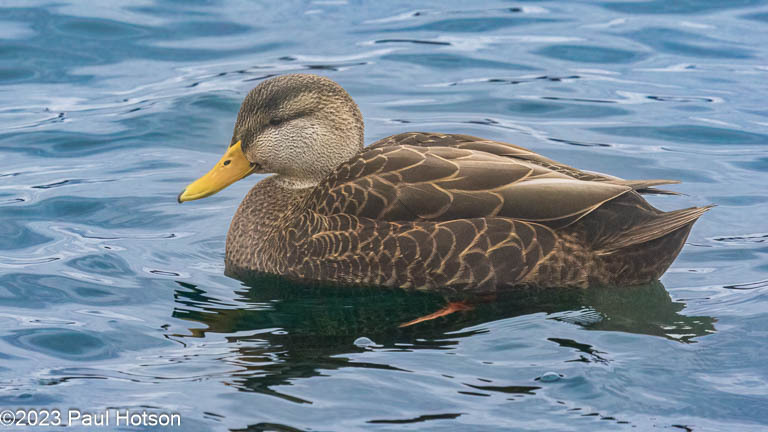
The American black duck (Anas rubripes) is a large dabbling duck in the family Anatidae. It was described by William Brewster in 1902. It is the heaviest species in the genus Anas, weighing 720–1,640 g (1.6–3.6 lb) on average and measuring 54–59 cm (21–23 in) in length with an 88–95 cm (35–37 in) wingspan. It somewhat resembles the female and eclipse male mallard in coloration, but has a darker plumage. The male and female are generally similar in appearance, but the male's bill is yellow, while the female's is dull green with dark marks on the upper mandible. It is native to eastern North America. During the breeding season, it is usually found in coastal and freshwater wetlands from Saskatchewan to the Atlantic in Canada and the Great Lakes and the Adirondacks in the United States. It is a partially migratory species, mostly wintering in the east-central United States, especially in coastal areas.
It interbreeds regularly and extensively with the mallard, to which it is closely related. The female lays six to 14 oval eggs, which have smooth shells in varied shades of white and buff green. Incubation usually takes 25 to 26 days, with both sexes sharing duties, although the male usually defends the territory until the female reaches the middle of her incubation period. Fledging occurs about 6 weeks after hatching. Once the eggs hatch, the hen leads the brood to rearing areas with abundant invertebrates and vegetation.
From the article American black duck on Wikipedia (CC BY-SA), quoted section by section
Description
The American black duck weighs 720–1,640 g (1.59–3.62 lb) and measures 54–59 cm (21–23 in) in length with a 88–95 cm (35–37 in) wingspan. This species has the highest mean body mass in the genus Anas, with a sample of 376 males averaging 1.4 kg (3.1 lb) and 176 females averaging 1.1 kg (2.4 lb), although its size is typically quite similar to that of the familiar mallard. The American black duck somewhat resembles the female mallard in coloration, although the black duck's plumage is darker. Males and females are generally similar in appearance, but the male's bill is yellow while the female's is dull green with dark marks on the upper mandible, which is occasionally flecked with black. The head is brown, but is slightly lighter in tone than the darker brown body. The cheeks and throat are streaked brown, with a dark streak going through the crown and dark eye. The speculum feathers are iridescent violet-blue with predominantly black margins. The fleshy orange feet of the duck have dark webbing. Both male and female American black ducks produce similar calls to their close relative, the mallard, with the female producing a loud sequence of quacks that fall in pitch. In flight, the white lining of the underwings can be seen in contrast to the blackish underbody and upperside. The purple speculum lacks white bands at the front and rear, and rarely has a white trailing edge. …
Range & habitat
The American black duck is endemic to eastern North America. In Canada, the range extends from northeastern Saskatchewan to Newfoundland and Labrador. In the United States, it is found in northern Illinois, Michigan, New Jersey, Ohio, Connecticut, Vermont, South Dakota, central West Virginia, Maine, and on the Atlantic coast south to North Carolina. The American black duck is a habitat generalist, as it is associated with tidal marshes and present throughout the year in salt marshes from the Gulf of Maine to coastal Virginia. It usually prefers freshwater and coastal wetlands throughout northeastern America, including brackish marshes, estuaries, and edges of backwater ponds and rivers lined by speckled alder. It also inhabits beaver ponds, shallow lakes with sedges and reeds, bogs in open boreal, and mixed hardwood forests, as well as forested swamps. Populations in Vermont have also been found in glacial kettle ponds surrounded by bog mats. During winter, the American black duck mostly inhabits brackish marshes bordering bays, agricultural marshes, flooded timber, agricultural fields, estuaries, and riverine areas. Ducks usually take shelter from hunting and other disturbances by moving to brackish and fresh impoundments on conservation land.
Wikipedia: “Distribution and habitat”
What it does
The American black duck is an omnivorous species with a diverse diet. It feeds by dabbling in shallow water and grazing on land. Its plant diet primarily includes a wide variety of wetland grasses and sedges, and the seeds, stems, leaves, and root stalks of aquatic plants, such as eelgrass, pondweed, and smartweed. Its animal diet includes mollusks, snails, amphipods, insects, mussels, and small fishes. During the breeding season, the diet of the American black duck consists of roughly 80% plant food and 20% animal food. The animal food diet increases to 85% during winter. During nesting, the proportion of invertebrates increases. Ducklings mostly eat water invertebrates for the first 12 days after hatching, including aquatic snowbugs, snails, mayflies, dragonflies, beetles, flies, caddisflies, and larvae. After this, they shift to seeds and other plant food.
Wikipedia: “Feeding”
In human culture
American ornithologist William Brewster described the American black duck as Anas obscura rubripes, for "red-legged black duck", in his landmark article, "An undescribed form of the black duck (Anas obscura)", in The Auk in 1902, to distinguish between the two kinds of black ducks found in New England. One of them was described as being comparatively small, with brownish legs and an olivaceous or dusky bill, and the other as being comparatively larger, with a lighter skin tone, bright red legs, and a clear yellow bill. The larger of the two was described as Anas obscura by German naturalist Johann Friedrich Gmelin in 1789 in the 13th edition of the Systema Naturae, Part 2, and he based it on the "Dusky Duck" of Welsh naturalist Thomas Pennant. The current scientific name, Anas rubripes, is derived from Latin, with Anas meaning "duck" and rubripes coming from ruber, "red", and pes, "foot". Pennant, in Arctic Zoology, Volume 2, described this duck as coming "from the province of New York" and having "a long and narrow dusky bill, tinged with blue: chin white: neck pale brown, streaked downwards with dusky lines." In a typical A. …
Wikipedia: “Taxonomy and etymology”
Listen
Looking for field recordings…
Where it lives
Recorded sightings
—
geo-referenced records in GBIF, from museums, herbaria and field observers.
Drag the globe to turn it. Dots are where records exist, not a range map; darker means more records.
In the stacks
Searching the stacks…
Every page naming Anas rubripes in the Biodiversity Heritage Library →
This page is assembled live from iNaturalist, GBIF, Wikipedia, the Source Library and the Internet Archive. It is not yet part of the hand-edited codex. iNaturalist taxon 6924.