 NL·0508
Herbarium of the Nature Library
- Name
- Lanius schach
- Family
- Laniidae
- Native to
- Kazakhstan and Iran through Afghanistan, Pakistan, India, Sri Lanka and Nepal to China, Southeast Asia and New Guinea
- Habitat
- Scrub, Farmland, Open woodland
On eBird ↗
Long-tailed Shrike
Live sightings near you, the range map, bar charts of when it is seen, and Macaulay Library photos and recordings.
Long-tailed shrike
Lanius schach
Also calledLahtora (Hindi/Urdu) · Zōng bèi bóláo 棕背伯劳 (Chinese) · Rufous-backed shrike
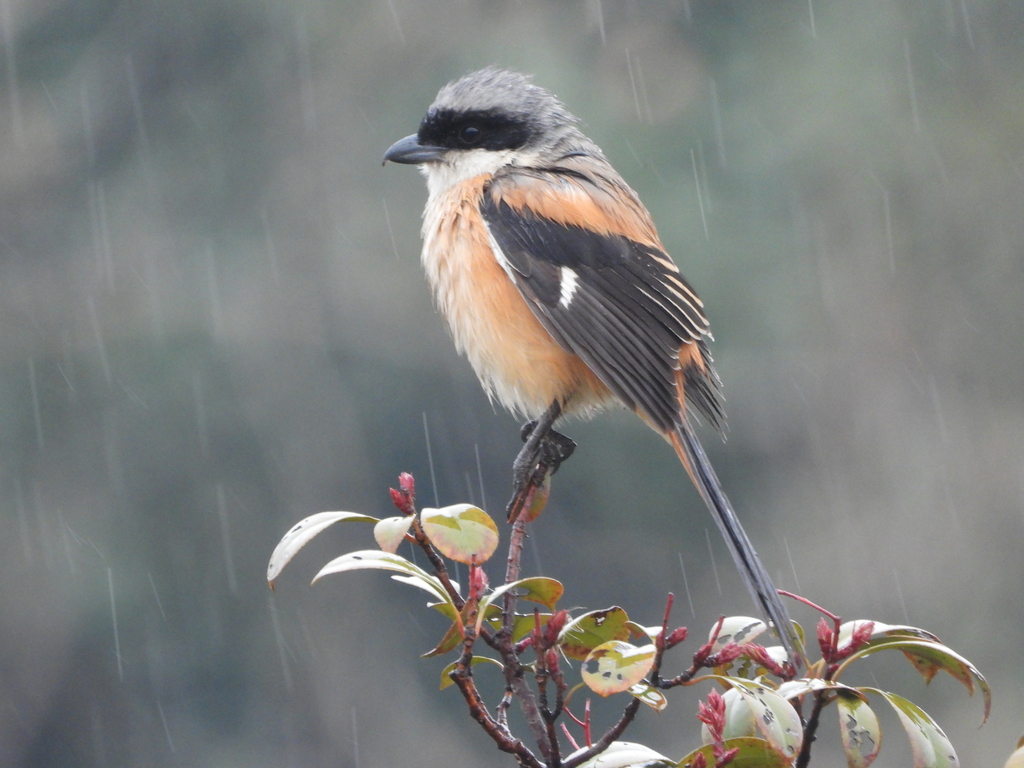
A predatory songbird with a black bandit mask and a rufous back, which perches on bushes and wires to pounce on insects, lizards and small birds. Like other shrikes it impales surplus prey on thorns as a larder.
The long-tailed shrike or rufous-backed shrike is a member of the bird family Laniidae, the shrikes. They are found widely distributed across Asia and there are variations in plumage across the range. The species ranges across much of Asia, both on the mainland and the eastern archipelagos. The eastern or Himalayan subspecies, L. s. tricolor, is sometimes called the black-headed shrike. Although there are considerable differences in plumage among the subspecies, they all have a long and narrow black tail, have a black mask and forehead, rufous rump and flanks and a small white patch on the shoulder. It is considered to form a superspecies with the grey-backed shrike which breeds on the Tibetan Plateau. Wikipedia
What it can do
- iImpales prey on thorns and barbed wire for storage and to tear it apart
- iiMimics the calls of other birds within its song
- iiiTakes vertebrate prey as large as small birds and mice
In the field
Field marks
- aBlack mask through the eye, grey crown and nape
- bRufous back, rump and flanks
- cLong, graduated black tail with pale edges
- dHooked black bill; small white wing patch
- Voice
- Harsh 'chaak' and grating calls; song is a quiet, rambling warble with much mimicry
- Not to be confused with
- Bay-backed shrike is smaller with a black forehead and maroon back; Isabelline shrike is sandy-brown; Grey-backed shrike (Himalaya) has an all-grey back.
- Where to see it
- Hedgerows and farmland across Punjab, Islamabad's sector parks and northern Pakistan valleys in summer; widespread in India and Sri Lanka in winter
- When
- Resident or partly migratory; northern breeders move south in winter
Listen
Looking for field recordings…
Life & habits
- Diet
- Large insects, lizards, small birds, rodents and frogs
- Habitat
- Open scrub, cultivation, gardens and hedgerows
- Size
- About 25 cm long
Sits upright on exposed perches, swinging its long tail, then drops on prey; males defend territories with harsh calls and songs full of mimicry.
Where it lives
Recorded sightings
—
geo-referenced records in GBIF, from museums, herbaria and field observers.
Native range
Kazakhstan and Iran through Afghanistan, Pakistan, India, Sri Lanka and Nepal to China, Southeast Asia and New Guinea
Drag the globe to turn it. Dots are where records exist, not a range map; darker means more records.
In the old herbals & bestiaries
No plate in the Source Library names this exact species, so these show its closest relatives as the old naturalists drew them: same genus, or the same kind of animal. Click a plate to read the page it came from, with translation.

Ornithology
Relative · Ulisse Aldrovandi · 1599 · p.416

Ornithologiae: de avibus historiae libri XII
Relative · Ulisse Aldrovandi · 1599 · p.405

Ornithology
Relative · Ulisse Aldrovandi · 1599 · p.421

History of Animals, Book I: On Viviparous Quadrupeds
Relative · Conrad Gessner · 1554 · p.745

Historiae Animalium Liber III: De Avium Natura
Relative · Conrad Gesner · 1555 · p.818

History of Animals, Book I: On Viviparous Quadrupeds
Relative · Conrad Gessner · 1554 · p.963

Historiae Animalium Liber III: De Avium Natura
Relative · Conrad Gesner · 1555 · p.600

François Bouchard — Recueil de cent-trente-trois oiseaux des plus belles especes (1775)
Relative · François Bouchard · 1775 · p.163

François Bouchard — Recueil de cent-trente-trois oiseaux des plus belles especes (1775)
Relative · François Bouchard · 1775 · p.169

François Le Vaillant — Histoire naturelle des promerops et des guêpiers (1807)
Relative · François Le Vaillant · 1807 · p.531
In the stacks
Searching the stacks…
Every page naming Lanius schach in the Biodiversity Heritage Library →
Marginalia
The shrike habit of impaling prey earned the family the English folk name 'butcher-bird'.
Kinship
Photographs: iNaturalist contributors under the licences shown. Records: GBIF.org. Historical plates: Source Library (CC BY-SA 4.0; originals public domain). Summary text: Nature Library editors and Wikipedia (CC BY-SA). Medicinal and edibility notes are historical and educational, not advice. iNaturalist taxon 12035.