- Animals
- ›Chordates
- ›Vertebrates
- ›Ray-finned Fishes
- ›Spiny-rayed fishes
- ›Perches, Scorpionfishes, Sticklebacks, and Allies
- ›Icefishes and allies
- ›Cod Icefishes
- ›Notothens
- ›Notothenia
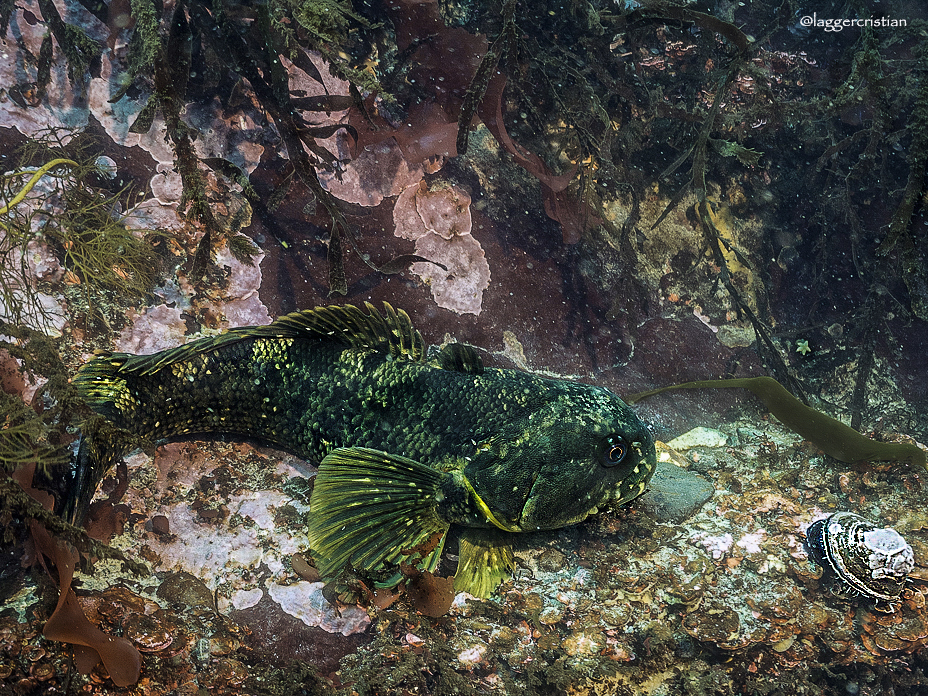
Black Rockcod
Notothenia coriiceps
Notothenia coriiceps, also known as the black rockcod, Antarctic yellowbelly rockcod, or Antarctic bullhead notothen, is a species of marine ray-finned fish, belonging to the family Nototheniidae, the notothens or cod icefishes. It is widely spread around the Antarctic continent. Like other Antarctic notothenioid fishes, N. coriiceps evolved in the stable, ice-cold environment of the Southern Ocean. It is not currently targeted by commercial fisheries.
From the article Notothenia coriiceps on Wikipedia (CC BY-SA), quoted section by section
Description
N. coriiceps members have scales that typically appear brown or gray in color. Its teeth consist of a multi-row tooth plate and caniform teeth, which are located in the outer portion of the jaw. Adults males typically reach a length of approximately 50 cm (20 in). Like many other notothenioid fishes, it lacks a swim bladder. Bone density increases during maturation, resulting in reduced buoyancy and the transition from pelagic to demersal swimming behavior. Adults N. coriiceps possess a dense, well-developed skeleton compared to its congener Notothenia rossii, accounting for its reduced buoyancy. Its epithelium is characterized by the presence of fat droplets, which serve as a storage mechanism for dietary lipids. Fat droplets are also stored in bone tissue.
Wikipedia: “Morphology”
Range & habitat
N. coriiceps maintains a circum-Antarctic distribution that is likely governed at least in part by the presence of the Antarctic Circumpolar Current (ACC) as well as its egg dispersal patterns. Populations of this species have been recorded at sites in the western Ross Sea, the Weddell Sea, the Western Antarctic Peninsula, the islands of the Scotia Arc to South Georgia, the Balleny Islands, and the sub-Antarctic islands of the Indian Ocean sector. N. coriiceps feeds on macroalgae amphipods and euphausiids. It appears to feed year-round, although diet composition likely varies seasonally.
Wikipedia: “Distribution and diet”
Where it lives
Recorded sightings
—
geo-referenced records in GBIF, from museums, herbaria and field observers.
Drag the globe to turn it. Dots are where records exist, not a range map; darker means more records.
In the stacks
Searching the stacks…
Every page naming Notothenia coriiceps in the Biodiversity Heritage Library →
This page is assembled live from iNaturalist, GBIF, Wikipedia, the Source Library and the Internet Archive. It is not yet part of the hand-edited codex. iNaturalist taxon 371728.