- Animals
- ›Chordates
- ›Vertebrates
- ›Birds
- ›Woodpeckers and Allies
- ›Woodpeckers
- ›Typical woodpeckers
- ›Green Woodpeckers, Flickers, and Allies
- ›Dinopium
On eBird ↗
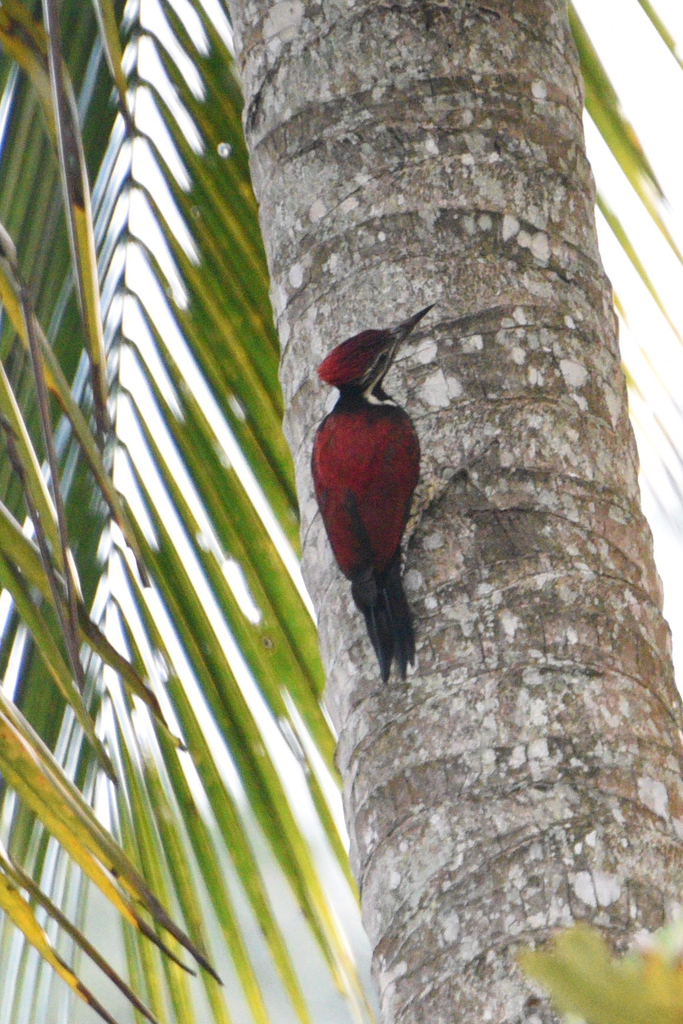
Red-backed Flameback
Live sightings near you, the range map, bar charts of when it is seen, and Macaulay Library photos and recordings.
Red-backed Flameback
Dinopium psarodes
The Red-backed flameback, Lesser Sri Lanka flameback, Sri Lanka red-backed woodpecker or Ceylon red-backed woodpecker (Dinopium psarodes) is a species of bird in the family Picidae. It is endemic to Sri Lanka, only absent in the far-north. It is sometimes considered a subspecies of the Black-rumped flameback.
From the article Red-backed flameback on Wikipedia (CC BY-SA), quoted section by section
Description
About 28 centimetres (11 in) in length. Mostly crimson with black trailing edges to wings. underparts white with messy black marks. The breast and neck are black with white spots on the throat and white streaks on the breast. A black eyestripe stretches to the back of the neck and diffuses into the nape and upper back, with white streaks between the eye and neck. It has a red crown, with the forecrown and forehead black speckled with white in females. The eye is hidden among the black eyestripe. It has a fairly sized grey bill, which forms a blunt point. Juveniles are duller with less bold markings, with males having white spots on crown and females with few spots if not none. Hybrids can be either mostly red with orange or yellow (closer to Red-backed flameback) or mostly yellow with red or orange (closer to Black-rumped flameback)
Range & habitat
Its natural habitats are subtropical or tropical dry forests, subtropical or tropical moist lowland forests, and subtropical or tropical mangrove forests, including manmade environments like home gardens. It can be seen from 1,500 metres (4,900 ft) away. Mostly found in the dry zone, but likes humid environments.
Wikipedia: “Habitat”
What it does
Its main source of food are ants. It seems to prefer Carpenter ants (Camponotus spp.), ants in the genus Meranoplus, and the pupae and larvae of Asian weaver ants (Oecophylla smaragdina). Other invertebrates eaten include spiders, caterpillars, weevils and beetles. Also feeds on some fruit occasionally, as a source of dietary fiber and other nutrients.
Wikipedia: “Diet”
Listen
Looking for field recordings…
Where it lives
Recorded sightings
—
geo-referenced records in GBIF, from museums, herbaria and field observers.
Drag the globe to turn it. Dots are where records exist, not a range map; darker means more records.
In the stacks
Searching the stacks…
Every page naming Dinopium psarodes in the Biodiversity Heritage Library →
This page is assembled live from iNaturalist, GBIF, Wikipedia, the Source Library and the Internet Archive. It is not yet part of the hand-edited codex. iNaturalist taxon 979698.