 NL·0546
Herbarium of the Nature Library
- Name
- Luscinia megarhynchos
- Family
- Muscicapidae
- Native to
- Breeds in southern and central Europe, North Africa, Turkey and the Middle East east to Central Asia (Kazakhstan, Afghanistan); winters in tropical Africa
- Habitat
- Woodland, Scrub, Riparian thicket
On eBird ↗
Common Nightingale
Live sightings near you, the range map, bar charts of when it is seen, and Macaulay Library photos and recordings.
Common nightingale
Luscinia megarhynchos
Also calledBolbol (Persian) · Bülbül (Turkish) · Andalib (Arabic) · Bulbul (Urdu poetry) · Nachtigall (German) · Ruiseñor (Spanish) · Aidoni (Greek)
A plain brown skulker with one of the most celebrated voices on Earth. Males sing by day and, before they find a mate, through the night, from deep inside thickets. It winters in sub-Saharan Africa.
The common nightingale, rufous nightingale or simply nightingale, is a small passerine bird which is known for its powerful and beautiful song, often described as one of the most beautiful sounds in nature. An Old World flycatcher, it belongs to a group of more terrestrial species, often called chats. Its range partly overlaps with that of the more northerly thrush nightingale, a closely related species with which hybrids have occurred. Wikipedia
What it can do
- iMales command repertoires of roughly 180–260 different song types
- iiUnpaired males sing through the night to attract migrating females; nocturnal song largely stops once they pair
- iiiRaises the volume of its song in noisy places (the Lombard effect), shown in Berlin
- ivMigrates by night between Europe and Africa, crossing the Sahara
In the field
Field marks
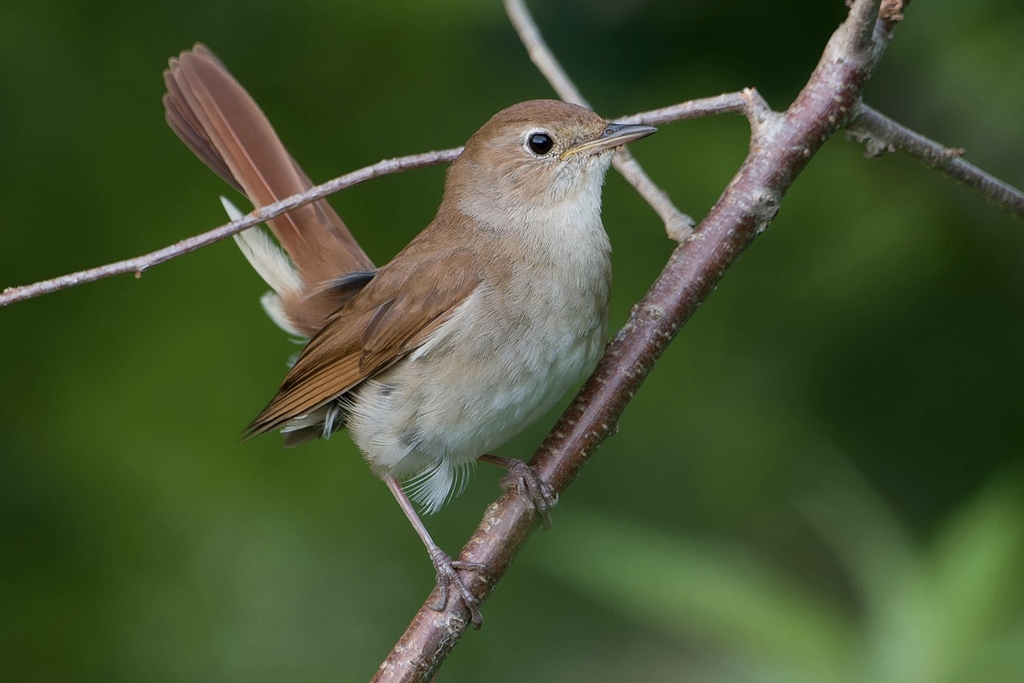
- aUniform warm brown upperparts with a brighter rufous tail
- bPale buffy-grey underparts with no streaks
- cLarge dark eye with a thin pale eye-ring
- dRather long-legged, robin-like posture
- Voice
- Rich, loud and varied: deep 'chook-chook' notes, liquid whistles, harsh rattles and a famous slow crescendo of pure 'piu piu piu' notes; call a soft 'hweet' and a croaking 'karrr'.
- Not to be confused with
- Thrush nightingale (eastern Europe) is darker, greyer-brown with faint mottling on the breast and a less rufous tail, and its song has dry clicking phrases. Garden warbler is smaller with a short bill and no rufous tail.
- Where to see it
- Mediterranean river valleys and scrub in Spain, Portugal, southern France and Italy; Kent and Sussex coppice in England; Turkey and the Levant in spring.
- When
- Summer visitor Apr–Aug; most vocal late April to early June
Listen
Looking for field recordings…
Life & habits
- Diet
- Ground invertebrates, especially beetles and ants; berries in late summer
- Habitat
- Dense deciduous thickets, coppice, scrub along rivers and woodland edges
- Size
- 15–16.5 cm; 17–30 g
- Lifespan
- Typically 1–3 years
Feeds on the ground in deep shade, hopping and pausing with its rufous tail cocked, and is far more often heard than seen.
Where it lives
Recorded sightings
—
geo-referenced records in GBIF, from museums, herbaria and field observers.
Native range
Breeds in southern and central Europe, North Africa, Turkey and the Middle East east to Central Asia (Kazakhstan, Afghanistan); winters in tropical Africa
Drag the globe to turn it. Dots are where records exist, not a range map; darker means more records.
In the old herbals & bestiaries
Woodcuts and engravings matched from the Source Library’s scanned books by name. Plates marked “relative” show a close kin rather than this exact species. Click a plate to read the page it came from, with translation.


In the stacks
Searching the stacks…
Every page naming Luscinia megarhynchos in the Biodiversity Heritage Library →
Marginalia
The bulbul's love for the rose (gol o bolbol) is a central image of Persian poetry from Hafez and Rumi onward, and in Greek myth the nightingale is Philomela or Procne transformed; Keats wrote his 'Ode to a Nightingale' in Hampstead in 1819.
Curiosity
In 1924 cellist Beatrice Harrison played in her Surrey garden while wild nightingales sang along, a performance broadcast live by the BBC as one of the first outside broadcasts.
Kinship


Photographs: iNaturalist contributors under the licences shown. Records: GBIF.org. Historical plates: Source Library (CC BY-SA 4.0; originals public domain). Summary text: Nature Library editors and Wikipedia (CC BY-SA). Medicinal and edibility notes are historical and educational, not advice. iNaturalist taxon 13079.