- Animals
- ›Chordates
- ›Vertebrates
- ›Ray-finned Fishes
- ›Spiny-rayed fishes
- ›Leaffishes, Snakeheads, and Gouramis
- ›Gouramis
- ›Gouramis
- ›Threadfishes
- ›Trichopodus
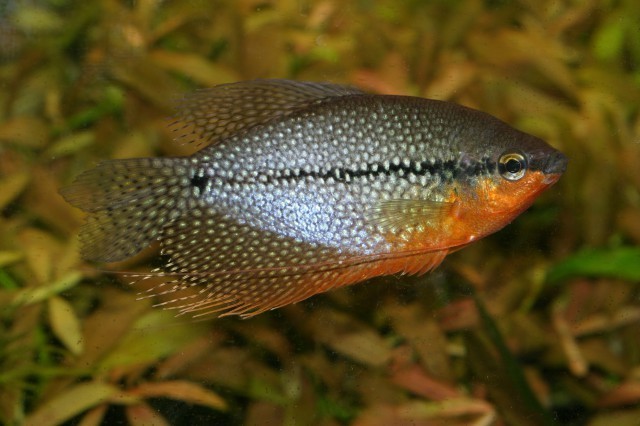
Pearl Gourami
Trichopodus leerii
The pearl gourami (Trichopodus leerii) is a species of gourami native to Southeast Asia.
From the article Pearl gourami on Wikipedia (CC BY-SA), quoted section by section
Description
It reaches about 12 centimetres (4.7 in) TL. Its body is a brownish-silver colour, covered in a pearl-like pattern with a distinct black line running from the fish's head, and gradually thinning towards the caudal fin. The pearl gourami's appearance has given rise to other popular names, such as the lace gourami and the mosaic gourami. Its male specimens, typical of many gouramis, are generally larger and more colourful than their female counterparts. They exhibit bright orange colouring around the throat region, which at breeding time becomes much brighter and is used to court the female. Males also exhibit somewhat of an orange tinge in their fins, with the exception of the caudal (tail) fin. The male also has longer fins, with a more pointed dorsal fin and extended anal fin rays.
Range & habitat
The pearl gourami is native to Thailand, Malaysia and Indonesia (where it is found on the islands of Sumatra and Borneo). It occurs in lowland swamps with acidic water.
Wikipedia: “Distribution and habitat”
Where it lives
Recorded sightings
—
geo-referenced records in GBIF, from museums, herbaria and field observers.
Drag the globe to turn it. Dots are where records exist, not a range map; darker means more records.
In the stacks
Searching the stacks…
Every page naming Trichopodus leerii in the Biodiversity Heritage Library →
This page is assembled live from iNaturalist, GBIF, Wikipedia, the Source Library and the Internet Archive. It is not yet part of the hand-edited codex. iNaturalist taxon 188580.