 NL·0529
Herbarium of the Nature Library
- Name
- Psilopogon asiaticus
- Family
- Megalaimidae
- Native to
- Himalayan foothills from Uttarakhand through Nepal, Bhutan and NE India to Bangladesh, Myanmar, southern China, Thailand and Indochina
- Habitat
- Montane forest, Subtropical forest, Gardens
On eBird ↗
Blue-throated Barbet
Live sightings near you, the range map, bar charts of when it is seen, and Macaulay Library photos and recordings.
Blue-throated barbet
Psilopogon asiaticus
Also calledLán hóu nǐ zhuómùniǎo 蓝喉拟啄木鸟 (Chinese)
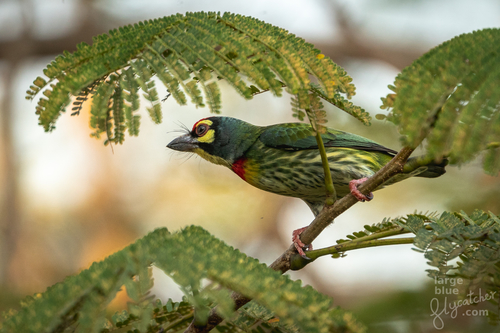
A bright green barbet with a sky-blue face and throat and a red crown crossed by a black band, whose loud rolling calls echo through Himalayan foothill forests. It is a fig specialist that carves its nest hole in dead wood.
The blue-throated barbet is a green Asian barbet native to the foothills of the Himalayas and Southeast Asia. It inhabits lowland and montane forests at elevations of 200–2,000 m (660–6,560 ft), frequenting fruiting trees. Due to its green colour, it is difficult to spot but is easily located by its continual loud calls. Sexes are similar in most respects and share domestic duties. Wikipedia
What it can do
- iDisperses the seeds of figs and other fruiting trees
- iiExcavates nest cavities in dead branches
- iiiCalls persistently from treetops through the breeding season
In the field
Field marks
- aStocky bright green barbet with a heavy bill, pale at the base with a dark upper mandible and tip
- bSky-blue face, cheeks and throat
- cRed forehead and crown with a black band across the crown
- dSmall red patch at the side of the throat
- Voice
- A loud, rolling 'took-a-rook, took-a-rook' or 'kutroo-kutroo', repeated endlessly
- Not to be confused with
- Golden-throated barbet has a yellow throat; Great barbet is larger with a blue-black head and red vent; Coppersmith barbet is smaller with a yellow throat and red breast patch.
- Where to see it
- Kathmandu valley gardens (Nepal), Corbett and Nainital (Uttarakhand), Darjeeling, Doi Inthanon (Thailand)
- When
- Resident year-round; most vocal in spring
Listen
Looking for field recordings…
Life & habits
- Diet
- Figs and other fruit; some insects
- Habitat
- Broadleaf forest, forest edges, orchards and gardens, up to about 2,400 m
- Size
- About 19–23 cm long
Sits motionless high in fruiting trees for long periods, so it is easier to hear than to see despite its colours.
Where it lives
Recorded sightings
—
geo-referenced records in GBIF, from museums, herbaria and field observers.
Native range
Himalayan foothills from Uttarakhand through Nepal, Bhutan and NE India to Bangladesh, Myanmar, southern China, Thailand and Indochina
Drag the globe to turn it. Dots are where records exist, not a range map; darker means more records.
In the stacks
Searching the stacks…
Every page naming Psilopogon asiaticus in the Biodiversity Heritage Library →
Marginalia
Its incessant calling makes it one of the signature sounds of Himalayan hill stations such as Darjeeling and Kathmandu in spring.
Curiosity
Asian barbets were once placed in the same family as African and American barbets, but genetics showed they form a separate family, Megalaimidae.
Kinship
- kingdomAnimalia
- ›phylumChordata
- ›subphylumVertebrata
- ›classAves
- ›orderPiciformes
- ›familyMegalaimidae
- ›genusPsilopogon
Neighbours on the shelf
Fact-checked: 3 corrections made to this sheet. Photographs: iNaturalist contributors under the licences shown. Records: GBIF.org. Historical plates: Source Library (CC BY-SA 4.0; originals public domain). Summary text: Nature Library editors and Wikipedia (CC BY-SA). Medicinal and edibility notes are historical and educational, not advice. iNaturalist taxon 367546.