On eBird ↗
Piping Cisticola
Live sightings near you, the range map, bar charts of when it is seen, and Macaulay Library photos and recordings.
Piping Cisticola
Cisticola fulvicapilla
The neddicky, or piping cisticola (Cisticola fulvicapilla), is a small passerine bird in the family Cisticolidae, which is native to Africa, southwards of the equator. Its strongholds are the light woodlands and shrublands of the subtropics and temperate regions of southern Africa. The common name, neddicky, is the Afrikaans name for the species.
From the article Neddicky on Wikipedia (CC BY-SA), quoted section by section
Description
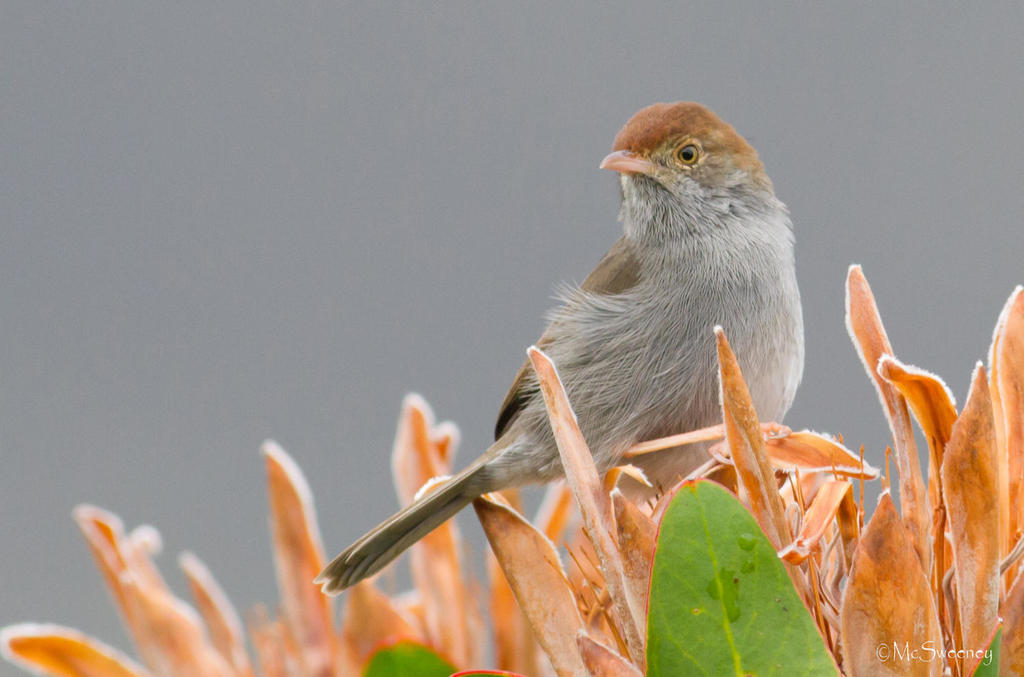
The neddicky is a small, vocal, dull-coloured brown bird, 11 cm in length. Its tail is not as short as that of some other cisticola species. This bird has a reddish cap and a plain back. The underparts are buff, darker in tone on the breast. The brown bill is short and straight, and the feet and legs are pinkish-brown. The eye is light brown. The sexes are similar, but juvenile birds are yellower. The southern form, found in the southern parts of South Africa, has the face and underpart plumage grey, with the back plumage greyish brown. As opposed to most cisticolas which are very similarly plumaged, this trio of greyish plumaged subspecies stands out as quite distinctive. The call of the neddicky is a monotonous, penetrating, repetitive weep weep weep. The alarm call is a loud clicking tictictictic, like a fingernail running across the teeth of a comb.
Range & habitat
The neddicky is a resident breeder in much of Africa from Gabon, the DRC, Rwanda and Tanzania south to the Cape. It is a common bird of open woodland, including savannah with trees and open plantations of exotic species. It avoids densely wooded habitats.
Wikipedia: “Distribution and habitat”
What it does
The neddicky is usually seen in pairs or singly, flitting in a bush or the grass at the base of a tree as it forages for small insects.
Breeding. The neddicky builds a ball-shaped nest with a side entrance from dry grass, cobwebs and felted plant down. The nest is placed low in a thorny shrub, or in thick grass. In South Africa, this bird breeds mainly from September to March.
Wikipedia: “Behaviour”
Listen
Looking for field recordings…
Where it lives
Recorded sightings
—
geo-referenced records in GBIF, from museums, herbaria and field observers.
Drag the globe to turn it. Dots are where records exist, not a range map; darker means more records.
In the stacks
Searching the stacks…
Every page naming Cisticola fulvicapilla in the Biodiversity Heritage Library →
This page is assembled live from iNaturalist, GBIF, Wikipedia, the Source Library and the Internet Archive. It is not yet part of the hand-edited codex. iNaturalist taxon 72731.