- Plants
- ›Vascular Plants
- ›flowering plants
- ›monocots
- ›grasses, sedges, cattails, and allies
- ›grasses
- ›Chloridoideae
- ›Cynodonteae
- ›Eleusininae
- ›Cynodon
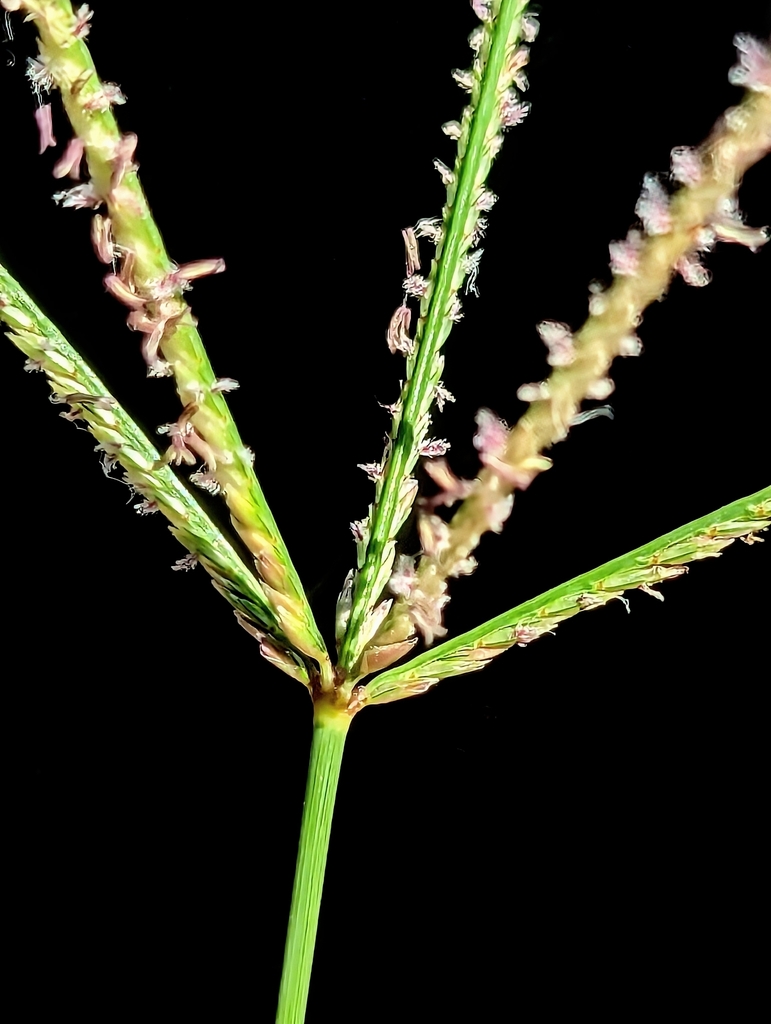
Bermuda grass
Cynodon dactylon
Cynodon dactylon, also known as Vilfa stellata dūrvā grass, Dhoob, Bermuda grass, dubo, dog's tooth grass, Bahama grass, devil's grass, couch grass, Indian doab, arugampul, grama, wiregrass and scutch grass, is a grass that originated in the Middle East. Although it is not native to Bermuda, it is an abundant invasive species there. It is presumed to have arrived in North America from Bermuda, resulting in its common name. In Bermuda it has been known as...
From the article Cynodon dactylon on Wikipedia (CC BY-SA), quoted section by section
Description
The blades are grey-green in color and short, usually 2–15 cm (0.79–5.91 in) long with rough edges. The erect stems can grow 1–30 cm (0.39–11.81 in) tall. The stems are slightly flattened, often white or green, and occasionally tinged purple in colour. The seed heads are produced in a cluster of two to six spikes together at the top of the stem, each spike 2–5 cm (0.79–1.97 in) long. Cynodon dactylon has a deep root system. When grown in penetrable soil under drought conditions, its roots can grow to over 2 metres (6.6 ft) deep, though most of the root mass is less than 60 centimetres (24 in) under the surface. The grass creeps along the ground with its stolons and roots wherever a node touches the ground, forming a dense mat. C. dactylon reproduces through seeds, stolons, and rhizomes. The grass starts actively growing at temperatures above 15 °C (59 °F) with ideal growth between 24 and 37 °C (75 and 99 °F); in winter or in the dry season, the grass becomes dormant and turns light brown. Optimal development also occurs in areas of full sun exposure, while dense shade, especially near tree bases, generally suppresses it.
In medicine
In Mexico, the plant may have been used during the 20th century as a decoction intended to treat various illnesses.
Wikipedia: “Folk medicine”
Toxicity
The hybrid variety Tifton 85, like some other grasses (e.g. sorghum), produces cyanide under certain conditions, and has been implicated in several livestock deaths.
How it is grown
Cynodon dactylon is widely cultivated in warm climates all over the world between about 30° S and 30° N latitude, and in regions that receive between 625 and 1,750 mm (24.6 and 68.9 in) of rainfall a year, or less, if irrigation is available. For example, in the United States, it is grown mostly in the southern half of the country.
Cultivars. Hundreds of cultivars have been created specifically for environmental tolerance and stakeholder requirements. New cultivars are released annually.
Wikipedia: “Cultivation”
Where it lives
Recorded sightings
—
geo-referenced records in GBIF, from museums, herbaria and field observers.
Drag the globe to turn it. Dots are where records exist, not a range map; darker means more records.
In the stacks
Searching the stacks…
Every page naming Cynodon dactylon in the Biodiversity Heritage Library →
This page is assembled live from iNaturalist, GBIF, Wikipedia, the Source Library and the Internet Archive. It is not yet part of the hand-edited codex. iNaturalist taxon 58371.