On eBird ↗
Rufous-backed Wren
Live sightings near you, the range map, bar charts of when it is seen, and Macaulay Library photos and recordings.
Rufous-backed Wren
Campylorhynchus capistratus
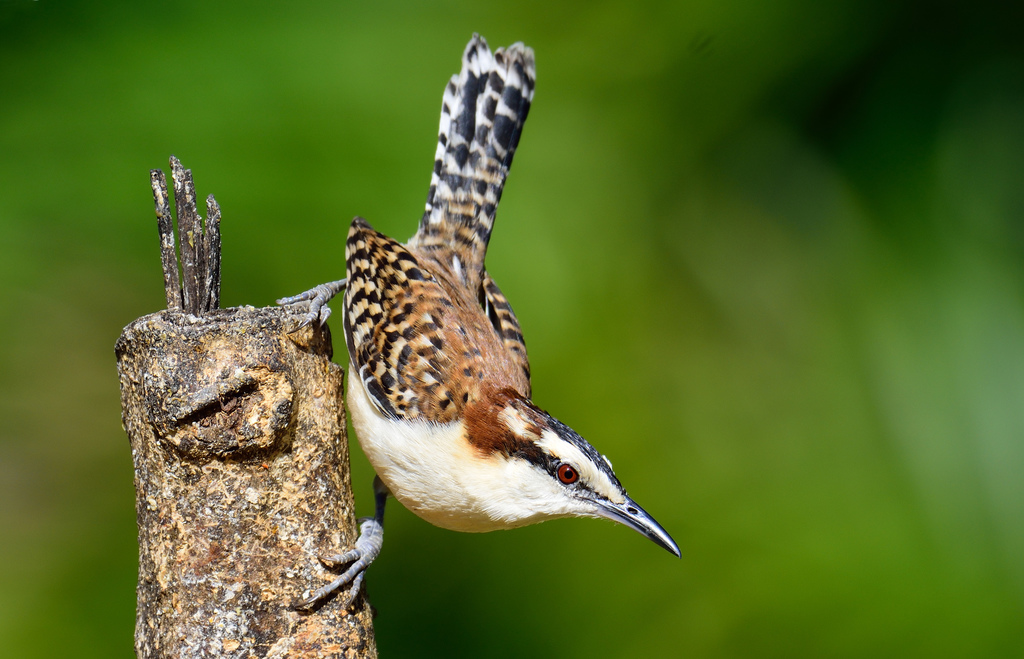
The rufous-backed wren (Campylorhynchus capistratus) is a species of songbird in the family Troglodytidae. It is a resident breeding species distributed from southwestern Mexico to northwestern Costa Rica.
From the article Rufous-backed wren on Wikipedia (CC BY-SA), quoted section by section
Description
The adult rufous-backed wren measure 17 cm (6.7 in) in length and weighs between 29 to 42 g (1.0 to 1.5 oz). While slight variation exists among the subspecies, adults generally possess a black crown and eyestripe separated by a white supercilium, a rufous nape, and cinnamon to chestnut upper parts streaked with black and white, most prominently on the rump. The wings and tail feature black and grayish-white barring, while the underparts are plain white. Juveniles are distinguished by duller upper parts and buff-colored underparts.
Range & habitat
The six subspecies of rufous-backed wren are found thus:
C. c. nigricaudatus, the Pacific coastal plain from southwestern Chiapas, Mexico into Guatemala C. c. capistratus, the Pacific coastal plain from Guatemala south into El Salvador C. c. xerophilus, the Motagua Valley of Guatemala C. c. castaneus, interior Guatemala east to Honduras and Nicaragua C. c. nicaraguae, interior of western Nicaragua C. c. nicoyae, the Nicoya Peninsula of northwestern Costa Rica This large wren occurs in lowlands and foothills from sea level up to 800 m (2,600 ft) elevation in Costa Rica and as high as 1,400 m (4,600 ft) in El Salvador. It inhabits dry forest or open woodland, scrub, second growth and savanna, mainly on the Pacific side of the central mountain ranges.
Wikipedia: “Distribution and habitat”
What it does
The rufous-backed wren forages actively in low vegetation in pairs or family groups, searching primarily for insects and other invertebrates. The species has adapted well to human presence and occasionally consumes table scraps. When handling prey, individuals frequently thrash it with their beak prior to ingestion.
Wikipedia: “Feeding”
Listen
Looking for field recordings…
Where it lives
Recorded sightings
—
geo-referenced records in GBIF, from museums, herbaria and field observers.
Drag the globe to turn it. Dots are where records exist, not a range map; darker means more records.
In the stacks
Searching the stacks…
Every page naming Campylorhynchus capistratus in the Biodiversity Heritage Library →
This page is assembled live from iNaturalist, GBIF, Wikipedia, the Source Library and the Internet Archive. It is not yet part of the hand-edited codex. iNaturalist taxon 603035.