On eBird ↗
Pale Crag-Martin
Live sightings near you, the range map, bar charts of when it is seen, and Macaulay Library photos and recordings.
Pale Crag-Martin
Ptyonoprogne obsoleta
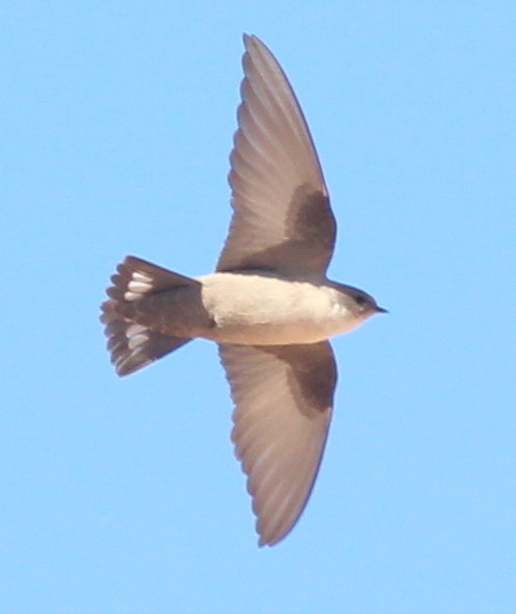
The pale crag martin (Ptyonoprogne obsoleta) is a small passerine bird in the swallow family that is resident in Northern Africa and in Southwestern Asia, east to Pakistan. It breeds mainly in the mountains, but also at lower altitudes, especially in rocky areas and around towns. Unlike most swallows, it is often found far from water. It is 12–13 cm (4+1⁄2–5 in) long, with mainly brown plumage, paler-toned on the upper breast and underwing coverts, and with white "windows" on the spread tail in flight. The sexes are similar in appearance, but juveniles have pale fringes to the upperparts and flight feathers. It was formerly considered to be the northern subspecies of the rock martin of southern Africa, although it is smaller, paler, and whiter-throated than that species. The pale crag martin hunts along cliff faces for flying insects using a slow flight with much gliding. Its call is a soft twitter.
This martin builds a deep bowl nest on a sheltered horizontal surface, or a neat quarter-sphere against a vertical rock face or wall. The nest is constructed with mud pellets and lined with grass or feathers, and may be built on natural sites under cliff overhangs or on man-made structures such as buildings and bridges. It is often reused for subsequent broods or in later years. This species is often a solitary breeder, but small groups may breed close together in suitable locations. The two or three eggs of a typical clutch are white with brown and grey blotches, and are incubated by both adults for 16–19 days prior to hatching. Both parents then feed the chicks.
From the article Pale crag martin on Wikipedia (CC BY-SA), quoted section by section
Description
The pale crag martin of the nominate subspecies P. o. obsoleta is 12–13 centimetres (4+1⁄2–5 inches) long with light brown upperparts, becoming paler on the lower back, and a short square tail that has small white patches near the tips of all but the central and outermost pairs of feathers. It has a pale grey throat, upper breast and underwing coverts, and the rest of the underparts are a dirty white. The eyes are brown, the small bill is mainly black, and the legs are brownish-pink. The wing length averages 13 cm (5 in) and the tail averages 4.8 cm (1+7⁄8 in). The sexes are similar in appearance, but juveniles have pale edges to the upperparts and flight feathers. The other subspecies differ from the nominate form as detailed in the table above. This martin moults early, with adults having completely replaced their feathers by late August. Juveniles moult somewhat later, and their old primary feathers are retained even when the body has mainly adult plumage. The pale crag martin's flight is slow, with rapid wing beats interspersed with flat-winged glides, and it is more acrobatic than the larger Eurasian crag martin. …
Range & habitat
The pale crag martin breeds in suitable habitats throughout northern Africa and through the Middle East as far as Afghanistan and Pakistan. It is largely resident apart from local movements or a descent to lower altitudes after breeding. In addition, there is some short-range movement, including martins from southern Arabia crossing the Red Sea and wintering alongside the local breeding birds in Ethiopia and the Horn of Africa, and non-breeding P. f. spatzi and P. f. presaharica joining rock martins in Mali and Mauritania. In Pakistan, the breeding range of the subspecies P. f. peloplasta overlaps with that of the dusky crag martin, although that species breeds at much lower levels, and in North Africa P. f. obsoleta occupies desert habitats whilst the Eurasian crag martin is found in the mountains. The pale crag martin has been recorded as a vagrant in Bahrain, Qatar, Kuwait, and Sri Lanka, although its occurrence in the last country is treated as unproven in a 2011 field guide. The martin has been claimed to visit Turkey, but this is also disputed. The natural breeding habitat is hilly or mountainous country with cliffs, gorges and caves up to 3,700 m (12,100 ft) above sea level, but this martin also breeds in lowlands, especially if rocks or buildings are available, and may be found far from water. …
Wikipedia: “Distribution and habitat”
What it does
The pale crag martin feeds mainly on insects caught in flight, but will occasionally feed on the ground. Breeding birds often feed close to their nesting territory, flying back and forth along a rock face catching insects in their bills. Cliff faces generate standing waves in the airflow which concentrate insects near vertical areas. Crag martins exploit the area close to the cliff when they hunt, relying on their high manoeuvrability. When not breeding, they may also hunt low over open ground. The insects caught depend on what is locally available, but may include mosquitoes, flies, Hymenoptera, ants and beetles. This martin often feeds alone, but sizeable groups may gather at grass fires to feast on the fleeing insects, and outside the breeding season flocks of up to 300 may form where food is abundant, such as agricultural areas, wetlands and sewage works. The pale crag martin drinks in flight as it skims the water surface; some of its water requirement is obtained from the insects it consumes. Wintering hirundines of other species are not normally found in the dry, rocky areas in which the pale crag martin nests, so there is little competition for food.
Wikipedia: “Feeding”
Listen
Looking for field recordings…
Where it lives
Recorded sightings
—
geo-referenced records in GBIF, from museums, herbaria and field observers.
Drag the globe to turn it. Dots are where records exist, not a range map; darker means more records.
In the stacks
Searching the stacks…
Every page naming Ptyonoprogne obsoleta in the Biodiversity Heritage Library →
This page is assembled live from iNaturalist, GBIF, Wikipedia, the Source Library and the Internet Archive. It is not yet part of the hand-edited codex. iNaturalist taxon 465888.