On eBird ↗
Plumbeous Warbler
Live sightings near you, the range map, bar charts of when it is seen, and Macaulay Library photos and recordings.
Plumbeous Warbler
Setophaga plumbea
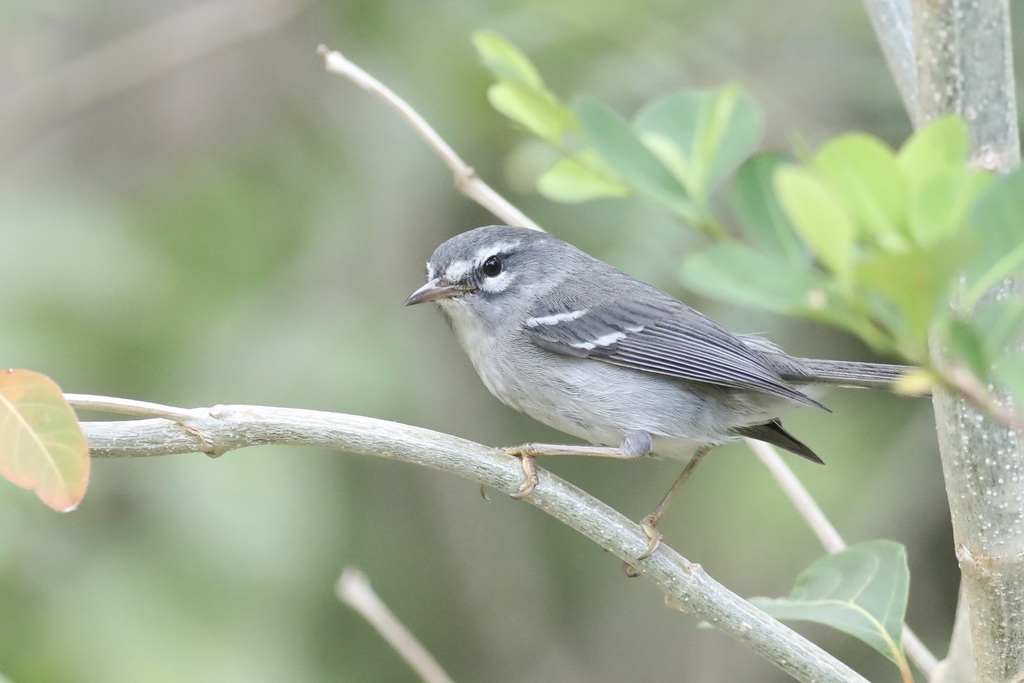
The plumbeous warbler (Setophaga plumbea) is a species of bird in the family Parulidae. It is found only in Dominica and Guadeloupe. Its natural habitats are subtropical or tropical dry forests and subtropical or tropical moist lowland forests.
From the article Plumbeous warbler on Wikipedia (CC BY-SA), quoted section by section
Description
The plumbeous warbler is 12 to 14 cm (4.7 to 5.5 in) long and weighs 8.4 to 11.3 g (0.30 to 0.40 oz). The sexes have the same plumage. Adults have a mostly gray head with a white supercilium that is broken over the eye and a white arc below the eye. Their upperparts are gray. Their wings are mostly gray with wide white tips on the greater and median coverts that show as two white wing bars. Their tail is mostly gray with a whitish underside and white tips on the outer two pairs of feathers. Their underparts are mostly whitish with grayer flanks. They have a dark iris, a grayish black maxilla, a dark horn mandible, and dusky legs and feet. Immature birds have buffy white facial markings, grayish olive upperparts, buffy wing bars, and buffy white underparts.
Range & habitat
The plumbeous warbler is endemic to the Lesser Antilles where it is restricted to Guadeloupe, its two dependencies Marie-Galante and Îles des Saintes, and Dominica. It inhabits humid montane forest, elfin forest, rainforest, low-elevation scrubby forest, and mangroves. In elevation it ranges from sea level to 900 m (3,000 ft).
Wikipedia: “Distribution and habitat”
What it does
The plumbeous warbler feeds primarily on insects and also includes small amounts of berries in its diet. It forages mostly in the understory, gleaning prey from foliage and branches.
Wikipedia: “Feeding”
In human culture
The plumbeous warbler's genus Setophaga means "moth eater" in Greek. The specific epithet plumbea is Latin and means "lead-colored".
Wikipedia: “Etymology”
Listen
Looking for field recordings…
Where it lives
Recorded sightings
—
geo-referenced records in GBIF, from museums, herbaria and field observers.
Drag the globe to turn it. Dots are where records exist, not a range map; darker means more records.
In the stacks
Searching the stacks…
Every page naming Setophaga plumbea in the Biodiversity Heritage Library →
This page is assembled live from iNaturalist, GBIF, Wikipedia, the Source Library and the Internet Archive. It is not yet part of the hand-edited codex. iNaturalist taxon 145226.