On eBird ↗
Little Pied Cormorant
Live sightings near you, the range map, bar charts of when it is seen, and Macaulay Library photos and recordings.
Little Pied Cormorant
Microcarbo melanoleucos
The little pied cormorant, little shag or little pied shag (Microcarbo melanoleucos) (Māori: kawaupaka) is a common species of Australasian waterbird, found around the coasts, islands, estuaries, and inland waters of Australia, New Guinea, New Zealand, Timor-Leste and Indonesia, and around the islands of the south-western Pacific and the subantarctic. It is a small short-billed cormorant usually black above and white below with a yellow bill and small crest, although a mostly black white-throated form predominates in New Zealand. Three subspecies are recognised. Until recently, most authorities referred to this species as Phalacrocorax melanoleucos.
From the article Little pied cormorant on Wikipedia (CC BY-SA), quoted section by section
Description
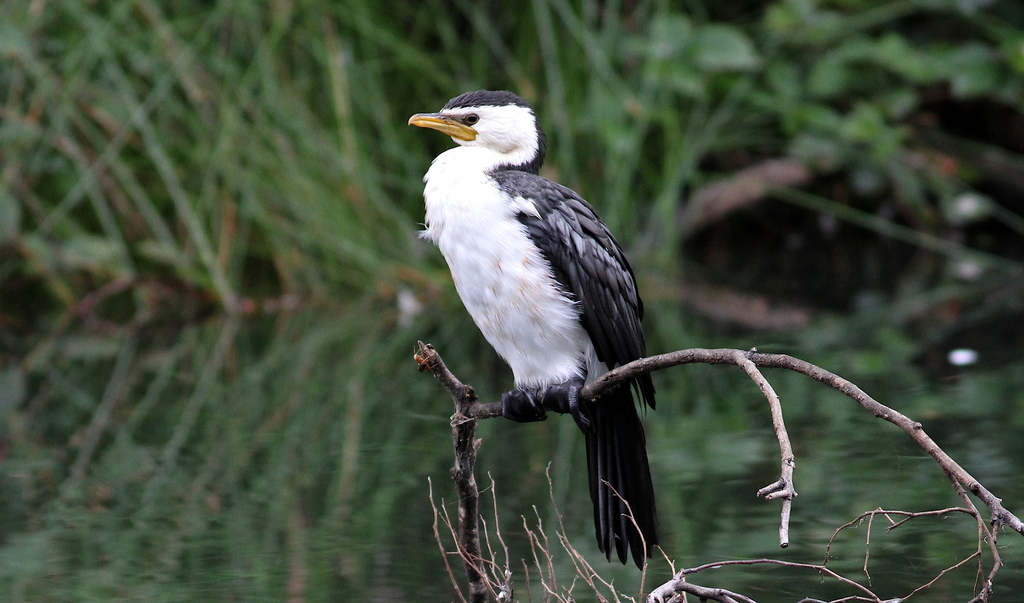
The little pied cormorant is a small cormorant measuring 56–58 cm (22–23 in) with a shorter 3 cm (1.2 in) bill and longer tail than the little black cormorant; it has a small black crest. It is found in two morphs in New Zealand. Subspecies melanoleucos and brevicauda are found only in a pied morph, black (with a slight green tinge) above and white beneath. This is also found in subspecies brevirostris, but in this form the melanistic morph is much more common. In this form the entire plumage is black with a greenish tinge except for the sides of the head, chin, throat and upper neck; the bill is yellow with black on top. Intermediate forms are also found. The pied form is glossy black above with white face, underparts and thighs. The bill and bare skin around the face are yellow. In both forms the legs and feet are black. The pied form is rare in New Zealand, and is most common there in Northland, where it makes up one in every four birds or so. Chicks have dark brown down, with pied morph having patches of paler down. Immature birds are a dull blackish brown, with pied morph birds having paler underparts. The little pied cormorant makes a low cooing during courtship. Similar species include the black-faced cormorant (slightly larger) and the Australian pied cormorant (substantially larger).
Range & habitat
The species ranges across New Zealand, from Stewart Island to Northland, and across mainland Australia (although not in the arid interior of the west of the country) and Tasmania. It is also present in Papua New Guinea, Palau, Timor-Leste, the Solomon Islands, New Caledonia, and Vanuatu. In eastern Indonesia, the little pied cormorant's range includes Sulawesi, the Lesser Sunda Islands, Maluku Islands, and Western New Guinea, with non-breeding birds recorded in Java, Bali, and once off the coast of East Kalimantan. Widespread and common, it lives near bodies of water such as swamps, lakes, lagoons, estuaries and the coastline.
Wikipedia: “Distribution and habitat”
What it does
The little pied cormorant is a benthic feeder, i.e. it finds its prey on the sea floor. It is a solitary feeder, normally diving in relatively shallow water, often near the shore. Dive times are short, around 15 to 20 seconds, with recovery times on the surface of 5 to 10 seconds unless prey are being swallowed. It takes a variety of fish prey but an unusually high proportion (nearly 30% by weight on average, and up to 80% in some individuals) of crustaceans. In New Zealand waters it is most often seen preying on the local flounder and other small flatfish. Eels and insect larvae are also consumed. These are brought to the surface to be swallowed: the bird will sometimes put a fish down on the surface of the water in order to re-orient it and swallow it head first. Because of this habit, they suffer some kleptoparasitism from red-billed gulls.
Wikipedia: “Feeding”
Listen
Looking for field recordings…
Where it lives
Recorded sightings
—
geo-referenced records in GBIF, from museums, herbaria and field observers.
Drag the globe to turn it. Dots are where records exist, not a range map; darker means more records.
In the stacks
Searching the stacks…
Every page naming Microcarbo melanoleucos in the Biodiversity Heritage Library →
This page is assembled live from iNaturalist, GBIF, Wikipedia, the Source Library and the Internet Archive. It is not yet part of the hand-edited codex. iNaturalist taxon 370351.