On eBird ↗
Little Cormorant
Live sightings near you, the range map, bar charts of when it is seen, and Macaulay Library photos and recordings.
Little Cormorant
Microcarbo niger
The little cormorant (Microcarbo niger) is a member of the cormorant family of seabirds. Slightly smaller than the Indian cormorant it lacks a peaked head and has a shorter beak. It is widely distributed across the Indian subcontinent and extends east to Java, where it is sometimes called the Javanese cormorant. It forages singly or sometimes in loose groups in lowland freshwater bodies, including small ponds, large lakes, streams and sometimes coastal estuaries. Like other cormorants, it is often found perched on a waterside rock with its wings spread out after coming out of the water. The entire body is black in the breeding season but the plumage is brownish, and the throat has a small whitish patch in the non-breeding season. These birds breed gregariously in trees, often joining other waterbirds at heronries.
From the article Little cormorant on Wikipedia (CC BY-SA), quoted section by section
Description
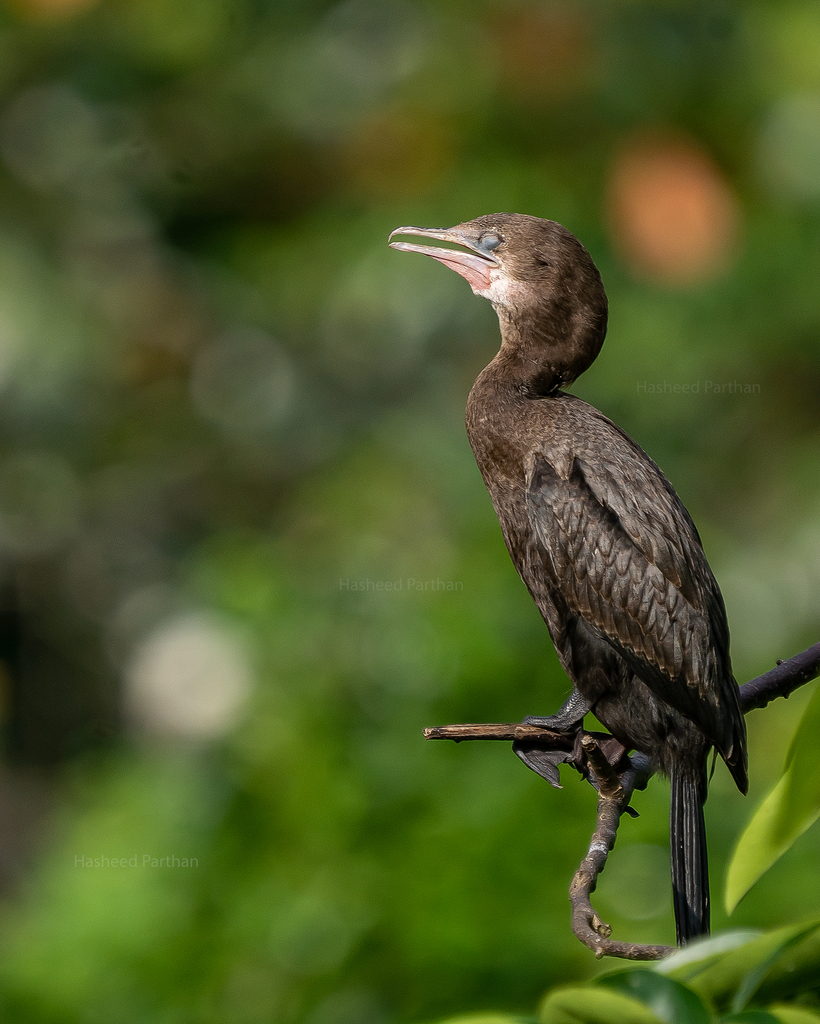
The little cormorant is about 50 centimetres (20 in) long and only slightly smaller than the Indian cormorant (Phalacrocorax fuscicollis). The Indian cormorant has a narrower and longer bill which ends in a prominent hook tip, blue iris and a more pointed head profile. The breeding adult bird has a glistening all black plumage with some white spots and filoplumes on the face. There is also a short crest on the back of the head. The eyes, gular skin and face are dark. In the non-breeding bird or juvenile, the plumage is brownish and the bill and gular skin can appear more fleshy. The crest becomes inconspicuous and a small and well-marked white patch on the throat is sometimes visible. Towards the west of the Indus River valley, its range can overlap with vagrant pygmy cormorants (Microcarbo pygmaeus), which can be difficult to differentiate in the field and are sometimes even considered conspecific. The sexes are indistinguishable in the field, but males tend to be larger. Some abnormal silvery-grey plumages have been described. The species was described by Vieillot in 1817 as Hydrocorax niger. The genus Hydrocorax literally means water crow. It was later included with the other cormorants in the genus Phalacrocorax but some studies place the smaller "microcormorants" under the genus Microcarbo.
Range & habitat
The little cormorant is found across India, Sri Lanka, Bangladesh, Pakistan and lowland Nepal. It is also found in parts of Myanmar, Thailand, Laos, Cambodia and Indonesia. It is not found in the Himalayas, but vagrants have been seen in Ladakh. It inhabits wetlands, ranging from small village ponds to large lakes, and sometimes tidal estuaries.
Wikipedia: “Distribution”
What it does
Little cormorants tend to forage mainly in small loose groups and are often seen foraging alone. They swim underwater to capture their prey, mainly fish. A study in northern India found that the little cormorant fished in water which was less than a metre deep and captured fishes of about 2–8 centimetres (0.79–3.15 in) length. They propel themselves underwater using their webbed feet. Captured fishes are often brought up to the surface to swallow them and during this time other birds including other little cormorants, painted storks, gulls and egrets may attempt to steal them. Indian cormorants tend to fish communally in larger groups. Like all other cormorants, they will emerge from water and will hold out their wings and stay immobile for a while. The behaviour has been suggested to be for wing-drying, but this interpretation is debated. A study in Sri Lanka found that the time spent with spread wings was always after they had spent some time underwater, and that the duration was related to time spent underwater and inversely related to the temperature and dryness of air. These observations support the theory that the studied behaviour aids drying of the wings.
The breeding season of the little cormorant is between July and September in Pakistan and northern India and between November and February in southern India. In Sri Lanka it is December to May. …
Wikipedia: “Behaviour and ecology”
Listen
Looking for field recordings…
Where it lives
Recorded sightings
—
geo-referenced records in GBIF, from museums, herbaria and field observers.
Drag the globe to turn it. Dots are where records exist, not a range map; darker means more records.
In the stacks
Searching the stacks…
Every page naming Microcarbo niger in the Biodiversity Heritage Library →
This page is assembled live from iNaturalist, GBIF, Wikipedia, the Source Library and the Internet Archive. It is not yet part of the hand-edited codex. iNaturalist taxon 497004.