- Animals
- ›Chordates
- ›Vertebrates
- ›Birds
- ›Shorebirds and Allies
- ›Gulls, Terns, and Skimmers
- ›Gulls
- ›Chroicocephalus
On eBird ↗
Black-headed Gull
Live sightings near you, the range map, bar charts of when it is seen, and Macaulay Library photos and recordings.
Black-headed Gull
Chroicocephalus ridibundus
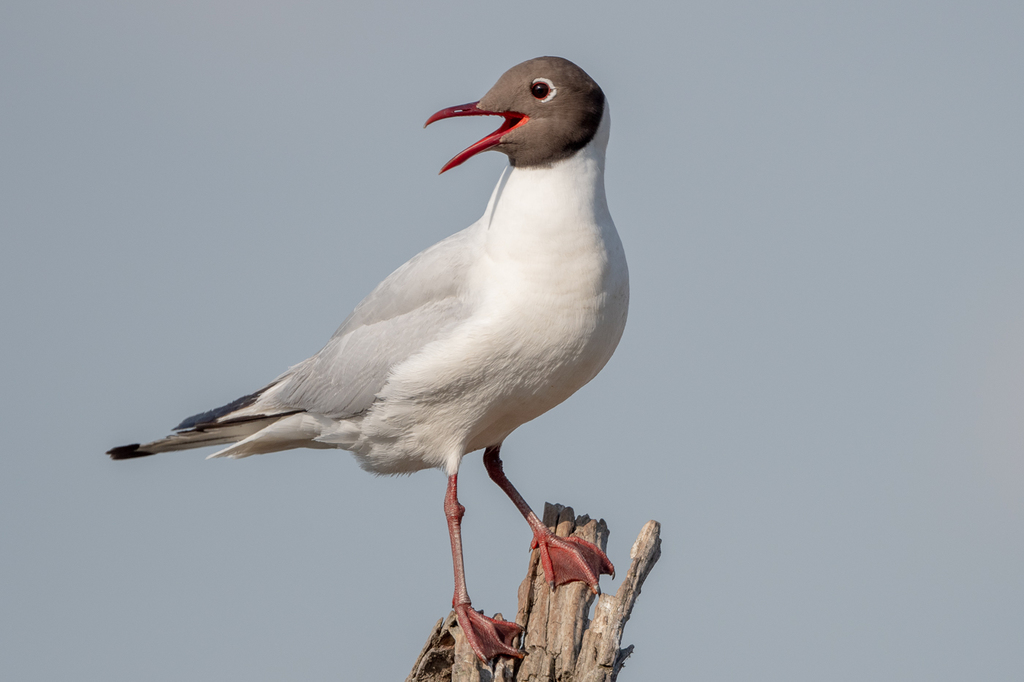
The black-headed gull (Chroicocephalus ridibundus) is a small gull that breeds in much of the Palearctic in Europe and Asia, and also locally in smaller numbers in coastal eastern Canada. Most of the population is migratory and winters further south, but many also remain in the milder areas of northwestern Europe. It was formerly sometimes cited as "common black-headed gull" to distinguish it from "great black-headed gull" (an old name for Pallas's gull).
The genus name Chroicocephalus is from the Ancient Greek words khroizo, "to colour", and kephale, "head". The specific name ridibundus is Latin for "laughing".
From the article Black-headed gull on Wikipedia (CC BY-SA), quoted section by section
Description
This gull is 34–39 cm (13+1⁄2–15+1⁄2 in) long with a 100–110 cm (39+1⁄2–43+1⁄2 in) wingspan and weighs 166–400 g (5+7⁄8–14+1⁄8 oz); males (186–400 g) average heavier than females (166–350 g), but with considerable overlap. In flight, the white leading edge of the outer wing (the outer primaries) is a good field mark, particularly combined with the dark underside of the inner primaries, which distinguishes it from the white underside of those feathers in its close relative the Bonaparte's gull. The summer adult has a chocolate-brown head (not black, although does look black from a distance), white neck, underparts and tail, pale grey wings and back, black tips to the primary wing feathers, and red bill and legs. The hood is lost in winter, leaving just two dark spots above and behind the eye. Summer plumage occurs from March to July (rarely from late January, and into August), winter plumage from late July until March or April. Black-headed gulls take two years to reach maturity. Juvenile birds, for the first month or two after fledging, have a mottled pattern of brown spots over most of the body, and a black band on the tail; in late summer, they moult into first-winter plumage, with a grey back, but retaining a brown carpal bar on the inner wing, blackish secondary feathers, and the black band on the tail. …
Range & habitat
Black-headed gulls breed across the Palearctic over much of Europe and northern Asia, from Iceland and Ireland east to Japan and eastern China. It is abundant, with a global population of 2–3 million pairs; most numerous in Europe, with up to 300,000 pairs in Great Britain and 250,000 pairs in Poland the largest concentrations. The range is slowly expanding westwards, with Iceland first colonised in 1911, Greenland in 1969, and Newfoundland in Canada in 1977, with around 20 pairs breeding in northeastern Canada in the late 20th century. They migrate south and west away from regions which freeze hard in winter, reaching northern Africa and southern Asia (with small numbers south to the Equator). Areas within the breeding range with milder winters such as Great Britain receive large influxes of migrants from colder areas like Scandinavia, Poland, the Baltic States, and Russia; the British winter population is around 3 million. Small numbers occur in winter in northeast North America as far south as Virginia, often in flocks of the similar-looking Bonaparte's gull.
Vagrancy. South of its regular range in eastern North America, it is recorded as a very rare transient south to the Carolina coast, and also in some Caribbean islands and Mexico. …
Wikipedia: “Distribution”
What it does
The black-headed gull is a bold and opportunistic feeder. It eats insects, fish, seeds, worms, scraps, and carrion in towns, or invertebrates in ploughed fields with equal facility. It is a noisy species, especially in colonies, with a familiar "kree-ar" call. It displays a variety of behaviour and adaptations. Some of these include removing eggshells from the nest after hatching, begging co-ordination between siblings, differences between sexes, conspecific brood parasitism, and extra-pair paternity. They are found in a variety of different habitats.
Eggshell removal. Eggshell removal is a behaviour seen in birds once the chicks have hatched, observed mostly to reduce risk of predation. Removing the eggshell acts as a way of camouflage to avoid predators seeing the nest. The further away egg shells are from the nest, the lower the predation risk. Black-headed gull eggs experience predation from different species of birds, foxes, stoats, and even other black-headed gulls. Although mothers show some form of aggressiveness when a predator is near, in the first 30 minutes, wet chicks can be easily taken by other black-headed gulls after hatching when the parents of the wet chick are distracted. Black headed gulls also carry away other objects that do not belong in the nest. …
Wikipedia: “Behaviour”
At the table
The eggs of the black-headed gull were considered a delicacy by some in the UK and eaten hard boiled. The collection of black-headed gull eggs is heavily regulated by the UK government. Eggs may only be taken by a small number of licensed individuals at six sites between 1 April and 15 May each year and only a single egg may be taken from each nest. No eggs are permitted to be sold after 30 June. As the gulls tend to lay in late April and early May, the eggs are only available to purchase for 3 or 4 weeks per year.
Wikipedia: “Uses”
In human culture
The black-headed gull is the official bird of Tokyo, Japan, and the Yurikamome automated guideway transit in Tokyo Bay is named after it. In Richard Adams' 1972 novel Watership Down, a black-headed gull named Kehaar (who claims his name is the onomatopoeia of waves breaking against the shore) plays a major part in the story. Injured by a farm cat and left behind during the seasonal migration, Kehaar finds himself stranded on the Downs and is taken in by a warren of rabbits. He later becomes their friend and ally, and helps to save the rabbits from danger many times; instincts eventually force him to return to his colony, but he promises to visit the rabbits each winter. True to Adams' stated intentions of trying to keep his fictional animals' behaviour close to reality, Kehaar is characterised as intelligent, gregarious, noisy, messy, and impatient, and with a guttural accent. Kehaar appears in all three screen adaptations of the novel; the character was voiced by Zero Mostel in the 1978 film, Rik Mayall in the 1999 TV series, and Peter Capaldi in the 2018 miniseries.
Wikipedia: “In popular culture”
Listen
Looking for field recordings…
Where it lives
Recorded sightings
—
geo-referenced records in GBIF, from museums, herbaria and field observers.
Drag the globe to turn it. Dots are where records exist, not a range map; darker means more records.
In the stacks
Searching the stacks…
Every page naming Chroicocephalus ridibundus in the Biodiversity Heritage Library →
This page is assembled live from iNaturalist, GBIF, Wikipedia, the Source Library and the Internet Archive. It is not yet part of the hand-edited codex. iNaturalist taxon 144510.