- Animals
- ›Chordates
- ›Vertebrates
- ›Birds
- ›Shorebirds and Allies
- ›Gulls, Terns, and Skimmers
- ›Gulls
- ›Chroicocephalus
On eBird ↗
Silver Gull
Live sightings near you, the range map, bar charts of when it is seen, and Macaulay Library photos and recordings.
Silver Gull
Chroicocephalus novaehollandiae
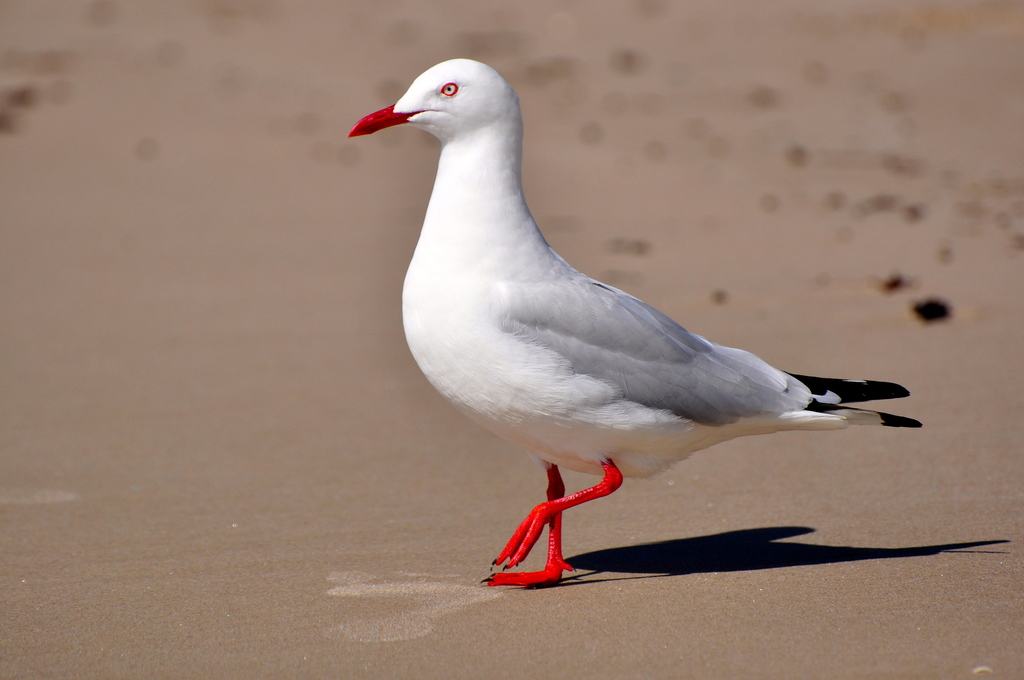
The silver gull (Chroicocephalus novaehollandiae) is a gull in Oceania. It is the most common gull of Australia. It has been found throughout the continent, but particularly at or near coastal areas. It is smaller than the Pacific gull (Larus pacificus), which also lives in Australia.
The silver gull should not be confused with the herring gull, which is called "silver gull" in many other languages (scientific name Larus argentatus, German Silbermöwe, French Goéland argenté, Dutch zilvermeeuw), but is a much larger, robust gull with no overlap in range.
From the article Silver gull on Wikipedia (CC BY-SA), quoted section by section
Range & habitat
Silver gulls are found in all states of Australia, as well as New Zealand and New Caledonia. It is a common species near human habitations and beaches, having adapted well to urban environments and thriving around shopping centres and rubbish tips. Their successful adaption to urban habitats have seen their population increase in areas of human activity, with the availability of nesting grounds the only limiting factor on population growth. Silver gulls have twice been recorded in the United States; one bird was shot in August 1947 at the mouth of the Genesee River, Lake Ontario, and another was photographed in Salem County, New Jersey, in autumn 1996. Both are believed to have escaped from captivity.
Wikipedia: “Distribution and habitat”
What it does
The silver gull has a sharp voice consisting of a variety of calls. The most common call is a harsh, high pitched 'kwarwh'.
Feeding. The silver gull naturally feeds on worms, fish, insects and crustaceans. It is a successful scavenger, allowing increased numbers near human settlements. It is known to pester humans for chips and steal unattended food.
Breeding. Breeding occurs from August to December, typically in large colonies on offshore islands. The nest is located on the ground and consists of seaweed, roots, and plant stems. The nests may be found in low shrubs, rocks and jetties. Typical clutch size is one to three eggs. Often two broods are raised in a year, and both adults share nest-building, incubation and feeding.
Wikipedia: “Behaviour”
Listen
Looking for field recordings…
Where it lives
Recorded sightings
—
geo-referenced records in GBIF, from museums, herbaria and field observers.
Drag the globe to turn it. Dots are where records exist, not a range map; darker means more records.
In the stacks
This page is assembled live from iNaturalist, GBIF, Wikipedia, the Source Library and the Internet Archive. It is not yet part of the hand-edited codex. iNaturalist taxon 144507.