On eBird ↗
Javan Myna
Live sightings near you, the range map, bar charts of when it is seen, and Macaulay Library photos and recordings.
Javan Myna
Acridotheres javanicus
The Javan myna (Acridotheres javanicus), also known as the white-vented myna, is a species of myna. It is a member of the starling family. It is native to Bali and Java. It has been introduced to other Asian countries, and as far away as Puerto Rico.
From the article Javan myna on Wikipedia (CC BY-SA), quoted section by section
Description
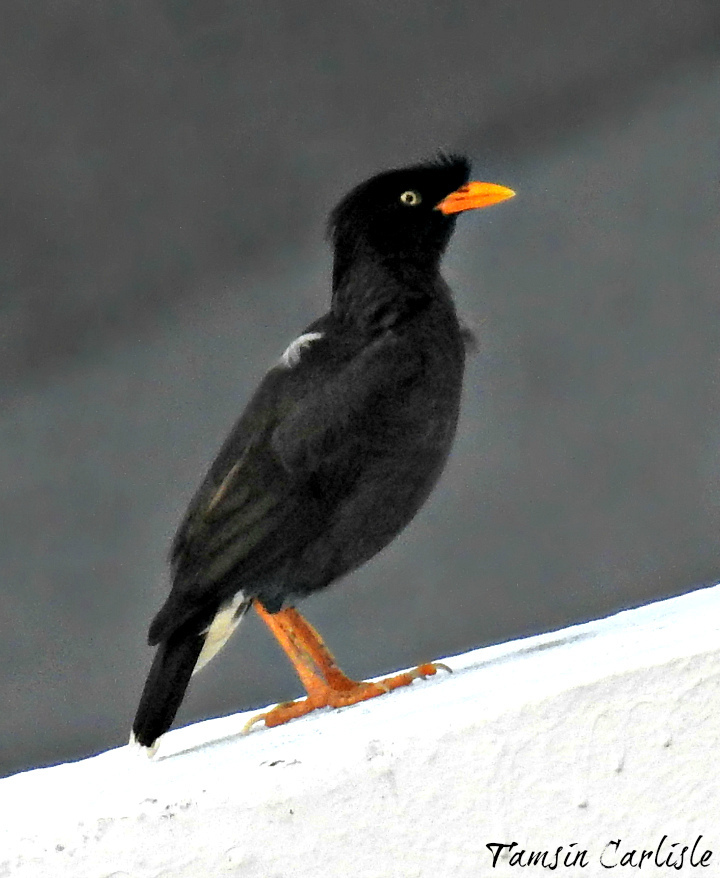
The Javan myna is mainly black. The wings are brownish-black, and the primary feathers have white bases, displayed in flight as a striking white wing bar, along with a white tail bar. The undertail-coverts are white. There is a short crest on the forehead. Its beak, legs and feet are yellow. The eyes are lemon-yellow. The immature is browner. Its length is 21–23 cm (8.3–9.1 in). Its weight is about 100 g (3.5 oz).
Range & habitat
The Javan myna is native to Bali and Java, and has been introduced to southeastern Thailand, southern Malaysia, Singapore, Sumatra, the Lesser Sundas, Taiwan, Puerto Rico, Japan and Nepal. It is found in cities and cultivated areas. Javan mynas are considered endangered in native areas like Java, where excessive cage trapping dwindled its population.
Introduction to Singapore. Javan mynas were first introduced to Singapore, a massive colonial trade hub by the British Empire, in the 1920s through caged bird trade.
Wikipedia: “Habitat”
What it does
Javan mynas are bold and not very afraid of humans. Even when within two meter's distance, they would stay put instead of flying likely due to being used to people.Javan mynas are kept in cages in Malaysia and Indonesia. Javan mynas are found in pairs and associate in larger groups. Its voice is similar to that of the common myna. It builds its nest in holes. Javan mynas scavenge in groups of 2 to 4, or more, with all except one feeding and one usually at a vantage point keeping a look out. If the bird that is keeping watch sees anything that might pose a threat, it alarms the group members with a high pitch tweet and they all flee the area swiftly. Javan mynas are also known to be adaptive and are therefore able to learn fast. A myna had learnt to fly up to an automatic door's motion sensor which caused it to open. It and its mate flew out of the door. Javan mynas sleep in one of two ways:
The Javan myna supports itself on its tarsi and rump. It placed its head to one side of its shoulder and raises its lower eyelids to close its eyes. The Javan myna rests its entire body on the ground, with the head also touching the ground.
Fighting. Javan mynas are territorial and are often quarrelsome, engaging in noisy fights. Javan mynas often fight in pairs, usually two sets of pairs. They mostly fight over territorial, mating or food rights. …
Wikipedia: “Behaviour”
Listen
Looking for field recordings…
Where it lives
Recorded sightings
—
geo-referenced records in GBIF, from museums, herbaria and field observers.
Drag the globe to turn it. Dots are where records exist, not a range map; darker means more records.
In the stacks
Searching the stacks…
Every page naming Acridotheres javanicus in the Biodiversity Heritage Library →
This page is assembled live from iNaturalist, GBIF, Wikipedia, the Source Library and the Internet Archive. It is not yet part of the hand-edited codex. iNaturalist taxon 145095.