- Animals
- ›Chordates
- ›Vertebrates
- ›Birds
- ›Cranes, Rails, and Allies
- ›Rails, Gallinules, and Coots
- ›Porphyrio
On eBird ↗
Australasian Swamphen
Live sightings near you, the range map, bar charts of when it is seen, and Macaulay Library photos and recordings.
Australasian Swamphen
Porphyrio melanotus
The Australasian swamphen (Porphyrio melanotus), commonly known as the pūkeko in New Zealand, is a striking and socially complex bird found in Oceania, including eastern Indonesia (the Moluccas, Aru and Kai Islands), Papua New Guinea, New Zealand and Australia. A member of the rail family, it is part of the diverse order Gruiformes, which includes species with similar characteristics such as cranes and other rail species. Within the Australasian swamphen species, five recognised subspecies exist, with P. m. melanotus being the most common and widely distributed in New Zealand. They display phenotypic characteristics typical of rails: relatively short wings and strong, elongated bills, adapted to its semi-aquatic lifestyle in wetlands.
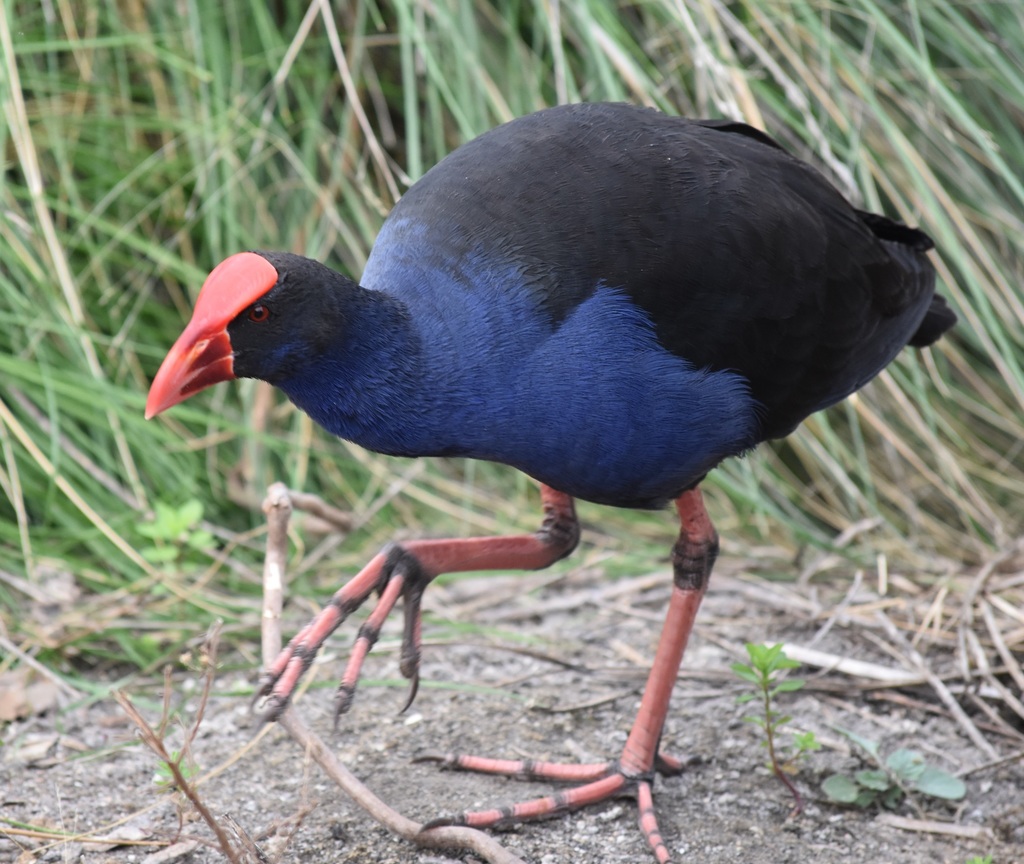
The swamphen is renowned for its distinctive blue-purple plumage, striking red frontal shield, and strong red legs. It is often found in swamps, marshes, and other wet lowland areas, though its habitat has expanded to include pastures, roadside verges, and farmland, due to significant landscape changes in New Zealand over the last 150 years. Unlike many other wetland birds, it is highly opportunistic and adaptable, thriving in both natural and human-modified environments. Its diet reflects this adaptability, consisting primarily of plant material such as grass stems, shoots, and leaves, but also including animal matter like invertebrates and, occasionally, the young of other bird species.
From the article Australasian swamphen on Wikipedia (CC BY-SA), quoted section by section
Description
Australasian swamphen are long-legged birds, standing about 51 cm tall, with dark plumage, black upper-parts, and a contrasting white undertail. They have a large, bright red bill and an expanded frontal shield that extends from their culmen, giving them a distinctive appearance. Their throat and breast are purple, contributing to their striking colour pattern. Variations exist across subspecies, with some having greener or bluer upper-parts or smaller body sizes depending on the region. The New Zealand population (along with green-yellow swamphens in Tasmania) are possibly slightly larger than mainland Australian birds, but are otherwise identical.
Range & habitat
The Australasian swamphen occurs in mainland Australia, eastern Indonesia, the Moluccas, Aru and Kai Islands, and in Papua New Guinea. It is also found on New Zealand's main islands and in the Chatham and Kermadec Islands.
Dispersal. Although it is thought that P. porphyrio subspecies rarely use flight, this lineage has effectively dispersed, colonised, and established populations numerous times across extensive bodies of water. In support of the belief that Australasian swamphens are good flyers, and may have self-introduced, a dead bird was found on L'Esperance Rock, a tiny, isolated rock in the Kermadec group of New Zealand, more than 200 km from the nearest established population. This demonstrates the ability of swamphens to fly great distances over the sea.
Subspecies. The Australasian swamphen has five subspecies distributed as follows:
P. m. melanopterus – northern and south-eastern Sulawesi, the Moluccas, Lesser Sundas and New Guinea region. P. m. pelewensis – Palau (western Caroline Islands, western Micronesia). P. m. melanotus – northern and eastern Australia, Tasmania, Lord Howe and Norfolk Islands, as well as the North, South, Stewart, Kermadec and Chatham Islands of New Zealand. P. m. bellus – far south-west Australia. P. m. samoensis – Admiralty Islands to New Caledonia, Solomon Islands, Fiji and Samoa.
In New Zealand. …
Wikipedia: “Distribution”
What it does
Swamphens exhibit diverse feeding and foraging habits, making use of both plant and animal resources in their diet. Primarily, they consume plant material, including stems, shoots, leaves, and seeds of various grasses, sedges, rushes, and clover. However, they are also opportunistic feeders, supplementing their diet with animal matter, primarily invertebrates. Notably, they have been observed preying on larger vertebrate species, such as pied stilt eggs, Eurasian blackbird chicks, and pāteke and mallard ducklings in New Zealand, as well as common starlings, myna chicks, black swan eggs and cygnets in Australia. This positions them as both a predator and prey species within their ecosystems. Their foraging habits extend beyond natural environments, often leading them to forage on roadsides, where they seek out invertebrates struck by vehicles and graze on grass shoots from mown verges. In these areas, they also ingest grit, which aids in processing food in their gizzards. Swamphens are bold foragers and have a history of raiding gardens for crops such as kumara and taro, a behaviour that has continued as they adapted to European farmland by feeding on grain and vegetable crops. …
Wikipedia: “Feeding and foraging”
Listen
Looking for field recordings…
Where it lives
Recorded sightings
—
geo-referenced records in GBIF, from museums, herbaria and field observers.
Drag the globe to turn it. Dots are where records exist, not a range map; darker means more records.
In the stacks
Searching the stacks…
Every page naming Porphyrio melanotus in the Biodiversity Heritage Library →
This page is assembled live from iNaturalist, GBIF, Wikipedia, the Source Library and the Internet Archive. It is not yet part of the hand-edited codex. iNaturalist taxon 418530.