- Animals
- ›Chordates
- ›Vertebrates
- ›Birds
- ›Shorebirds and Allies
- ›Gulls, Terns, and Skimmers
- ›True Terns
- ›Thalasseus
On eBird ↗
Great Crested Tern
Live sightings near you, the range map, bar charts of when it is seen, and Macaulay Library photos and recordings.
Great Crested Tern
Thalasseus bergii
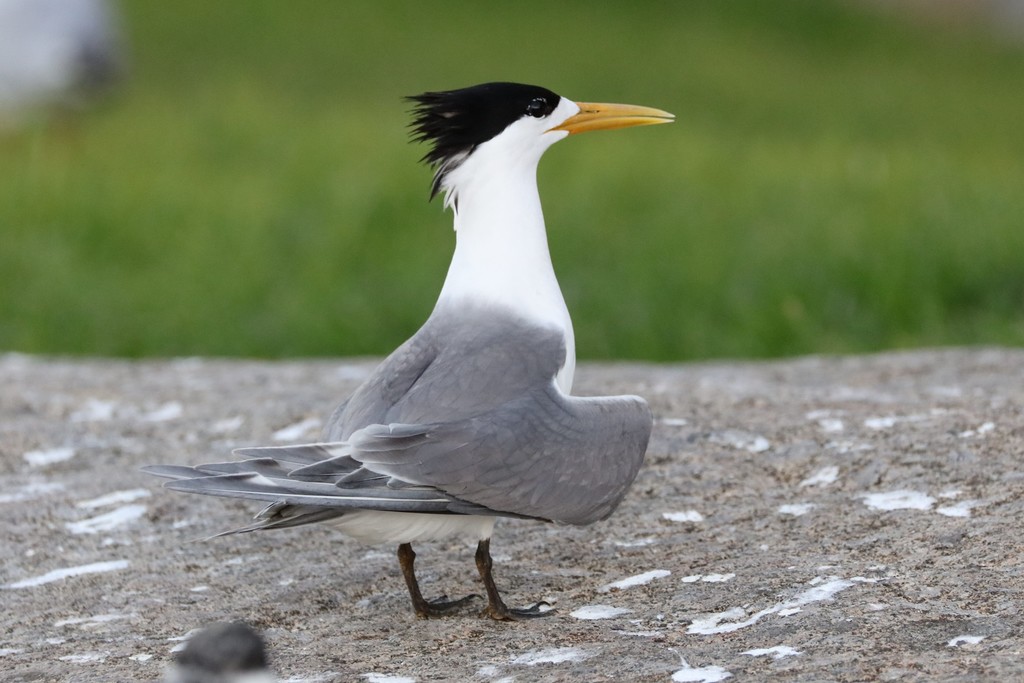
The greater crested tern (Thalasseus bergii), also called crested tern, swift tern, or great crested tern, is a tern in the family Laridae that nests in dense colonies on coastlines and islands in the tropical and subtropical Old World. Its four or five subspecies breed in the area from South Africa around the Indian Ocean to the central Pacific and Australia, all populations dispersing widely from the breeding range after nesting. This large tern is closely related to other species in its genus, but can be distinguished by its darker, battleship-grey upperparts, white forehead even in full breeding plumage, and greenish-tinged yellow (not orange or black) bill colour.
The greater crested tern has dark grey upperparts, white underparts, a yellow bill, and a shaggy black crest that recedes in winter. Its young have a distinctive appearance, with strongly patterned grey, brown and white plumage, and rely on their parents for food for several months after they have fledged. Like all members of the genus Thalasseus, the greater crested tern feeds by plunge diving for fish, usually in marine environments; the male offers fish to the female as part of the courtship ritual.
From the article Greater crested tern on Wikipedia (CC BY-SA), quoted section by section
Description
The greater crested tern is a large tern with a long (5.4–6.5 cm or 2.1–2.6 in) yellow bill, black legs, and a glossy black crest that is noticeably shaggy at its rear. The breeding adult of the nominate subspecies T. b. bergii is 46–49 cm (18–19.5 in) long, with a 125–130 cm (49–51 in) wing-span; weight 325–397 grams (11.5–14.0 oz). The forehead and the underparts are white, the back and inner wings are dusky-grey. In winter, the upperparts plumage wears to a paler grey, and the crown of the head becomes white, merging at the rear into a peppered black crest and mask. The adults of both sexes are identical in appearance, but juvenile birds are distinctive, with a head pattern like the winter adult, and upperparts strongly patterned in grey, brown, and white; the closed wings appear to have dark bars. After moulting, the young terns resemble the adult, but still have a variegated wing pattern with a dark bar on the inner flight feathers. The northern subspecies T. b. velox and T. b. thalassinus are in breeding plumage from May to September or October, whereas the relevant period for the two southern African subspecies is from December to April. For T. b. …
Range & habitat
The greater crested tern occurs in tropical and warm temperate coastal parts of the Old World from South Africa around the Indian Ocean to the Pacific and Australia. The subspecies T. b. bergii (including the doubtfully distinct T. b. enigma) breeds in southern Africa from Namibia to Tanzania, and possibly on islands around Madagascar. There is then a break in the breeding distribution of the species until T. b. velox is met in Somalia, the Red Sea, and the Persian Gulf, and another discontinuity further east in southern India. The subspecies T. b. thalassinus breeds on many islands in the Indian Ocean including Aldabra and Etoile in the Seychelles, the Chagos Archipelago, and Rodrigues. In the Pacific Ocean, there are colonies of T. b. cristatus on numerous Pacific islands, including Kiribati, Fiji, Tonga, the Society Islands and the Tuamotus, as well as more widely on islets off the coasts of China, Taiwan, the Philippines, Indonesia, New Guinea, and Australia south to Tasmania. The nests are located on low‑lying sandy, rocky, or coral islands, sometimes amongst stunted shrubs, often without any shelter at all. When not breeding, the greater crested tern will roost or rest on open shores, less often on boats, pilings, harbour buildings and raised salt mounds in lagoons. …
Wikipedia: “Distribution and habitat”
What it does
Fish are the main food of the greater crested tern, found to make up nearly 90% of all prey items with the remainder including cephalopods, crustaceans and insects. Unusual vertebrate prey included agamid lizards and green turtle hatchlings. The greater crested tern feeds mostly at sea by plunge diving to a depth of up to 1 m (3.3 ft), or by dipping from the surface, and food is usually swallowed in mid-air. Birds may forage up to 10 km (6.2 mi) from land in the breeding season. Prey size ranges from 7–138 mm (0.28–5.43 in) in length and up to 30 g (1.1 oz) in weight. Shoaling pelagic fish such as anchovy and sardine are typical prey, but bottom-living species are taken as discards from commercial fishing. This tern actively follows trawlers, including at night, and during the fishing season trawl discards can constitute 70% of its diet. Prawn fishing is particularly productive in providing extra food, since prawns usually represent only 10–20% of the catch, the remaining being bycatch, mainly fish such as cardinalfish and gobies.
A study of an area of the Great Barrier Reef where the number of breeding great crested terns has grown ten-fold, probably due to extra food from trawl by-catch, suggested that lesser crested and sooty terns have moved away and now breed on a part of the reef where fishing is banned. …
Wikipedia: “Feeding”
Listen
Looking for field recordings…
Where it lives
Recorded sightings
—
geo-referenced records in GBIF, from museums, herbaria and field observers.
Drag the globe to turn it. Dots are where records exist, not a range map; darker means more records.
In the stacks
Searching the stacks…
Every page naming Thalasseus bergii in the Biodiversity Heritage Library →
This page is assembled live from iNaturalist, GBIF, Wikipedia, the Source Library and the Internet Archive. It is not yet part of the hand-edited codex. iNaturalist taxon 144540.