On eBird ↗
Cobb's Wren
Live sightings near you, the range map, bar charts of when it is seen, and Macaulay Library photos and recordings.
Cobb's Wren
Troglodytes cobbi
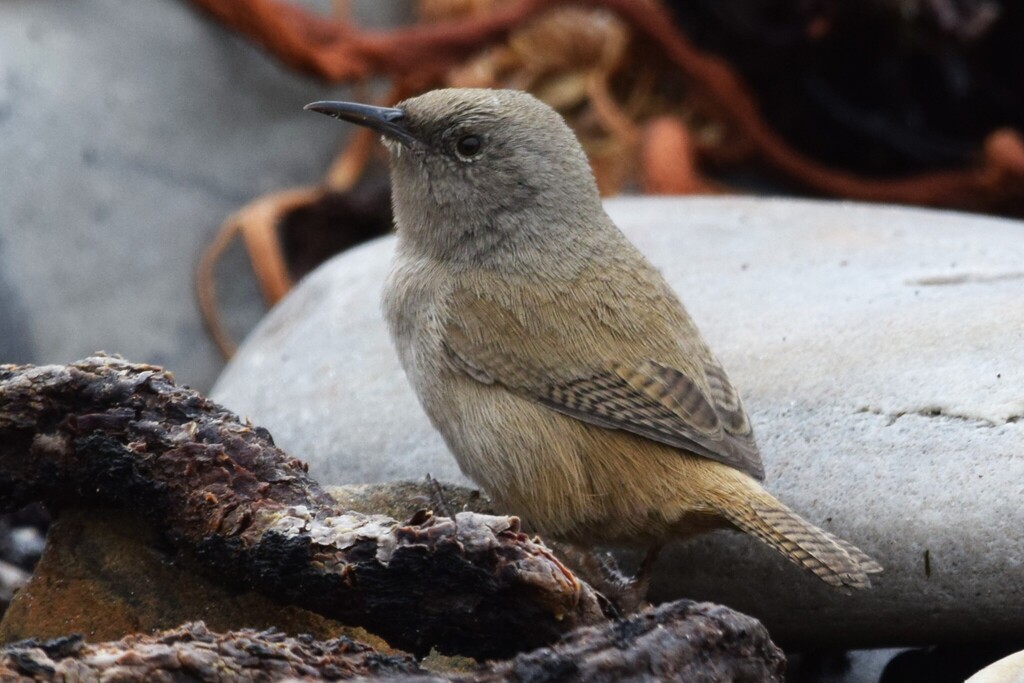
Cobb's wren (Troglodytes cobbi) is a fairly small (12-13.5 cm) wren which is endemic to the Falkland Islands. It was formerly classified as a subspecies of the southern house wren but is now commonly considered to be a separate species due to differences in plumage, voice, ecology and morphology.
The scientific and common names commemorate Arthur Cobb, an author from the Falkland Islands.
From the article Cobb's wren on Wikipedia (CC BY-SA), quoted section by section
Description
The plumage is brown, greyer on the head and breast and more rufous on the tail. There are dark bars on the flight feathers and tail. The bill is long, blackish and slightly curved. The main confusion species is the grass wren which is smaller with a shorter bill, buff eyestripe and dark streaks on the back and head. Cobb's wrens have a number of buzzing calls, and their song is a series of jumbled trills and whistles. The song can be heard from August to February and varies between individuals, with different males having different song patterns.
What it does
The birds typically inhabit dense stands of tussac grass near the coast. They are often found on beaches, searching among kelp and debris to find small invertebrates such as insects and amphipods. They are tame and can often be approached closely. When disturbed, they prefer to slip away like a mouse between boulders or tussac clumps rather than fly.
Breeding. The nest is a ball of grass lined with feathers and tussac root fibres. It is built on or near the ground among tussac or in a rock crevice. The eggs are pinkish with small reddish spots, three or four are laid in a clutch. The eggs are laid from early October to December, and two broods are probably raised during the breeding season.
Wikipedia: “Behaviour”
Listen
Looking for field recordings…
Where it lives
Recorded sightings
—
geo-referenced records in GBIF, from museums, herbaria and field observers.
Drag the globe to turn it. Dots are where records exist, not a range map; darker means more records.
In the stacks
Searching the stacks…
Every page naming Troglodytes cobbi in the Biodiversity Heritage Library →
This page is assembled live from iNaturalist, GBIF, Wikipedia, the Source Library and the Internet Archive. It is not yet part of the hand-edited codex. iNaturalist taxon 114544.