On eBird ↗
Upland Goose
Live sightings near you, the range map, bar charts of when it is seen, and Macaulay Library photos and recordings.
Upland Goose
Chloephaga picta
The upland goose or Magellan goose (Chloephaga picta) is a sheldgoose of the shelduck-sheldgoose subfamily of the Anatidae, the biological family that includes the ducks and most duck-like waterfowl such as the geese and swans. Sheldgeese resemble true geese and display similar habits, yet they are more closely related to shelducks and ducks.
This species nests and breeds close to water (rivers, ponds, oceans) either on the ground or near it among vegetation, usually in grasslands or coastal meadows in the Falkland Islands or in southern Patagonia and Tierra del Fuego at the beginning of the austral summer. Population estimates suggest the insular subpopulations are stable, but continental populations show a recent decline in abundance. Upland geese are herbivorous, specializing in plant leaves, stems and seeds.
From the article Upland goose on Wikipedia (CC BY-SA), quoted section by section
Description
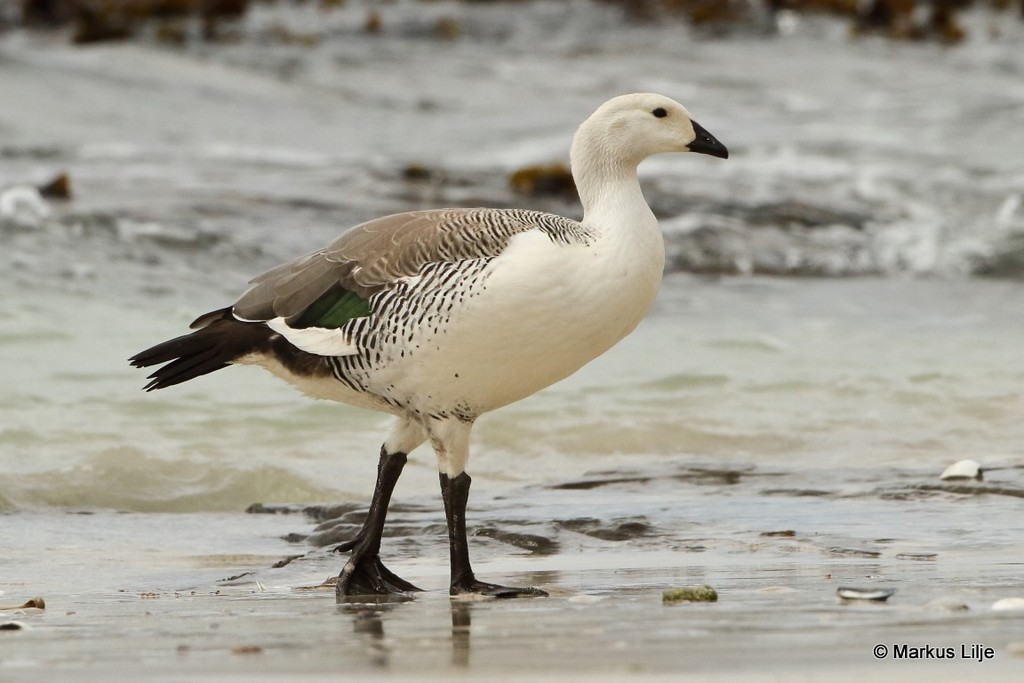
Upland geese males are similar to other sheldgeese, notably the kelp goose (Chloephaga hybrida) due to their predominantly white plumage, while females resemble the ruddy-headed goose (C. rubidiceps) due to their similarly barred breast plumage. This species is 60–72.5 centimetres (23.6–28.5 in) long. Greater Magellan geese (leucoptera subspecies) are the largest birds of the genus Chloephaga. Males typically weigh 3.5–4.5 kg (7.7–9.9 lbs) and females range from 2.9 to 3.5 kg (6.4–7.7 lbs). Lesser Magellan geese (picta subspecies) males weigh 2.7–3.6 kg (6.0–7.9 lbs) on average and females 2.9–3.5 kg (6.4–6.8 lbs). Upland geese display strong sexual dimorphism in their plumage. Males have white heads and breast plumage with black legs, whereas females have reddish-brown heads and breast plumage with yellow-orange legs. However, two interbreeding morphs exist for males. One morph causes black-barred breast plumage while the other causes white breast plumage. A greenish-bronze speculum is also located on the inner secondary flight feathers of the adult male. Males make a whistling "wheep" sound, while females make a low, rattling "a-rrr" sound. Upland geese molt both their primary and secondary feathers in ponds or sheltered sea inlets, usually between late November and early January. …
Range & habitat
Upland geese usually live in small, scattered groups on most pasture types (temperate grasslands, arid lowland scrubs), favouring areas with short green grasses. However, recent land use changes towards crop fields and managed pastures have forced them to adapt to and colonize such modern landscapes.
Wikipedia: “Habitat”
What it does
The upland goose is primarily a herbivore, feeding mostly of seeds, leaves, stems, and other plant matter. They are very gregarious, and flocks of thousands of birds can be found grazing in one pasture alone. They are considered pests by farmers due to the fact that they eat on the pastures that are used for cattle and sheep, and because they claim that upland geese significantly decrease crop yield. However, a recent study claims that while sheldgeese do reduce wheat cover, they do not reduce overall wheat yield and they might even provide an ecosystem service through weed grazing.
Wikipedia: “Food and feeding”
Listen
Looking for field recordings…
Where it lives
Recorded sightings
—
geo-referenced records in GBIF, from museums, herbaria and field observers.
Drag the globe to turn it. Dots are where records exist, not a range map; darker means more records.
In the stacks
Searching the stacks…
Every page naming Chloephaga picta in the Biodiversity Heritage Library →
This page is assembled live from iNaturalist, GBIF, Wikipedia, the Source Library and the Internet Archive. It is not yet part of the hand-edited codex. iNaturalist taxon 7117.