On eBird ↗
Ruddy-headed Goose
Live sightings near you, the range map, bar charts of when it is seen, and Macaulay Library photos and recordings.
Ruddy-headed Goose
Chloephaga rubidiceps
The ruddy-headed goose (Chloephaga rubidiceps) is a species of waterfowl in tribe Tadornini of subfamily Anserinae. It is found in Argentina, Chile, and the Falkland Islands.
From the article Ruddy-headed goose on Wikipedia (CC BY-SA), quoted section by section
Description
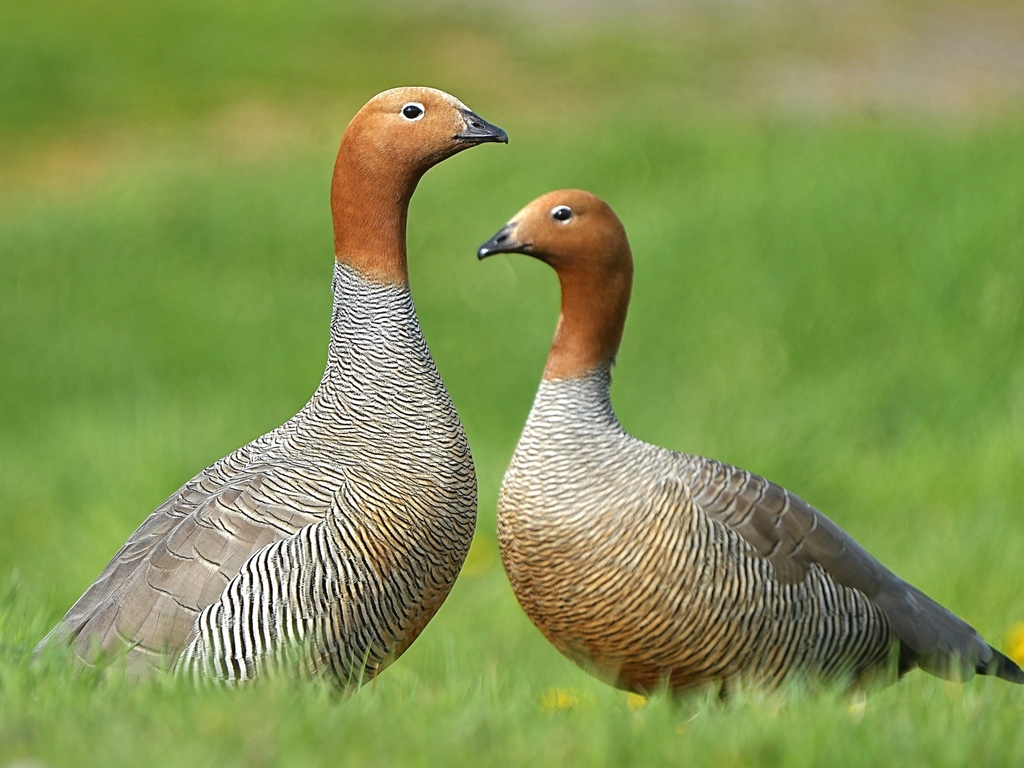
The ruddy-headed goose is 45 to 52.5 cm (18 to 21 in) long. It is the smallest of the South American sheldgeese of genus Chloephaga, with males weighing 1.65 to 2.02 kg (3.6 to 4.5 lb) and females 1.20 to 1.50 kg (2.6 to 3.3 lb). Adults of both sex have the same plumage. Their heads and necks are red-brown, with a short, thin black bill. The iris is dark brown, with a white eyering. The back, breast, and flanks are gray and buff with brown barring. The wings are gray overall, with an iridescent green speculum, black primaries, and bright white lesser wing-coverts and secondaries. They have a cinnamon belly, sometimes with white patches, and their tail is black. The legs and feet are orange with black blotchy markings, and the carpal knob is orange. Juveniles are similar to adults but duller overall and with a blackish or gray speculum.
Range & habitat
The ruddy-headed goose is found in the eastern Chilean and Argentinian parts of Tierra del Fuego and north from there to Buenos Aires Province, Argentina. It is also found on the Falkland Islands. It inhabits open landscapes such as meadows, Pampas wetlands, the borders of ponds, and coastal grasslands and meadows.
Wikipedia: “Distribution and habitat”
What it does
The ruddy-headed goose is almost entirely vegetarian and feeds mostly on the ground rather than in water. On the breeding grounds its diet is small berries and the roots, leaves, stems, and seeds of grasses and sedges. During winter it feeds on young wheat and in harvested fields of maize, sunflower, and sorghum.
Wikipedia: “Feeding”
Listen
Looking for field recordings…
Where it lives
Recorded sightings
—
geo-referenced records in GBIF, from museums, herbaria and field observers.
Drag the globe to turn it. Dots are where records exist, not a range map; darker means more records.
In the stacks
Searching the stacks…
Every page naming Chloephaga rubidiceps in the Biodiversity Heritage Library →
This page is assembled live from iNaturalist, GBIF, Wikipedia, the Source Library and the Internet Archive. It is not yet part of the hand-edited codex. iNaturalist taxon 7116.