- Animals
- ›Chordates
- ›Vertebrates
- ›Birds
- ›Perching Birds
- ›Old World Flycatchers, Robins, and Chats
- ›Oenanthe
On eBird ↗
Mourning Wheatear
Live sightings near you, the range map, bar charts of when it is seen, and Macaulay Library photos and recordings.
Mourning Wheatear
Oenanthe lugens
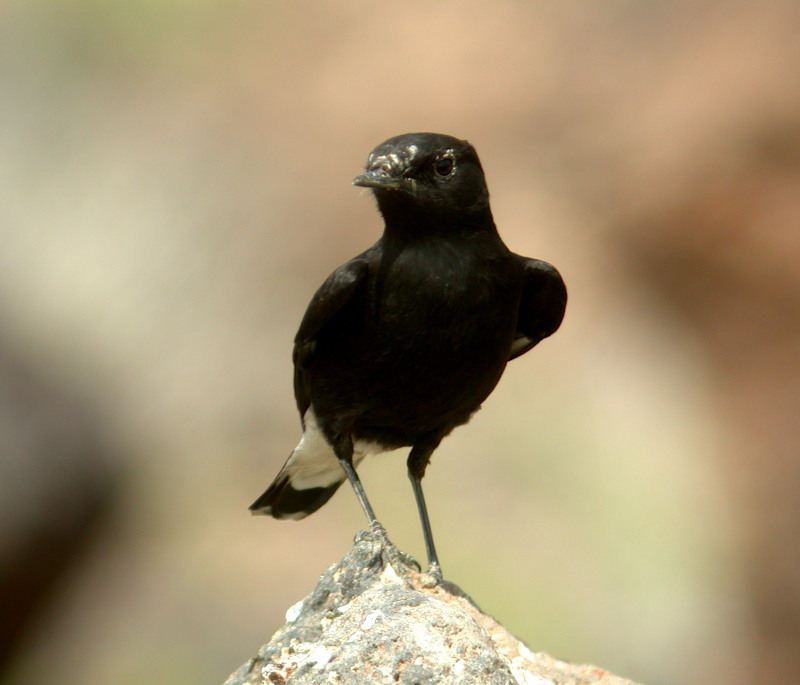
The mourning wheatear (Oenanthe lugens) is a bird, one of 14 species of wheatear found in northern Africa and the Middle East. It is a small passerine in a group formerly classed as members of the thrush family Turdidae, but now more generally considered to be part of the Old World flycatcher family Muscicapidae.
From the article Mourning wheatear on Wikipedia (CC BY-SA), quoted section by section
Description
The mourning wheatear measures 14–16 cm (5.5–6.3 in) in length and weighs between 19–25 g (0.67–0.88 oz). It is characterised by its striking black-and-white plumage. Both males and females share a similar appearance, featuring a white crown, nape, chest, and belly that contrast with the black head and neck, which extend to the black back. The tail is predominantly white, marked by a black stripe at the tip and a central black intrusion forming an inverted "T" pattern, a characteristic feature of wheatears. While the wings appear entirely black when at rest, they reveal white bases on the flight feathers during flight, creating a distinct white "flag" along the wing. It shows only a subtle sexual dimorphism, with the females sporting more subtle plumage. The basalt wheatear, subspecies O. l. warriae, differs from the nominate is having mainly black plumage except for white undertail coverts and a small white patch on the rump. The plumage of the adult female is less black and more brown in colour. The Maghreb wheatear, subspecies O. l. halophila, shows strong sexual dimorphism with the female having grey-brown plumage rather than the black and white of the male.
Range & habitat
The mourning wheatear is native to semi-desert areas of the Middle East, from eastern Egypt to Iran, and with O. l. halophila disjunct from Morocco to northwestern Egypt. It is primarily found in desert habitats, favouring environments with caves for shelter, rocky slopes, valleys, screes, cliffs, ravines, dry barren wadis, ridges, and flat plains. It occasionally visits villages, lowlands, wastelands, and cultivated fields. The species is typically observed at altitudes ranging from 1,000 to 4,000 metres (3,300 to 13,100 ft).
Wikipedia: “Distribution and habitat”
Listen
Looking for field recordings…
Where it lives
Recorded sightings
—
geo-referenced records in GBIF, from museums, herbaria and field observers.
Drag the globe to turn it. Dots are where records exist, not a range map; darker means more records.
In the stacks
Searching the stacks…
Every page naming Oenanthe lugens in the Biodiversity Heritage Library →
This page is assembled live from iNaturalist, GBIF, Wikipedia, the Source Library and the Internet Archive. It is not yet part of the hand-edited codex. iNaturalist taxon 12821.