On eBird ↗
Cape Sparrow
Live sightings near you, the range map, bar charts of when it is seen, and Macaulay Library photos and recordings.
Cape Sparrow
Passer melanurus
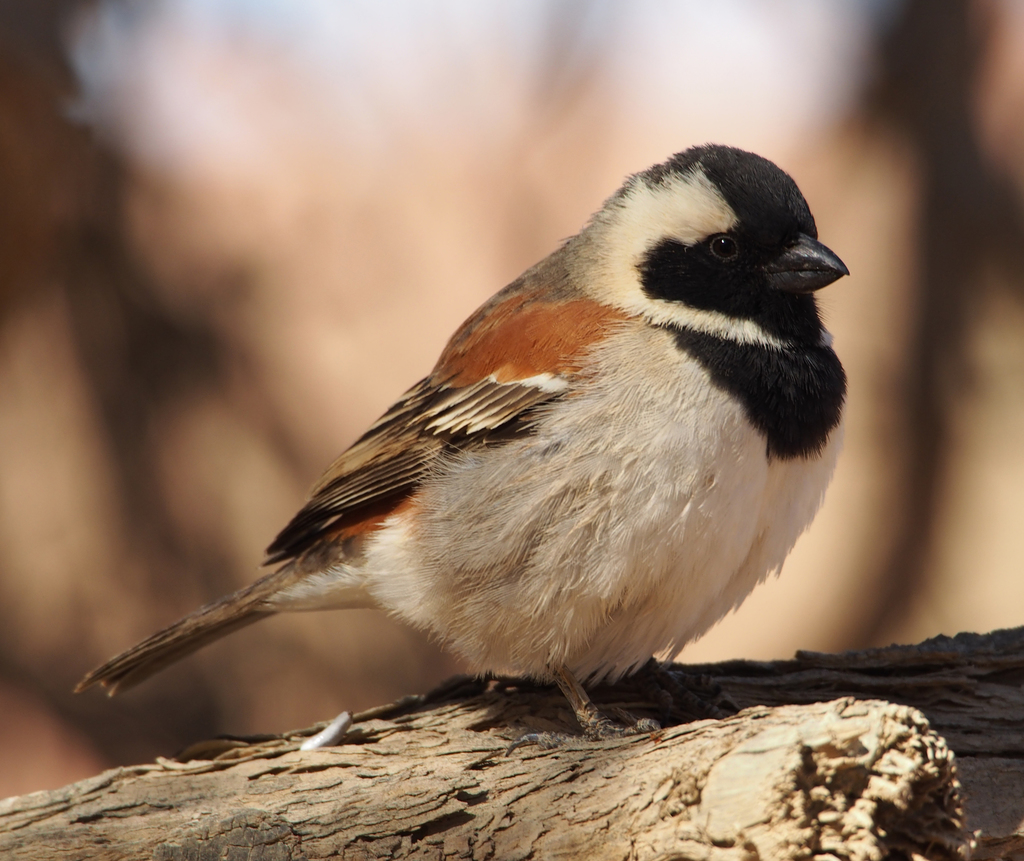
The Cape sparrow (Passer melanurus), or mossie, is a bird of the sparrow family Passeridae found in southern Africa. A medium-sized sparrow at 14–16 centimetres (5.5–6.3 in), it has distinctive plumage, including large pale head stripes in both sexes. Its plumage is mostly grey, brown, and chestnut, and the male has some bold black and white markings on its head and neck. The species inhabits semi-arid savannah, cultivated areas, and towns, and ranges from the central coast of Angola to eastern South Africa and Eswatini. Three subspecies are distinguished in different parts of its range.
Cape sparrows primarily eat seeds, and also eat soft plant parts and insects. They typically breed in colonies, and when not breeding they gather in large nomadic flocks to move around in search of food. The nest can be constructed in a tree, a bush, a cavity, or a disused nest of another species. A typical clutch contains three or four eggs, and both parents are involved in breeding, from nest building to feeding young. The Cape sparrow is common in most of its range and coexists successfully in urban habitats with two of its relatives, the native southern grey-headed sparrow and the house sparrow, an introduced species. The Cape sparrow's population has not been recorded decreasing significantly, and it is not seriously threatened by human activities, so it is assessed as a species of least concern by the International Union for Conservation of Nature (IUCN).
From the article Cape sparrow on Wikipedia (CC BY-SA), quoted section by section
Description
For a sparrow, the Cape sparrow is strikingly coloured and distinctive, and is medium-sized at 14–16 cm (5.5–6.3 in) long. Adults range in weight from 17 to 38 grams (0.60–1.34 oz). The breeding male has a mostly black head, but with a broad white mark on each side, curling from behind the eye to the throat. On the throat a narrow black band connects the black bib of the breast to black of the head. The underparts are greyish, darker on the flanks. The back of the male's neck is dark grey, and its back and shoulders are bright chestnut. The male has a white and a black wing bar below its shoulders, and flight feathers and tail streaked grey and black. The female is plumaged like the male, but is duller and has a grey head with a different pattern from the male, though it bears a hint of the pale head markings of the male. The juvenile is like the female, but young males have black markings on the head from an early age. The Cape sparrow's calls are chirps similar to those of the house sparrow, but much more musical and mellow. The basic call is used in flight and while perching socially and transcribed as chissip, chirrup, chreep, or chirrichup. A loud, distinctive call used by the male to advertise nest ownership can be written as tweeng or twileeng; this call can be extended into a jerky and repetitive song, chip cheerup, chip cheerup.
Range & habitat
The Cape sparrow inhabits southern Africa south of Angola and as far east as Eswatini. The northernmost point in its range is Benguela in Angola, and it is found in the coastal and central parts of Namibia, except for the driest parts of the Namib Desert. It occurs in all of South Africa except the farthest east, in southern Botswana and spottily in the Kalahari Basin of central Botswana. In the east, it breeds at a small number of localities in southeastern Zimbabwe. It has been recorded as a vagrant in Harare, in central Zimbabwe. The eastern limit of its range is reached in the wet forests of Limpopo and KwaZulu Natal, extending into the hills of western Eswatini. The original habitats of this species were the semi-arid savanna, thornveld, and light woodland typical of southern Africa. When settled agriculture arrived in its range about a thousand years ago, it adapted to cultivated land, and since the arrival of settlement, it has moved into towns. The Cape sparrow prefers habitats with an annual rainfall of less than 75 centimetres (30 in), though in desert areas it is usually found near watercourses or watering holes. …
Wikipedia: “Distribution and habitat”
What it does
The Cape sparrow is social, lives in flocks, and usually breeds in colonies. Away from settled areas it spends much of the year wandering nomadically, in flocks of up to 200 birds. In cultivated and built up areas, smaller flocks form where food is provided for livestock or birds. In such places, it associates with other seed-eating birds, such as the house sparrow, the Cape weaver, and weavers of the genus Euplectes. Birds from urban areas form large flocks seasonally and fly out to the nearby countryside to feed on ripening grain, returning at night to roost. Cape sparrows prefer to roost in nests, and while wandering outside of the breeding season, birds in uncultivated areas roost socially in old nests or dense bushes. In farmland and towns, Cape sparrows build special nests for roosting, lined more poorly than breeding nests but incorporating a greater quantity of insulating material. An unusual social behaviour has been described from Cape sparrows in Johannesburg. Groups of 20–30 birds separate from larger flocks and stand close together on the ground with tails on the ground and heads held high. These groups sometimes move in an unconcerted fashion by hopping slowly. Often birds will fly up and hover 30–60 centimetres (12–24 in) above the ground. During these gatherings birds are silent and are never antagonistic. …
Wikipedia: “Social behaviour”
Listen
Looking for field recordings…
Where it lives
Recorded sightings
—
geo-referenced records in GBIF, from museums, herbaria and field observers.
Drag the globe to turn it. Dots are where records exist, not a range map; darker means more records.
In the stacks
Searching the stacks…
Every page naming Passer melanurus in the Biodiversity Heritage Library →
This page is assembled live from iNaturalist, GBIF, Wikipedia, the Source Library and the Internet Archive. It is not yet part of the hand-edited codex. iNaturalist taxon 13853.