On eBird ↗
Plain Martin
Live sightings near you, the range map, bar charts of when it is seen, and Macaulay Library photos and recordings.
Brown-throated Martin
Riparia paludicola
The brown-throated martin or brown-throated sand martin (Riparia paludicola) is a small passerine bird in the swallow family. It was first formally described as Hirundo paludicola by French ornithologist Louis Vieillot in 1817 in his Nouveau Dictionnaire d'Histoire Naturelle. It was formerly regarded as conspecific with the grey-throated martin (R. chinensis) under the name "plain martin".
From the article Brown-throated martin on Wikipedia (CC BY-SA), quoted section by section
Description
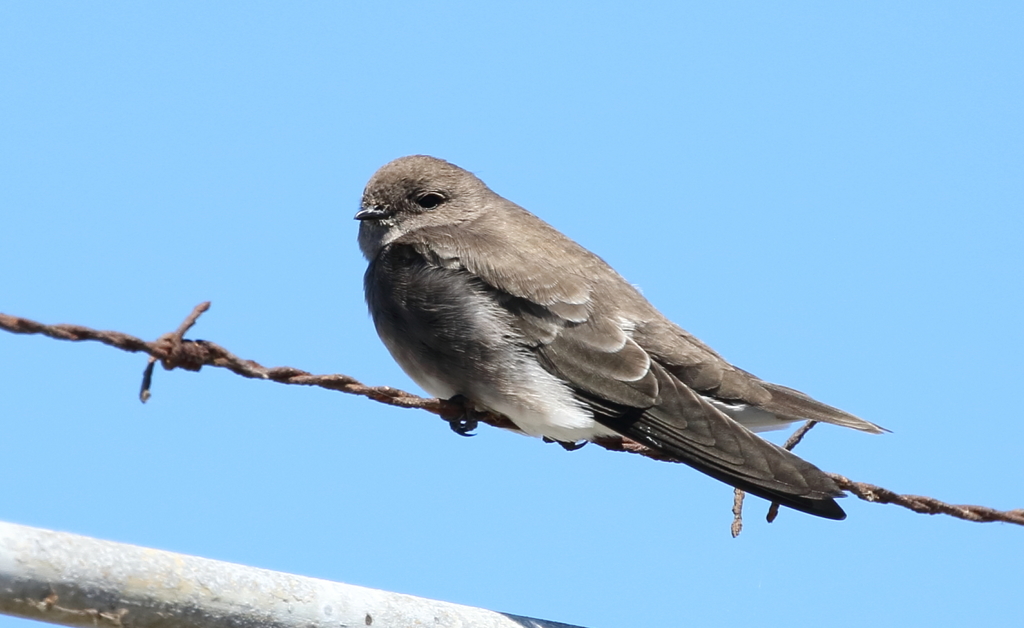
The 12 cm long brown-throated martin is brown above and white or pale brown below. It lacks the narrow brown band on the breast shown by the sand martin; the bill is black and the legs are brown. Sexes are similar, but the young have pale tips to the feathers on the rump and wings. The twittering song of the brown-throated martin is continuous when the birds are on the wing, and becomes a conversational undertone after they have settled in the roost. There is also a harsh alarm call.
Range & habitat
It has a wide range in Africa. It is a partially migratory species, with some populations making seasonal movements. It is usually associated closely with water as its specific epithet paludicola suggests.
Wikipedia: “Distribution and habitat”
What it does
Its brown back, small size and quicker, jerkier flight separate the brown-throated martin at once from most other members of the swallow family. It is most similar to the sand martin, Riparia riparia, which is its northern counterpart.
Breeding. The brown-throated martin is colonial in its nesting habits, with many pairs breeding close together, according to available space. The nests are at the end of tunnels of 30 to 60 cm in length, bored in sandbanks. The actual nest is a litter of straw and feathers in a chamber at the end of the burrow. Two to four white eggs are the normal clutch, and are incubated by both parents.
Food and feeding. The food of this species consists of small insects, mostly gnats and other flies whose early stages are aquatic.
Wikipedia: “Behaviour”
Listen
Looking for field recordings…
Where it lives
Recorded sightings
—
geo-referenced records in GBIF, from museums, herbaria and field observers.
Drag the globe to turn it. Dots are where records exist, not a range map; darker means more records.
In the stacks
Searching the stacks…
Every page naming Riparia paludicola in the Biodiversity Heritage Library →
This page is assembled live from iNaturalist, GBIF, Wikipedia, the Source Library and the Internet Archive. It is not yet part of the hand-edited codex. iNaturalist taxon 11945.