On eBird ↗
Red-winged Starling
Live sightings near you, the range map, bar charts of when it is seen, and Macaulay Library photos and recordings.
Red-winged Starling
Onychognathus morio
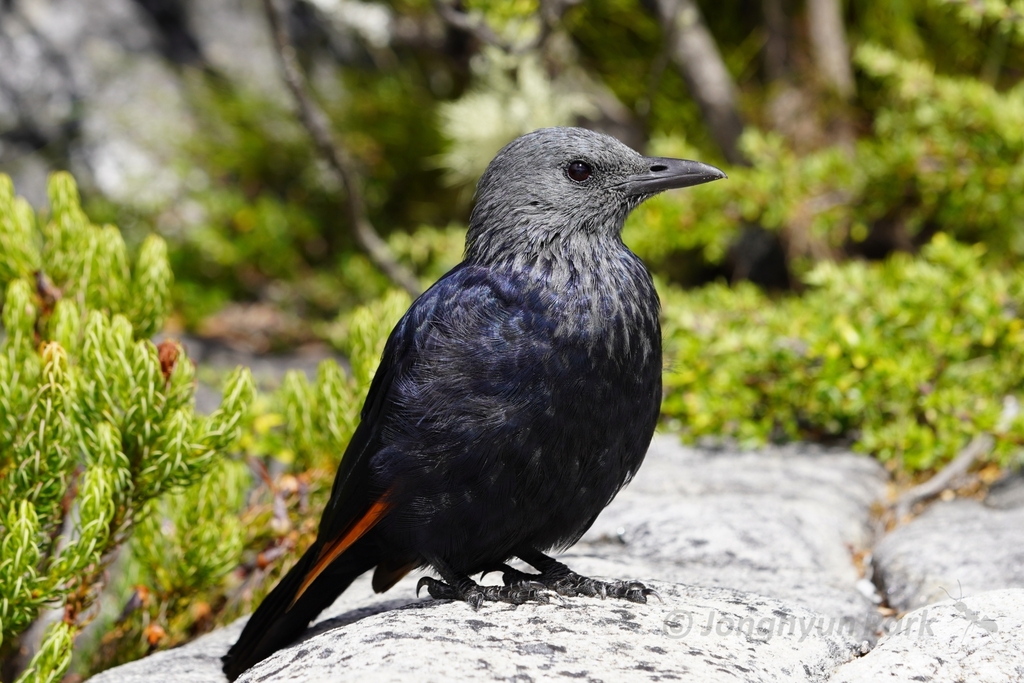
The red-winged starling (Onychognathus morio) is a bird of the starling family Sturnidae native to eastern and southern Africa from Ethiopia to South Africa. An omnivorous, generalist species, it prefers cliffs and mountainous areas for nesting, and has moved into cities and towns due to similarity to its original habitat.
From the article Red-winged starling on Wikipedia (CC BY-SA), quoted section by section
Description
The male of this 27–30-centimetre (11–12 in) long starling has mainly iridescent black plumage, with chestnut flight feathers, which are particularly noticeable in flight. The female has an ash-grey head and upper breast. The juvenile resembles the male, but is less glossy than the adults, and has brown rather than dark red eyes. The Ethiopian subspecies O. m. rupellii is longer-tailed than the nominate form and intergrades with it.
This species has a number of whistled calls, but the most familiar is the contact call, cher-leeeoo. This starling may be confused with other similar starling species, such as its sister species the pale-winged starling. The difference between the two is that the red-winged has rufous primaries while the pale-winged has whitish primaries edged with orange. The pale-winged has a bright red or orange eye, while the red-winged's is dark, almost black. Only the female of the red-winged has a grey head.
Range & habitat
The range runs down eastern Africa from Ethiopia to the Cape, KwaZulu-Natal and Gauteng in South Africa. This species has a wide habitat tolerance. It may be found in forest, savannah, grassland, wetlands, fynbos, farmlands and commercial plantations, as well as urban centres. It is now common in many urban areas, due to the similarity between the structure of tall buildings and houses as nest sites with the cliffs of its original habitat. It may also nest in residential areas, breeding in roofs and apertures and up house eaves.
Wikipedia: “Distribution and habitat”
What it does
Like other starlings, the red-winged starling is an omnivore, taking a wide range of seeds, berries, nectar from plants such as Aloe and Schotia brachypetala, and invertebrates, such as the beetle species Pachnoda sinuata. They may take nestlings and adults of certain bird species, such as the African palm swift. It will also scavenge on carrion and human food scrap. The red-winged starling will obviously only perch on plant structures that will be able to support its weight; therefore when taking nectar it will choose certain species with strong, robust racemes with easily accessible flowers, such as that of Aloe ferox and Aloe marlothii, and not Aloe arborescens. Large flowers that can support the bird's weight, such as that of Strelitzia nicolai and certain Protea species, are also chosen. Fruit species that this species may feed on include figs, such as the sycamore fig and others, marulas, date palm fruit, berries from species such as wild olive Olea europaea subsp. cuspidata and Euphorbia, and commercial fruit such as apples, grapes, citruses and others.
In rural areas, red-winged starlings are often spotted perching on livestock and game, such as cattle, klipspringers and giraffes, a trait shared by the pale-winged starling, and may take insects and ectoparasites such as ticks, much in the manner of oxpeckers.
Wikipedia: “Food and feeding”
Listen
Looking for field recordings…
Where it lives
Recorded sightings
—
geo-referenced records in GBIF, from museums, herbaria and field observers.
Drag the globe to turn it. Dots are where records exist, not a range map; darker means more records.
In the stacks
Searching the stacks…
Every page naming Onychognathus morio in the Biodiversity Heritage Library →
This page is assembled live from iNaturalist, GBIF, Wikipedia, the Source Library and the Internet Archive. It is not yet part of the hand-edited codex. iNaturalist taxon 204554.