On eBird ↗
Hispaniolan Pewee
Live sightings near you, the range map, bar charts of when it is seen, and Macaulay Library photos and recordings.
Hispaniolan Pewee
Contopus hispaniolensis
The Hispaniolan pewee (Contopus hispaniolensis) is a species of bird in the family Tyrannidae, the tyrant flycatchers. It is endemic to the Caribbean island of Hispaniola which is shared by the Dominican Republic and Haiti.
From the article Hispaniolan pewee on Wikipedia (CC BY-SA), quoted section by section
Description
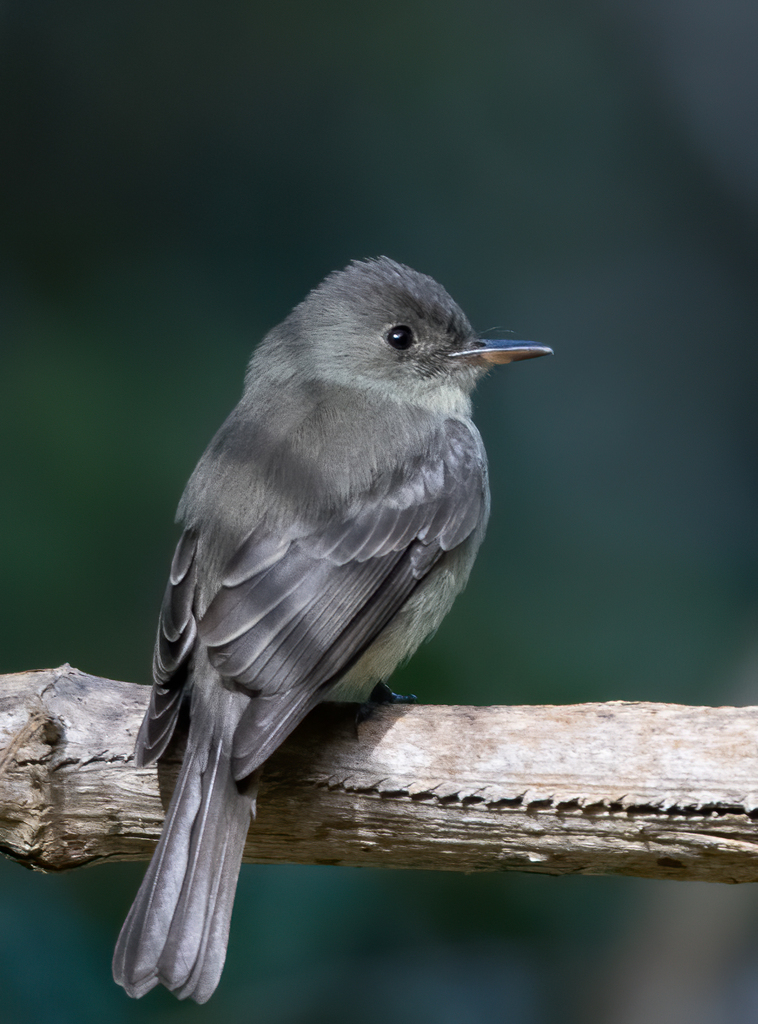
The Hispaniolan pewee is 15 to 16 cm (5.9 to 6.3 in) long and weighs about 11.5 g (0.41 oz). The sexes have the same plumage and the two subspecies are similar to each other. Adults have a grayish olive head and back with a slightly darker crown. Their wings are dusky, sometimes with two faint wing bars. Their tail is dusky. Their throat is gray, their breast gray with an olive wash across it, and their belly and undertail coverts yellowish buff with some gray mixed in. Juveniles have pale fringes on the feathers of the crown, back, and wing coverts. Adults have a dark iris, a wide blackish bill with a paler base to the mandible, and blackish legs and feet.
Range & habitat
The nominate subspecies of the Hispaniolan peewee is found across the main island of Hispaniola. Subspecies C. h. tacitus is found on Gonâve Island off the western coast of Haiti. The species has also been documented as a vagrant on Mona Island to the east between Hispaniola and Puerto Rico. It has also been recorded after a hurricane on Providenciales Island in the Turks and Caicos Islands. The species inhabits a variety of wooded landscapes in the tropical and subtropical zones including evergreen and deciduous broadleaf forest, pine forest, shade coffee plantations, and orchards. In elevation it ranges from sea level to 2,000 m (6,600 ft).
Wikipedia: “Distribution and habitat”
What it does
The Hispaniolan pewee feeds mostly on insects and includes some fruit in its diet. It sits erect on an exposed perch low to the ground and captures prey in mid-air with sallies from it ("hawking"). It usually returns to the same perch after a sally and flicks its tail upon landing. It has been observed following mixed-species feeding flocks in pine forest.
Wikipedia: “Feeding”
Listen
Looking for field recordings…
Where it lives
Recorded sightings
—
geo-referenced records in GBIF, from museums, herbaria and field observers.
Drag the globe to turn it. Dots are where records exist, not a range map; darker means more records.
In the stacks
Searching the stacks…
Every page naming Contopus hispaniolensis in the Biodiversity Heritage Library →
This page is assembled live from iNaturalist, GBIF, Wikipedia, the Source Library and the Internet Archive. It is not yet part of the hand-edited codex. iNaturalist taxon 16097.