On eBird ↗
Antarctic Prion
Live sightings near you, the range map, bar charts of when it is seen, and Macaulay Library photos and recordings.
Antarctic Prion
Pachyptila desolata
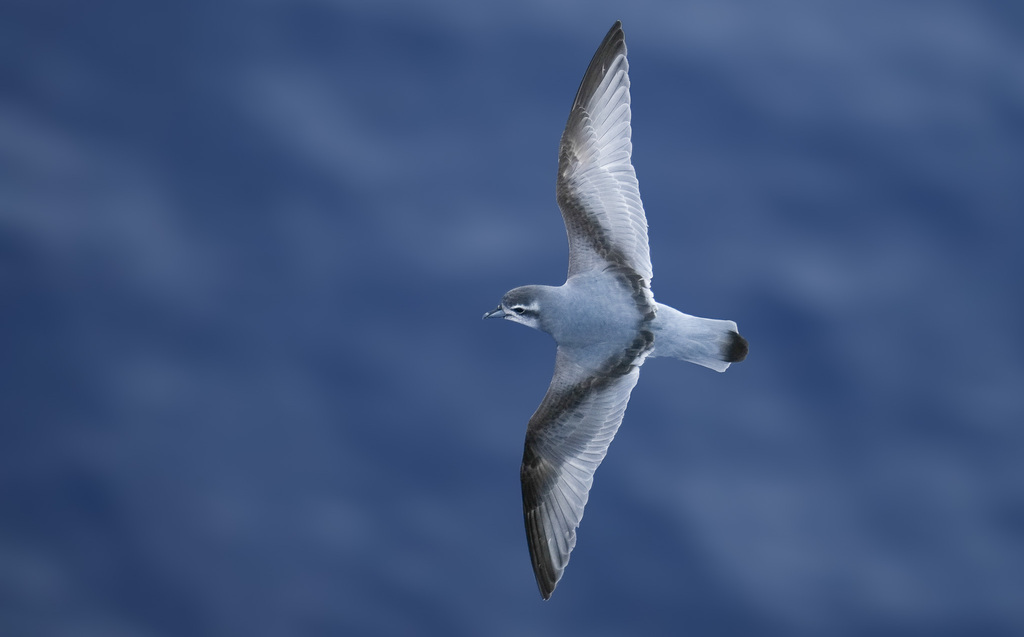
The Antarctic prion (Pachyptila desolata) also known as the dove prion, or totorore in Māori, is the largest of the prions, a genus of small petrels of the Southern Ocean.
From the article Antarctic prion on Wikipedia (CC BY-SA), quoted section by section
Description
The Antarctic prion has an overall length of 27 cm (11 in), a wingspan of 61–66 cm (24–26 in) and weighs 150–160 g (5.3–5.6 oz). Like all prions, its underparts are white and upperparts are blue-grey, with a dark "M" across its back to its wingtips. It has a white eyebrow, blue-grey bill, and blue feet. It also has a grey wedge-shaped tail with a black tip. On its wings, its greater coverts are near black. It is so similar in appearance to Salvin's prion that the two species cannot be distinguished at sea.
Range & habitat
It breeds in colonies on the Auckland Islands, Heard Island, Macquarie Island, Scott Island, South Georgia and the South Sandwich Islands, the South Orkney Islands, South Shetland Islands, Crozet Islands, and the Kerguelen Islands. When not breeding, it ranges throughout the southern oceans.
Wikipedia: “Distribution and habitat”
What it does
Like all prions, the Antarctic prion eats primarily zooplankton, which it obtains by filtering water through its upper bill.
Wikipedia: “Food and feeding”
Listen
Looking for field recordings…
Where it lives
Recorded sightings
—
geo-referenced records in GBIF, from museums, herbaria and field observers.
Drag the globe to turn it. Dots are where records exist, not a range map; darker means more records.
In the stacks
Searching the stacks…
Every page naming Pachyptila desolata in the Biodiversity Heritage Library →
This page is assembled live from iNaturalist, GBIF, Wikipedia, the Source Library and the Internet Archive. It is not yet part of the hand-edited codex. iNaturalist taxon 4164.