On eBird ↗
Southern Royal Albatross
Live sightings near you, the range map, bar charts of when it is seen, and Macaulay Library photos and recordings.
Southern Royal Albatross
Diomedea epomophora
The southern royal albatross or toroa (Diomedea epomophora) is a large seabird in the albatross family. With an average wingspan of more than 3 m (9.8 ft), it is one of the two largest species of albatross, together with the wandering albatross. Recent studies indicate that the southern royal albatross may, on average, be somewhat larger than the wandering albatross in mass and have a similar wingspan, although other sources indicate roughly similar size for the two species and the wandering species may have a larger average (and maximum) wingspan in some colonies.
From the article Southern royal albatross on Wikipedia (CC BY-SA), quoted section by section
Description
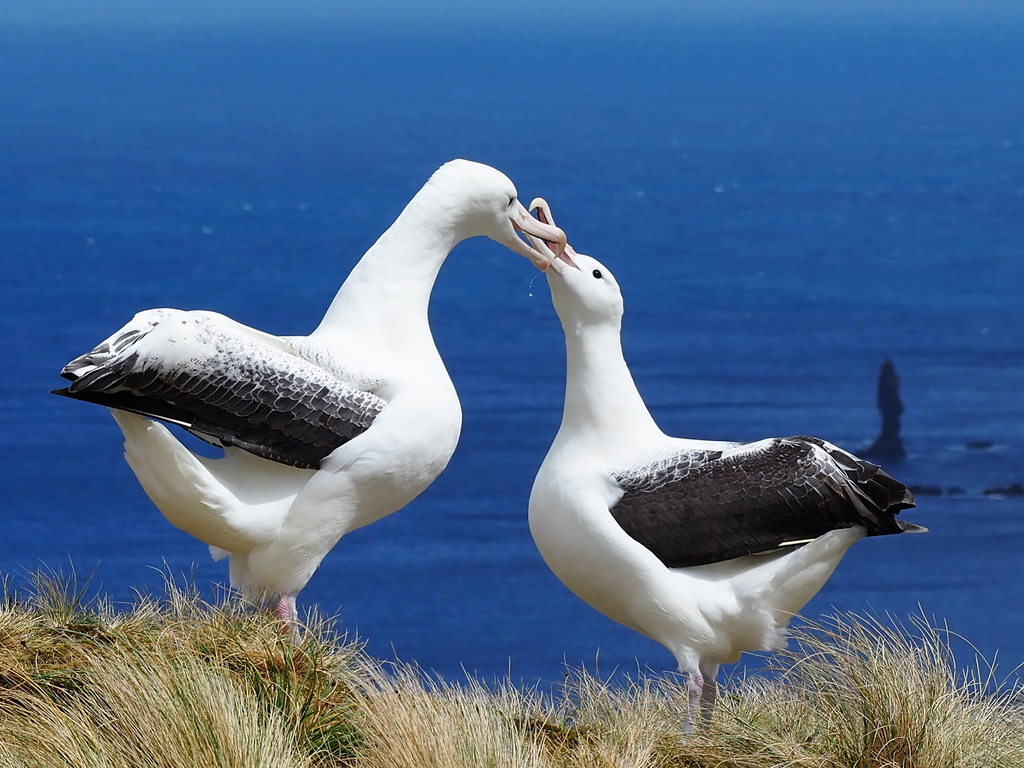
The southern royal albatross has a length of 112 to 123 cm (44–48 in) and a mean weight of 9 kg (20 lb). At Campbell Island, 11 males were found to have a mean mass of 10.3 kg (23 lb) and 7 females were found to have a mean mass of 7.7 kg (17 lb), thus may be heavier on average than most colonies of wandering albatross. Males are about 2 to 3 kg (4.4 to 6.6 lb) heavier than females. Average wingspan has been reported from 2.9 to 3.28 m (9.5 to 10.8 ft), with an upper limit of about 3.50 m (11.5 ft). The wandering albatross can exceed this species in maximum size and averages slightly larger in linear dimensions if not bulk, but the two species are close enough in dimensions that size cannot be used to distinguish between them. The juvenile has a white head, neck, upper mantle, rump, and underparts. There are black speckles on the mantle, and dark brown or black wings with white flecks on coverts. The tail is white except for the black tip as is the under-wing. Young birds soon lose the black on their tail and backs. White appears on the upperwing gradually, as speckles starting from the leading edge. All ages have a pink bill with black on the cutting edge on the upper mandible, and the legs are flesh-coloured. Young birds with all-dark upperwings can be hard to differentiate from the northern royal albatross. …
Range & habitat
Most of the royal albatross population is found between 30° S and 45° S. They range along the southern oceans concentrating on the west and east coast of southern South America, and also in the waters surrounding New Zealand. The majority of the world's population of southern royal albatrosses nest on the rat-free subantarctic Campbell Island, around 8,200 to 8,600 pairs. There are smaller colonies on Adams Island and Auckland Island in the Auckland Islands, 20 pairs combined, and 69 pairs on Enderby Island. Direct counts on Enderby Island using a helicopter and also on foot in January 2017 estimated there were 47 breeding pairs there. There are some sanfordi × epomophora hybrids at the northern royal albatross colony on the Otago Peninsula in New Zealand.
Wikipedia: “Range”
What it does
They attract their mates using methods such as bill-snapping, clapping and gulping. Others ways also include sky-calling with outstretched wings, and neck and head stretched upwards.
Feeding. The southern royal albatross eats squid and fish, with smaller amounts of carrion, crustaceans, and salps. Its foraging activities normally take place within a 1250 km radius of the breeding site. Although they travel vast distances, royal albatrosses in general tend to forage in somewhat shallower waters and closer to continental shelves than wandering albatrosses.
Breeding. They prefer to nest on tussock grassland, plateaus, or ridges, and will lay one egg biennially. This will normally take place in November or December. Both parents will incubate the egg, and rear the young. After they are born it takes about 240 days for a baby to grow its wings fully and fly by itself. There is very low mortality rates of the laid eggs once the parents settle in. When feeding the young they will range south to the Campbell Plateau and north to the Chatham Rise.
Wikipedia: “Behaviour”
In human culture
Diomedea refers to Diomedes, a figure from Greek mythology whose companions turned to birds.
Wikipedia: “Etymology”
Listen
Looking for field recordings…
Where it lives
Recorded sightings
—
geo-referenced records in GBIF, from museums, herbaria and field observers.
Drag the globe to turn it. Dots are where records exist, not a range map; darker means more records.
In the stacks
Searching the stacks…
Every page naming Diomedea epomophora in the Biodiversity Heritage Library →
This page is assembled live from iNaturalist, GBIF, Wikipedia, the Source Library and the Internet Archive. It is not yet part of the hand-edited codex. iNaturalist taxon 4124.