On eBird ↗
Crab-Plover
Live sightings near you, the range map, bar charts of when it is seen, and Macaulay Library photos and recordings.
Crab-Plover
Dromas ardeola
The crab-plover or crab plover (Dromas ardeola) is a coastal wader (shorebird). It is the only member of the genus Dromas and the family Dromadidae. It is unique among waders in making use of ground warmth to aid the incubation of its eggs. The crab-plover is classified in the suborder Lari in a group together with the Glareolidae (pratincoles and coursers), and next most closely related to the Laridae (gulls and terns), rather than to most other waders such as plovers (suborder Charadrii) and sandpipers (suborder Scolopaci).
From the article Crab-plover on Wikipedia (CC BY-SA), quoted section by section
Description
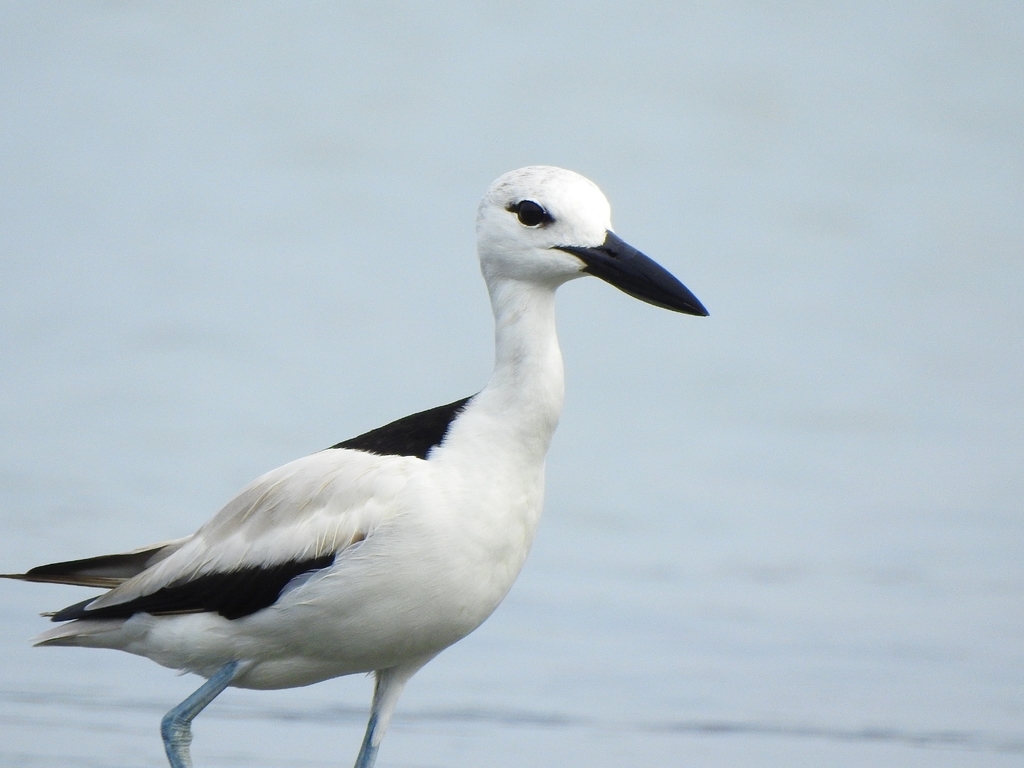
This bird resembles a plover, but has very long bluish-grey legs and a strong heavy black bill. Its pied plumage and long-necked upright posture with heavy bill makes it distinctive and unmistakable; apart from the massive bill, the plumage pattern is most reminiscent of a pied avocet. Its bill is unique among waders, and specialised for eating crabs. It has partially webbed toes. The plumage is white except for black on its back and in the primary feathers of the wings; in breeding plumage, the head is white apart from the small black eye patch, while in non-breeding plumage, the head is streaked grey. They are noisy birds, calling frequently on their breeding sites and in their wintering grounds. The usual call is a ka similar to that of the bar-tailed godwit but repeated rapidly. Flocks may produce a whinnying sound that rises and at in the breeding season produce whistling kew-ki-ki notes. Males and females are not easily distinguished but males have a heavier and longer bill. Juveniles have the mantle grey rather than black, and remain in this plumage for a year. Flocks fly in lines or "V" formations. The crab-plover is one of the species to which the Agreement on the Conservation of African-Eurasian Migratory Waterbirds (AEWA) applies.
Range & habitat
It is resident on the coasts and islands of the Indian Ocean, where it feeds on crabs and other small animals. They are gregarious and will feed in large groups, at night and during dawn and dusk as well as during the day; this crepuscular and nocturnal behaviour is more common during the breeding season. They breed around the Arabian Sea, Gulf of Oman and the Persian Gulf, Red Sea and Somalia in the months of April to July then disperse across the Indian Ocean in August as far as the Andaman Islands and Sri Lanka in the east and Tanzania and Madagascar.
Wikipedia: “Range”
Listen
Looking for field recordings…
Where it lives
Recorded sightings
—
geo-referenced records in GBIF, from museums, herbaria and field observers.
Drag the globe to turn it. Dots are where records exist, not a range map; darker means more records.
In the stacks
Searching the stacks…
Every page naming Dromas ardeola in the Biodiversity Heritage Library →
This page is assembled live from iNaturalist, GBIF, Wikipedia, the Source Library and the Internet Archive. It is not yet part of the hand-edited codex. iNaturalist taxon 4616.