On eBird ↗
Pallid Swift
Live sightings near you, the range map, bar charts of when it is seen, and Macaulay Library photos and recordings.
Pallid Swift
Apus pallidus
The pallid swift (Apus pallidus) is a swift (order Apodiformes). Swifts have very short legs which they use only for clinging to vertical surfaces. The genus name Apus is Latin for a swift, thought by the ancients to be a type of swallow with no feet (from Ancient Greek α, a, "without", and πούς, pous, "foot"), and pallidus is Latin for "pale". Like other swifts they never settle voluntarily on the ground, but spend most of their lives in the air, living on the insects they catch in their beaks. They drink on the wing.
From the article Pallid swift on Wikipedia (CC BY-SA), quoted section by section
Description
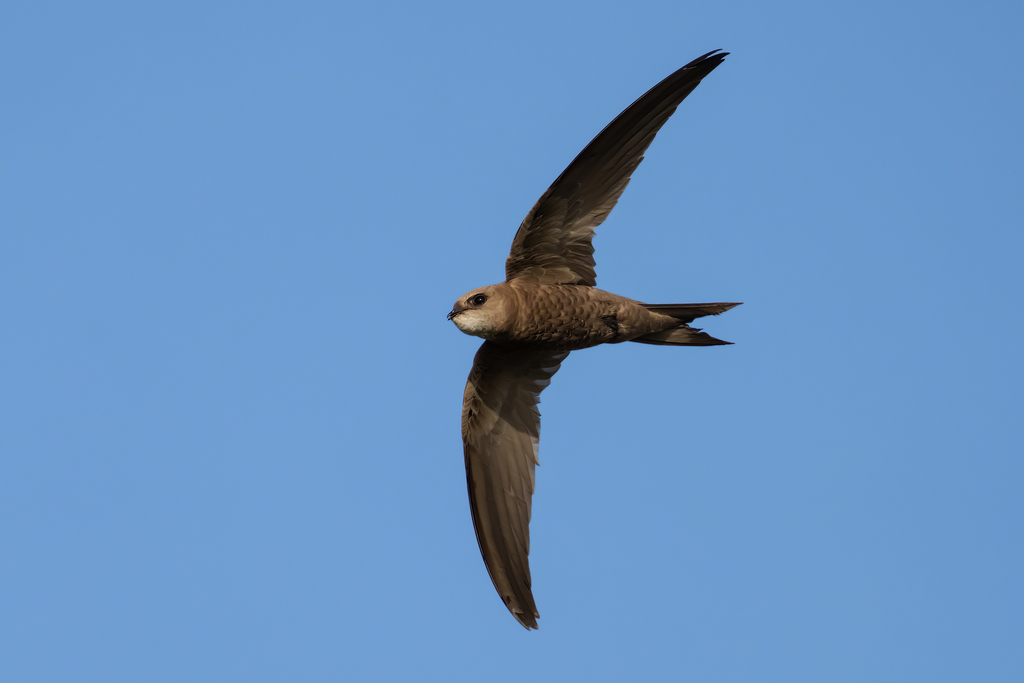
This 16–17 cm (6.3–6.7 in) long species is very similar to the common swift, and separation is only possible with good views. Like its relative, it has a short forked tail and very long swept-back wings that resemble a crescent or a boomerang. It is entirely dark except for a large white throat patch which is frequently visible from a distance. It is chunkier and browner than common swift, and the slightly paler flight feathers, underparts and rump give more contrast than that species. It also has a scalier looking belly and subtly different flight action. The call is a loud dry scream similar to that of its relative, though possibly more disyllabic.
Range & habitat
Pallid swifts breed on cliffs and eaves around the Mediterranean and on the Canary Islands and Madeira, laying two eggs. They are rare north of their breeding areas, although they are likely to be under-recorded due to identification problems. Because of its more southerly range, pallid swift arrives earlier and leaves later than the closely related common swift, so particularly early or late swifts north of the normal range should be carefully observed.
Migration. Like swallows, they are migratory, wintering in southern Africa or southeast Asia. Pallid swifts that breed in Gibraltar have been tracked using GPS technology, and has shown them to have multiple African wintering grounds south of the Sahara at specific times of the year. One bird, tracked over two consecutive winters, showed remarkable fidelity to the areas visited in Africa between years. The study also supports previous findings of an airborne existence in swifts outside the breeding season, with two pallid swifts giving no indication of coming to land.
Wikipedia: “Distribution and habitat”
Listen
Looking for field recordings…
Where it lives
Recorded sightings
—
geo-referenced records in GBIF, from museums, herbaria and field observers.
Drag the globe to turn it. Dots are where records exist, not a range map; darker means more records.
In the stacks
Searching the stacks…
Every page naming Apus pallidus in the Biodiversity Heritage Library →
This page is assembled live from iNaturalist, GBIF, Wikipedia, the Source Library and the Internet Archive. It is not yet part of the hand-edited codex. iNaturalist taxon 6643.