On eBird ↗
House Swift
Live sightings near you, the range map, bar charts of when it is seen, and Macaulay Library photos and recordings.
House Swift
Apus nipalensis
The house swift (Apus nipalensis) is a species of swift in the family Apodidae. It is found in Japan, Nepal, and Southeast Asia. It is capable of flying long distances by alternately shutting off hemispheres of their brain in-flight. In May 2012, one was discovered in Ladner, British Columbia, the first known sighting in North America.
From the article House swift on Wikipedia (CC BY-SA), quoted section by section
Description
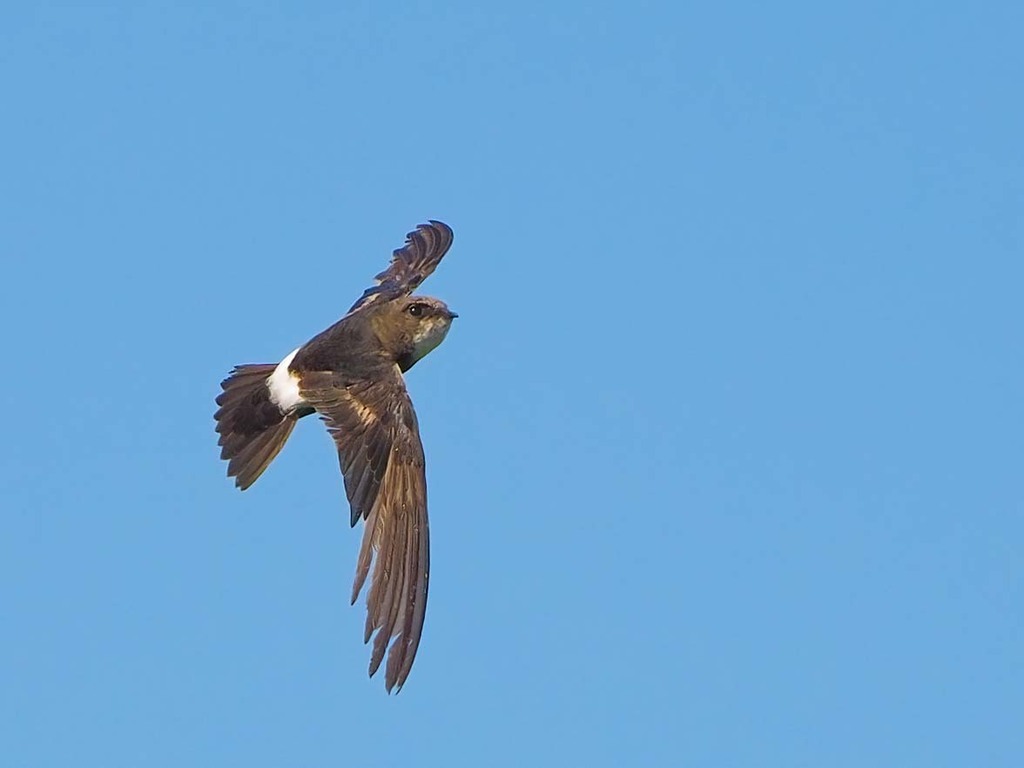
The house swift looks quite similar to the little swift. It is a small bird, but a medium-sized swift, with a wingspan of 12.5-14.5 cm. Its body size ranges from 14 to 16 cm and weighs approximately 20-35 g. This species has a dark, slightly forked tail. Other than the white rump band and white throat-patch, the house swift has a black plumage, darker than the little swift.
Range & habitat
The house swift is highly aerial, spending much of its time feeding in the air. The house swift is generally found on the Asian continent. Each subspecies has a slightly different distribution throughout the continent.
Apus nipalensis nipalensis occupy the area from Nepal to Southeastern China, Japan, and parts of Southeast Asia Apus nipalensis subfurcatus are in the Malay Peninsula and other islands in Southeast Asia. Apus nipalensis furcatus are on Java and Bali in Indonesia. Apus nipalensis kuntzi solely occupy the island of Taiwan. House swifts live both in urban and rural areas of Asia. They've been found from the mountainous regions of Nepal and in cities and towns in China, Vietnam, and Hong Kong. It has been found in North America only one time in 2012; it was identified as a house swift after DNA sequencing. However, this observation was unaccepted as the bird was dead when found.
Wikipedia: “Habitat and distribution”
What it does
House swifts have two main areas of nesting: in cliffs or in urban areas. When nesting in urban areas, this species tends to prefer under roof overhangs of buildings or in tunnels. Many nest in cliffs on offshore islands near Vietnam. House swifts build their nest using their saliva to messily stick together leaves, branches and feathers.
Reproduction. The house swift has one breeding period with, generally, two broods per year. The first egg-laying period takes three weeks. By early June, all fledglings from the first clutch have taken flight. A few weeks later, the second clutch hatches. The last fledglings leave the nest by mid-September. The clutch sizes can vary, ranging anywhere from one to five eggs. The incubation period can last anywhere from 20 to 30 days.
Diet. Like many swallows and swifts, house swifts eat in the air. They mainly feed on small organisms that are dispersed throughout the air. A fecal analysis discovered the house swift diet is almost solely from the arthropoda phylum. This primarily includes, but is not limited to, ants, spiders, mosquitos, and flies.
Vocalizations. House swifts make a ti-ti-ti-tititrrrrrr sound, among many others, as part of their vocal catalogues.
Wikipedia: “Behavior”
Listen
Looking for field recordings…
Where it lives
Recorded sightings
—
geo-referenced records in GBIF, from museums, herbaria and field observers.
Drag the globe to turn it. Dots are where records exist, not a range map; darker means more records.
In the stacks
Searching the stacks…
Every page naming Apus nipalensis in the Biodiversity Heritage Library →
This page is assembled live from iNaturalist, GBIF, Wikipedia, the Source Library and the Internet Archive. It is not yet part of the hand-edited codex. iNaturalist taxon 6633.