On eBird ↗
Little Swift
Live sightings near you, the range map, bar charts of when it is seen, and Macaulay Library photos and recordings.
Little Swift
Apus affinis
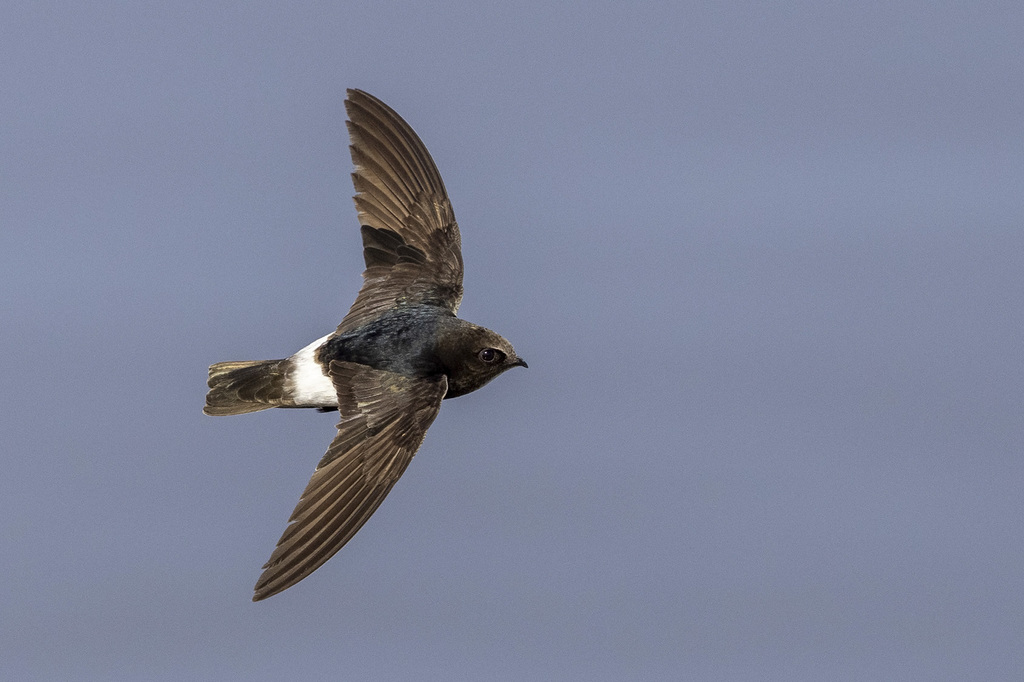
The little swift (Apus affinis) is a small species of swift found in Africa and southwestern Asia, and are vagrants and local breeders in southern Europe. They are found both in urban areas and at rocky cliffs where they build nests in a way typical of all members of the order Apodiformes. The genus name Apus is Latin for a swift, thought by the ancients to be a type of swallow without feet (from Ancient Greek α, a, "without", and πούς, pous, "foot"). The Latin specific affinis means similar to or related to, but in this case the species that the little swift supposedly resembles is not clear from the description. A population formerly considered to be an eastern subspecies of little swift is now separated as a distinct species, the house swift (Apus nipalensis).
From the article Little swift on Wikipedia (CC BY-SA), quoted section by section
Description
Little swifts are readily identified by their small size. Their wingspan is only 33 cm compared to 42 cm in the case of common swift. Their plumage is black except for a white throat and rump, the white rump patch extending onto the flanks. They have a short square tail, with all rectrices round-tipped. The flight is fluttering like that of a house martin, and the call is a high twittering. Like other swifts they are very short-legged. The legs are used for clinging to vertical surfaces only.
Listen
Looking for field recordings…
Where it lives
Recorded sightings
—
geo-referenced records in GBIF, from museums, herbaria and field observers.
Drag the globe to turn it. Dots are where records exist, not a range map; darker means more records.
In the stacks
Searching the stacks…
Every page naming Apus affinis in the Biodiversity Heritage Library →
This page is assembled live from iNaturalist, GBIF, Wikipedia, the Source Library and the Internet Archive. It is not yet part of the hand-edited codex. iNaturalist taxon 6612.