- Animals
- ›Chordates
- ›Vertebrates
- ›Reptiles
- ›Snakes and Lizards
- ›Lizards
- ›Geckos
- ›Typical Geckos
- ›Hemidactylus
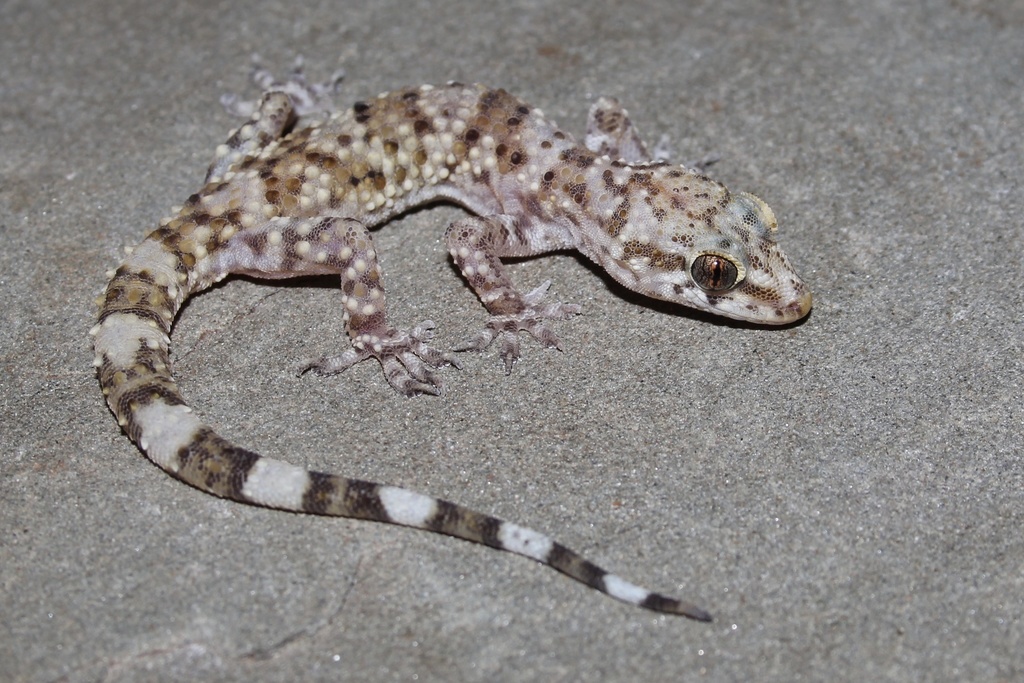
Mediterranean House Gecko
Hemidactylus turcicus
The Mediterranean house gecko (Hemidactylus turcicus) is a species of house gecko native to the Mediterranean region, from which it has spread to many parts of the world including parts of East Africa, South America, the Caribbean, and the Southern and Southeastern United States. It is commonly referred to as the Turkish gecko as represented in its Latin name and also as the moon lizard because it tends to emerge in the evening.
A study in Portugal found H. turcicus to be totally nocturnal, with its highest activity around 02:00. It is insectivorous, rarely exceeds 15 cm (5.9 in) in length, has large, lidless eyes with elliptical pupils, and purple or tan-colored skin with black spots, often with stripes on the tail. Its belly or undersides are somewhat translucent. What impact this gecko has on native wildlife in the regions to which it has been introduced is unknown.
From the article Mediterranean house gecko on Wikipedia (CC BY-SA), quoted section by section
Description
The Mediterranean gecko is a very small lizard generally measuring 10–13 cm (4–5 inches) in length, with sticky toe pads, vertical pupils, and large eyes that lack eyelids. Its snout is rounded, about as long as the distance between the eye and the ear opening, 1.25 to 1.3 times the diameter of the orbit; the forehead is slightly concave; the ear opening is oval, oblique, and nearly half the diameter of the eye. Body and limb sizes are moderate. The digits are variable in length, with the inner always well developed; 6 to 8 lamellae are under the inner digits, 8 to 10 are under the fourth finger, and 9 to 11 are under the fourth toe. The head has large granules anteriorly, but posteriorly has minute granules intermixed with round tubercles. The rostrum is four-sided, not twice as broad as deep, with amedial cleft above; the nostril is pierced between the rostrum, the first labial, and three nasals; it has 7 to 10 upper and 6 to 8 lower labials; the mental is large, triangular, and at least twice as long as the adjacent labials; its point is between two large chin-shields, which may be in contact behind it; a smaller chin shield on each side of the larger pair. …
Range & habitat
Native to the Mediterranean region, the "Med gecko" is one of the most successful species of geckos in the world. It has spread over much of the world and established stable populations far from its native range; it holds no threatened or endangered status. It can be found in countries with Mediterranean climates, such as Portugal, Spain, France, Italy, Greece, Israel, Malta, southern Bulgaria, North Macedonia, coastal Croatia (except western Istria), Bosnia and Herzegovina, the Adriatic islands, coastal Montenegro, the coastal part of Albania, Cyprus, Turkey, northern Morocco, Algeria, Tunisia, Jordan, Syria, Libya, Egypt, Lebanon, northern Yemen (the Socotra Archipelago), Somalia, Eritrea, Kenya, southern Iran, Iraq, Oman, Qatar, Saudi Arabia, Pakistan, India, the Balearic Islands (Island Addaya Grande), the Canary Islands (introduced to Gran Canaria and Tenerife), Panama, Puerto Rico, Belize, and Cuba. As of 1974, it was known from scattered records in the Southwestern United States, including Arizona, California, Nevada, and New Mexico and more extensively in the Southern United States, including Alabama, Arkansas, Florida, Georgia, Kansas, Kentucky, Louisiana, Maryland, Mississippi, Missouri, North Carolina, Oklahoma, South Carolina, Texas, and Virginia, being particularly well-established in Gulf Coast states in the east. …
Wikipedia: “Geographic distribution”
What it does
Mediterranean house geckos are nocturnal. They emit a distinctive, high-pitched call somewhat like a squeak or the chirp of a bird, possibly expressing a territorial message. Because of this aggressive behavior, juveniles avoid most interaction with adult geckos. They are voracious predators of moths and small roaches and are attracted to outdoor lights in search of these prey. Areas around outdoor lighting provide an opportunity for longer strike distances since there is often little structure in the adjacent area. They are also attracted by the call of a male decorated cricket (Gryllodes supplicans); although the males are usually safely out of reach in a burrow, female crickets attracted to the male's call can be intercepted and eaten.
Wikipedia: “Behavior”
Where it lives
Recorded sightings
—
geo-referenced records in GBIF, from museums, herbaria and field observers.
Drag the globe to turn it. Dots are where records exist, not a range map; darker means more records.
In the stacks
Searching the stacks…
Every page naming Hemidactylus turcicus in the Biodiversity Heritage Library →
This page is assembled live from iNaturalist, GBIF, Wikipedia, the Source Library and the Internet Archive. It is not yet part of the hand-edited codex. iNaturalist taxon 34435.