- Animals
- ›Chordates
- ›Vertebrates
- ›Ray-finned Fishes
- ›Spiny-rayed fishes
- ›Anglerfishes
- ›Batfishes
- ›Ogcocephalus
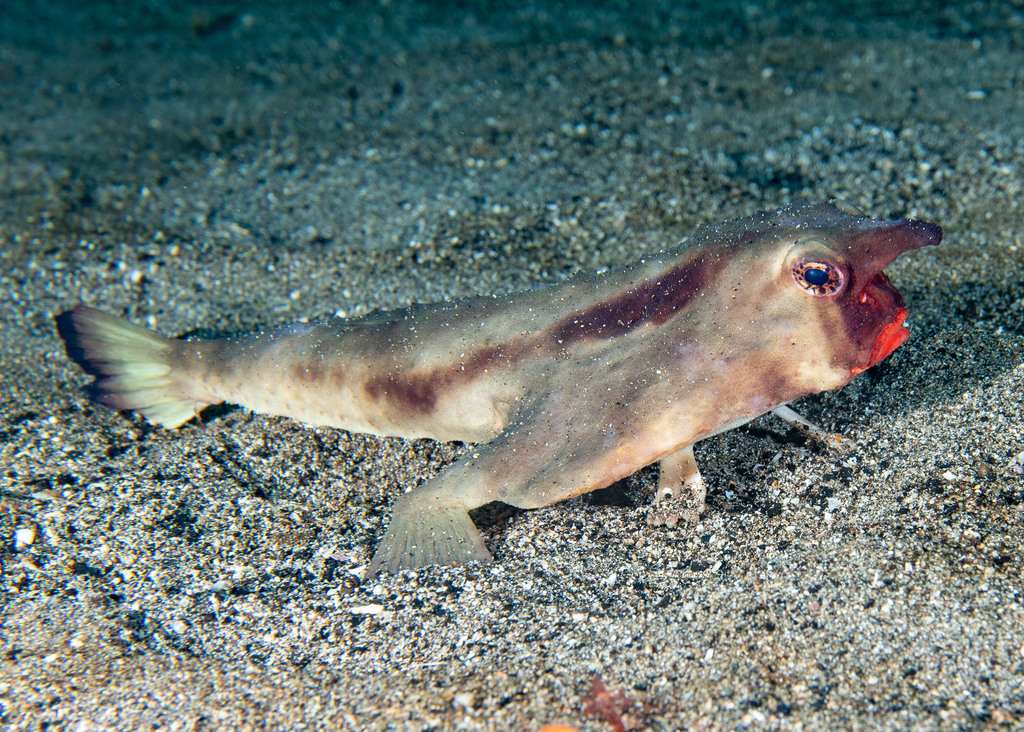
Red-lipped Batfish
Ogcocephalus darwini
The red-lipped batfish or Galápagos batfish (Ogcocephalus darwini) is a fish of unusual morphology found around the Galápagos Islands, Ecuador at depths of 3 to 76 m (10 to 249 ft). The red-lipped batfish is mainly known for its bright red lips. Batfish are not good swimmers; they use their highly adapted pectoral, pelvic and anal fins to "walk" on the ocean floor. When the batfish reaches maturity, its dorsal fin becomes a single spine-like projection (thought to function primarily as a lure for prey).
From the article Red-lipped batfish on Wikipedia (CC BY-SA), quoted section by section
Description
The red-lipped batfish reaches up to 40 centimetres (16 in) in length. Its body color is light brown and greyish on its back (though not very visible in sea), with white countershading on the underside. A dark brown stripe run on its back, from the head to the back to the tail. The snout and horn of the red-lipped batfish are brown. The color of the squamation of the red-lipped batfish is shagreen-like with a relatively smooth texture. The bucklers are concealed by a layer of fine spinules. As the vernacular name suggests, the batfish has bright, almost fluorescent, red lips, which allow to distinguish them from other batfish species. Marine biologists hypothesize that the lip coloration may enhance species recognition during spawning.
When compared to O. porrectus, the red-lipped batfish has a smaller disk size but a higher fibre pectoral fin ray count. Regarding the number of scales along the lateral line, there are four to nine subopercular scales, six to nine on the cheek, usually. The red-lipped batfish has 19 to 20 vertebrae. The large, lateral eyes provide a wide field of vision, allowing the fish to detect prey and predators effectively. …
Range & habitat
Red-lipped batfish can be found at depths of 3 to 76 m (10 to 250 ft) in the Pacific Ocean around the Galápagos Islands off Ecuador . Batfish are bottom dwellers, usually found in the sand or near the ocean floor. Although considered shallow-water forms, they occasionally come to the surface over deep water. They tend to associate themselves with the edges of reefs, up to about 120 m deep.
Wikipedia: “Habitat”
What it does
Red-lipped batfish are piscivores and invertivores and tend to be more active at night, mainly feeding on other small fish and small invertebrates including shrimp, crabs, worms and mollusks found on the seafloor. A specialised fin ray (illicium) extends outwards on top of the fish's head. At the tip of it is an esca emitting a bright light. In deep waters, this light lures the prey to the batfish's mouth. After the red-lipped batfish fully matures, its dorsal fin becomes a single spine-like projection, allowing the fish to lure prey near them. The red-lipped batfish uses suction feeding. By expanding its buccal cavity, the fish generates a rapid influx of water, letting the prey into the mouth, even in benthic environments where mobility is limited. The fish's specialized jaw protrusion plays a role in enhancing this process by increasing the volume of water into the mouth, improving the effectiveness of prey capture. Additionally, the batfish's suction feeding strategy aligns with observations across teleost fishes, which use this method to ambush and capture small, non-evasive prey such as shrimp and crabs. This adaptation is crucial, given the batfish's preference for walking along the ocean floor – rather than swimming actively – which typically hinders high-speed chases.
Wikipedia: “Diet and feeding strategies”
In human culture
The red-lipped batfish is a member of the genus Ogcocephalus (from Greek roots ogkos, "hook", and cephalus, "head"), an allusion to the pointed rostrum on the snout of the type species. The specific name refers to Charles Darwin, to mark the centenary of the publication of On the Origin of Species and to recognise the importance that the observations made on the Galápagos Islands had in developing the theory of island endemism.
Wikipedia: “Etymology”
Where it lives
Recorded sightings
—
geo-referenced records in GBIF, from museums, herbaria and field observers.
Drag the globe to turn it. Dots are where records exist, not a range map; darker means more records.
In the stacks
Searching the stacks…
Every page naming Ogcocephalus darwini in the Biodiversity Heritage Library →
This page is assembled live from iNaturalist, GBIF, Wikipedia, the Source Library and the Internet Archive. It is not yet part of the hand-edited codex. iNaturalist taxon 107415.