- Animals
- ›Chordates
- ›Vertebrates
- ›Ray-finned Fishes
- ›Spiny-rayed fishes
- ›Jacks, Flounders, Barracudas, and Allies
- ›Flatfishes
- ›Lefteye Flounders
- ›Bothus
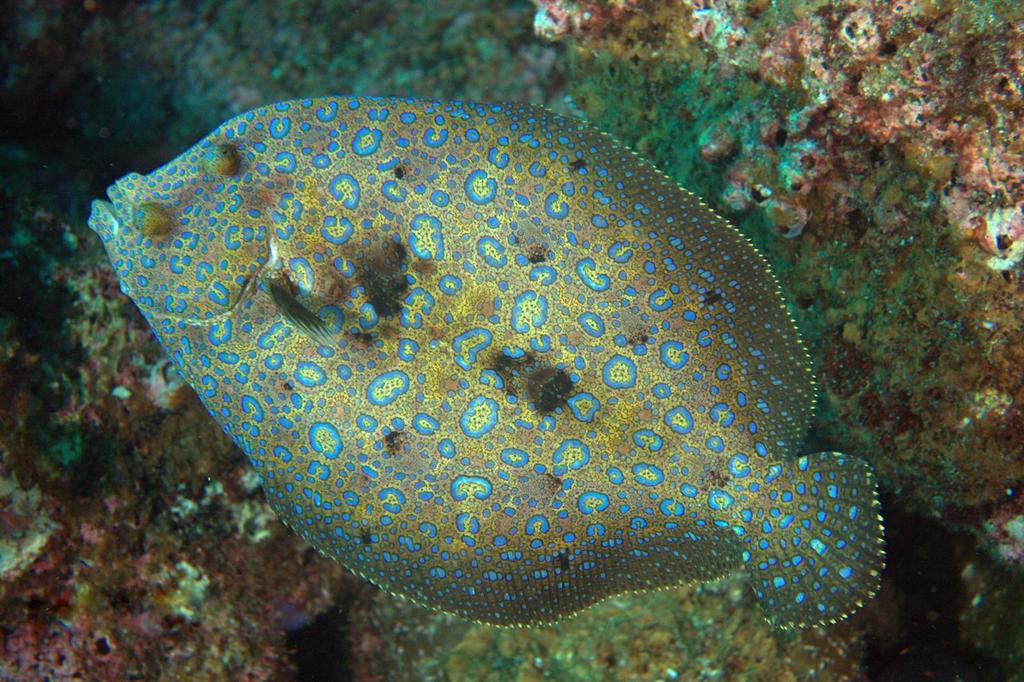
Pacific Peacock Flounder
Bothus mancus
The peacock flounder (Bothus mancus), also known as the flowery flounder, is a species of fish in the family Bothidae (lefteye flounders). The species is found widely in relatively shallow waters in the Indo-Pacific, also ranging into warmer parts of the east Pacific.
From the article Peacock flounder on Wikipedia (CC BY-SA), quoted section by section
Description
The peacock flounder is also called flowery flounder because it is covered in superficially flower-like bluish spots. As suggested by the family name, lefteye flounders have both eyes on top of the left hand side of their heads. The eyes are raised up on short stumps like radar dishes, and can move in any direction independent of each other. That feature provides flounders with a wide range of view. One eye can look forward while the other looks backward at the same time. The baby flounders have one eye on each side of their bodies like ordinary fish, and swim like other fishes do, but later on, as they undergo maturation to adulthood, the right eye moves to the left side, and flounders start to swim sideways, which gives them the ability to settle down flat on the bottom. The maximum length of this flounder is about 45 centimetres (18 in).
Range & habitat
Peacock flounders are mostly found in shallow water on sandy bottoms. Sometimes they rest over piles of dead corals or bare rock. They may be found as deep as 150 meters (490 ft).
Wikipedia: “Habitat”
What it does
As most flounders, the peacock flounder is mainly nocturnal, but is sometimes also active during the day. It hunts for small fish, crabs and shrimp.
Wikipedia: “Diet”
Where it lives
Recorded sightings
—
geo-referenced records in GBIF, from museums, herbaria and field observers.
Drag the globe to turn it. Dots are where records exist, not a range map; darker means more records.
In the stacks
Searching the stacks…
Every page naming Bothus mancus in the Biodiversity Heritage Library →
This page is assembled live from iNaturalist, GBIF, Wikipedia, the Source Library and the Internet Archive. It is not yet part of the hand-edited codex. iNaturalist taxon 95920.