- Animals
- ›Chordates
- ›Vertebrates
- ›Ray-finned Fishes
- ›Tarpons, Eels, and Allies
- ›True Eels
- ›Anguilloidei
- ›Freshwater Eels
- ›Anguilla
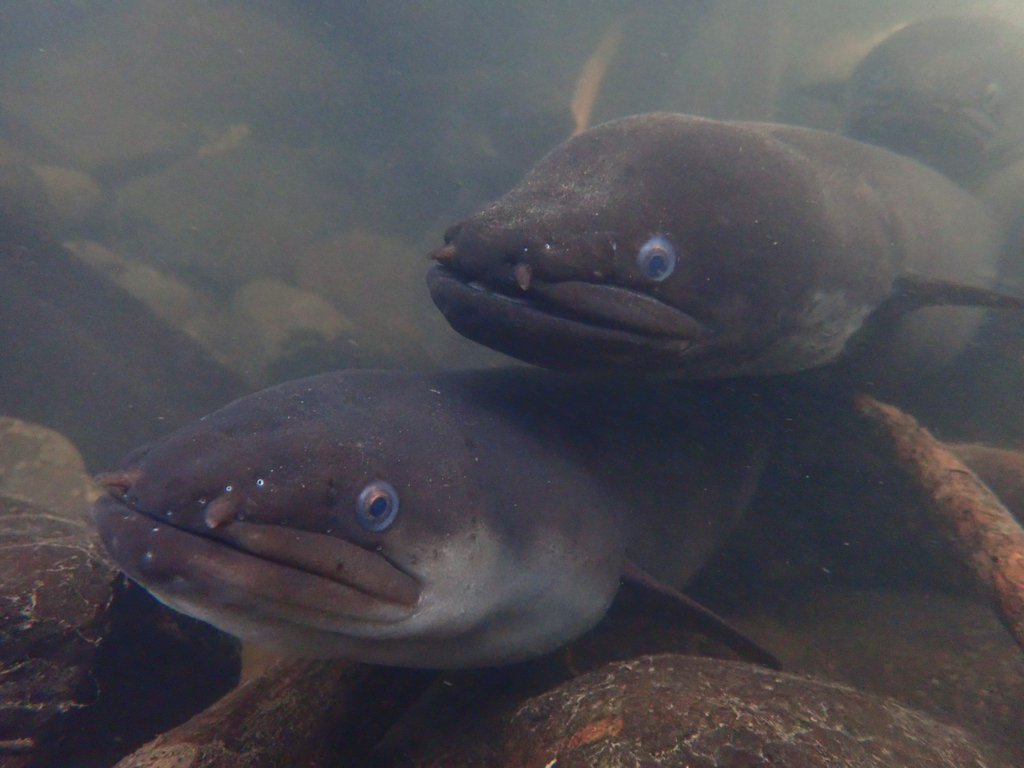
New Zealand Longfin Eel
Anguilla dieffenbachii
The New Zealand longfin eel (Anguilla dieffenbachii) is a species of freshwater eel that is endemic to New Zealand. It is the largest freshwater eel in New Zealand and the only endemic species – the other eels found in New Zealand are the native shortfin eel (Anguilla australis), also found in Australia, and the naturally introduced Australian longfin eel (Anguilla reinhardtii). Longfin eels are long-lived, migrating to an unknown site in the tropical Pacific Ocean to breed at the end of their lives. They are good climbers as juveniles and so are found in streams and lakes a long way inland. An important traditional food source for Māori (who name them ōrea), longfin eel numbers are declining and they are classified as endangered, but over one hundred tonnes are still commercially fished each year.
From the article New Zealand longfin eel on Wikipedia (CC BY-SA), quoted section by section
Description
The easiest way to identify the longfin eel is by the length of its fins: the dorsal (top) fin is about two-thirds the length of the body and starts significantly further towards the head than the anal (bottom) fin. In the shortfin eel the fins are of similar length. When a longfin eel bends its loose skin wrinkles distinctively inside each bend, where a shortfin eel's skin is smooth. A longfin's mouth extends past its eyes, further than a shortfin's. Female longfin eels are larger and longer-lived than males. Males average 66.6 cm but reach up to 73.5 cm in length, with an average age of 23 years (12–35 years). Females are considerably larger, ranging from 73 to 156 cm with an average length of 115 cm. Females attain an age of 20 to 60 years before migrating to sea to breed. Longfin eels in the North Island migrate at a younger age and thus have faster generation times. Determining longfin sex is difficult as their sexual organs are not determined until they are over 45 cm in length. The only method to determine longfin eels sex is through internal examination and it only becomes easy to distinguish when the eels mature and migrate.
Range & habitat
Anguilla dieffenbachii is endemic species to New Zealand, widely distributed through the country's lakes and rivers, including the Chatham Islands. Longfin eels are often found great distances inland (up to 361 km) along fresh waterways and in high country lakes which are connected to the sea. Aiding in their inland distribution is their climbing ability in elver (juvenile) stage, under 12 cm in length. These migration events frequently coincide with increased temperate, water flow and low light conditions. At this size the elvers can travel up to 130 km inland over a summer, and have been observed climbing near-vertical surfaces up to 43 m tall. This feat is accomplished through a combination of surface tension (with the water) and friction. Where in a waterway longfin eels live depends on their life stage. As juveniles, they prefer shallow water (under 0.5 m deep) with coarse substratum and faster than average stream flow (such as that found in riffles). Adult longfin eels tend to be found next to or under large pieces of debris and undercut river banks.
Wikipedia: “Habitat and distribution”
What it does
Like other members of the Anguillidae, longfin eels have a rather unusual life cycle: they grow and mature into fertile adults in fresh water, then migrate to the sea to breed. This catadromous breeding system also ensures randomised mating, creating a panmictic population. The New Zealand longfin eel is a very long-lived fish, with records of females reaching 106 years old and weighing up to 24 kg. They have the slowest growth rate of any eel species studied, just 1–2 centimetres a year.
Longfin eels life cycle like other species of Anguillidae eels is rather complex consisting of four distinct life stages which remained a mystery for many decades and still is not fully understood. New Zealand longfins breed only once at the end of their lives, making a journey of thousands of kilometres from New Zealand to their spawning grounds in the western South Pacific, possibly in the South Fiji basin. Although the spawning location of this species has often been stated as "near Tonga" or "east of Tonga", this was based on an analogy with the latitude of Atlantic eel spawning; no larval A. dieffenbachii have ever been observed, so the spawning location remains unknown. Their eggs (of which each female eel produces between 1 and 20 million) are fertilised in deep tropical water. …
Wikipedia: “Life cycle”
In human culture
There have been a number of attempts at aquaculture of longfin eels. The first were in the 1970s, and did not remain operational for long, with the last farm closing in 1982. The most common reasons for these failures were economic (the high cost of production vs low price for the eels), variable recruitment of glass eels, and the high mortality (death) rates in the farms. Since the early 2000s, there has been renewed interest in the aquaculture of longfins due to the increasing knowledge of their biology and the diminishing stocks of European eels (Anguilla anguilla), but no farms have been built.
Wikipedia: “Aquaculture”
Where it lives
Recorded sightings
—
geo-referenced records in GBIF, from museums, herbaria and field observers.
Drag the globe to turn it. Dots are where records exist, not a range map; darker means more records.
In the stacks
Searching the stacks…
Every page naming Anguilla dieffenbachii in the Biodiversity Heritage Library →
This page is assembled live from iNaturalist, GBIF, Wikipedia, the Source Library and the Internet Archive. It is not yet part of the hand-edited codex. iNaturalist taxon 123760.