- Animals
- ›Chordates
- ›Vertebrates
- ›Ray-finned Fishes
- ›Spiny-rayed fishes
- ›Jacks, Flounders, Barracudas, and Allies
- ›Jacks, Remoras, and Allies
- ›Jacks
- ›Naucratinae
- ›Elagatis
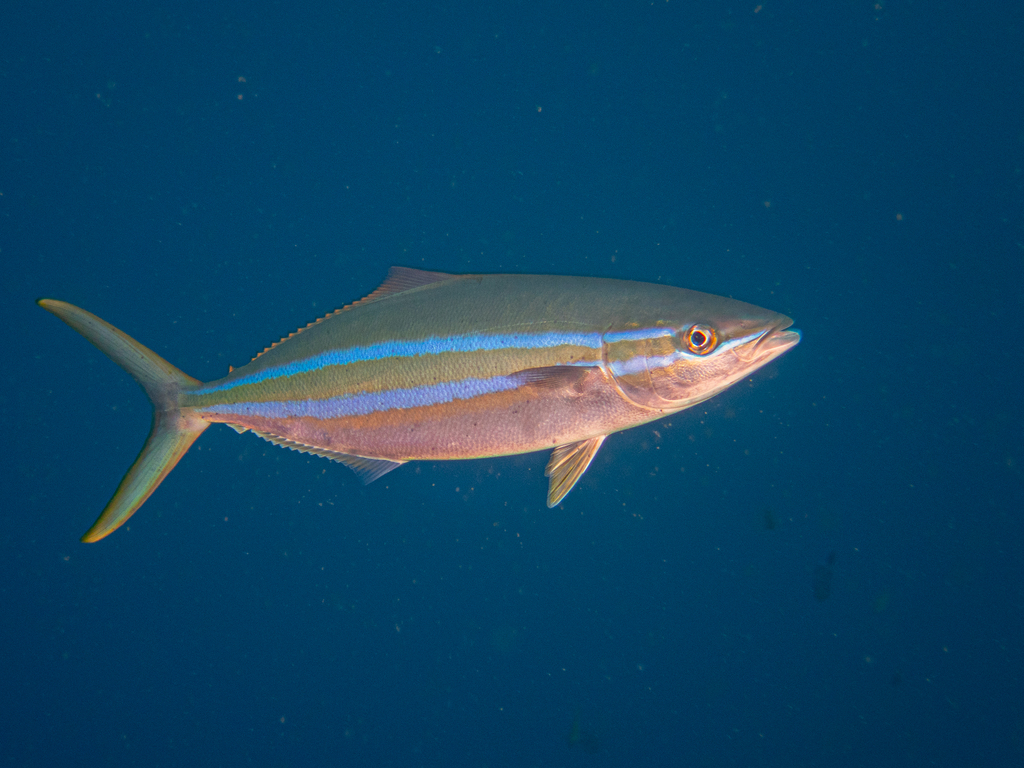
Rainbow Runner
Elagatis bipinnulata
The rainbow runner (Elagatis bipinnulata), also known as the rainbow yellowtail, Spanish jack and Hawaiian salmon, is a common species of pelagic marine fish of the jack family, Carangidae. The species is widespread throughout the tropical and subtropical waters of the world, inhabiting both coastal and offshore areas. The species is the only member of the genus Elagatis, which was created 15 years after its initial description, and is closely related to the amberjacks. The rainbow runner is easily distinguished by its body shape, and the brilliant colouration which gives the fish its name. It is a fast-swimming predator, taking small fish, cephalopods, and a wide variety of planktonic crustaceans. The species reaches sexual maturity around 60 cm (24 in), and spawning takes place at different times, with some populations spawning year round, while others only spawn at certain times of the year. The species is a well known game fish, taken by a variety of fishing methods, and is a well-regarded table fish. Large numbers of the species are taken as bycatch in tuna- and shark-fishing operations and marketed.
From the article Rainbow runner on Wikipedia (CC BY-SA), quoted section by section
Description
The rainbow runner's body is atypical of the jack family, which generally have deep, compressed bodies. The rainbow runner has a subcylindrical, elongated to almost fusiform body, with a long, pointed head and snout and a tapering rear end before the caudal fin emerges. The eyes are relatively small and the teeth are arranged on jaws in villiform bands, with minute teeth also present on the roof of the mouth and tongue. The fish has two dorsal fins, although the posterior rays of the long second fin have separated into a finlet. The first dorsal consists of six spines, the second of a single spine and 25 to 30 soft rays, with the last two as a separate finlet. About 4% of rainbow runners have only five spines in the first dorsal fin, and are apparently born without them. The anal fin consists of one spine detached from the fin anteriorally, while the main fin has a single spine and 18 to 22 soft rays, with the last two detached to form a finlet like the dorsal fin. The dorsal and anal fins are quite low, and the dorsal fin is much longer than the anal. The pectoral fin is small for a carangid, about the length of the pelvic fin and is not falcate, with 20 rays. The pelvic fin consists of one spine and five branched soft rays. The caudal fin is also highly diagnostic, being deeply forked and consisting of 17 caudal rays, 9 dorsally and 8 ventrally. …
Range & habitat
The rainbow runner has a circumtropical distribution, inhabiting tropical and some subtropical waters worldwide. In the Western Atlantic, the species occurs from Massachusetts and Bermuda to northeastern Brazil, including the northern and southern Gulf of Mexico, the Bahamas, and the Greater and Lesser Antilles, extending east to at least the Azores. The species is widespread throughout the Pacific Ocean, but appears to be slightly less abundant in parts of the Indian Ocean, and rare or absent in the Persian Gulf. The species is an occasional visitor to the Mediterranean Sea, generally as a Lessepsian immigrant through the Suez Canal, but has not taken up permanent residence like other species. The species also inhabits the nearby Canary Islands, possibly entering the Mediterranean from the east, also. The species is primarily pelagic, inhabiting the upper 164 m of the water column, sometimes close to land over rock and coral reef systems, as well as far offshore. The species occasionally comes quite close to shore, known to inhabits lagoons for short periods, and juveniles have even been reported in a Taiwanese estuary system. Rainbow runners, like other carangids such as yellowtail kingfish, are easily attracted to special fish-attracting devices (FADs), floating buoy-type structures. …
Wikipedia: “Distribution and habitat”
What it does
Rainbow runners are fast-swimming carnivores that take a wide range of prey, including a wide variety of small fishes, cephalopods, and pelagic or planktonic crustaceans, including, shrimp and crabs. The species shows selectivity of its prey, with fish in the Pacific Ocean taking higher numbers of Decapterus macarellus, a small fish, than any other prey available. Rainbow runners may increase their swimming and prey-searching abilities rapidly with their growth, becoming more efficient at finding their preferred prey items. Rainbow runners are also one of a number of pelagic fishes that prey on open-ocean species of sea-skaters (Halobates spp.), a type of insects which rest on the surface of the ocean. Rainbow runner themselves are important prey items for a number of larger species, with positively identified predators being Fraser's dolphin (Lagenodelphis hosei), and a number of seabirds of the family Laridae.
Wikipedia: “Diet”
Where it lives
Recorded sightings
—
geo-referenced records in GBIF, from museums, herbaria and field observers.
Drag the globe to turn it. Dots are where records exist, not a range map; darker means more records.
In the stacks
Searching the stacks…
Every page naming Elagatis bipinnulata in the Biodiversity Heritage Library →
This page is assembled live from iNaturalist, GBIF, Wikipedia, the Source Library and the Internet Archive. It is not yet part of the hand-edited codex. iNaturalist taxon 122033.