- Animals
- ›Chordates
- ›Vertebrates
- ›Ray-finned Fishes
- ›Spiny-rayed fishes
- ›Butterflyfishes, Angelfishes, and Allies
- ›Emperor Breams
- ›Monotaxinae
- ›Monotaxis
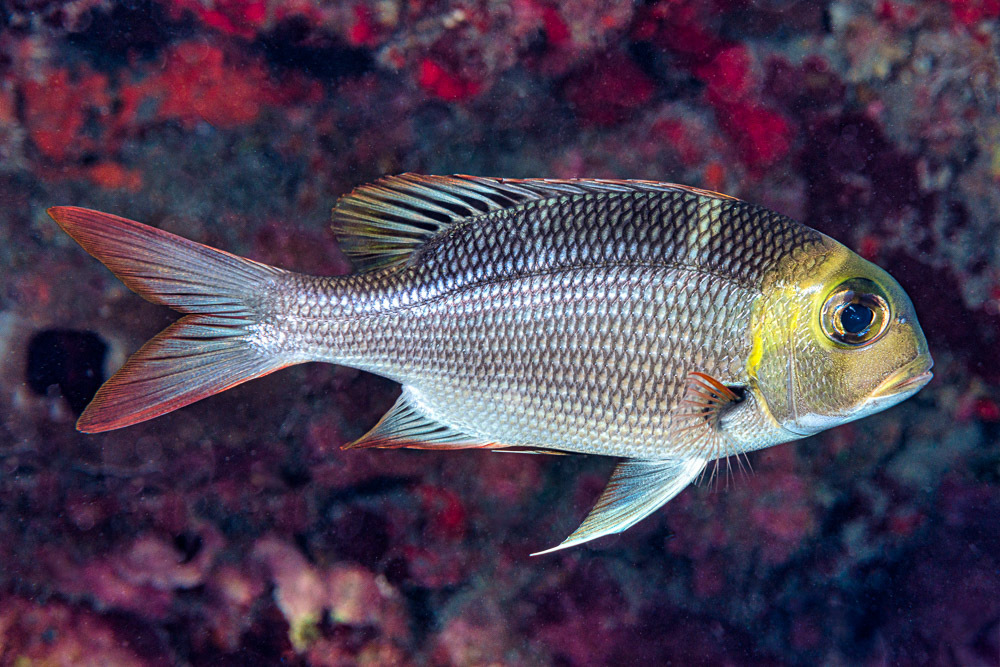
Humpnose Bigeye Bream
Monotaxis grandoculis
Monotaxis grandoculis, the Humpnose big-eye bream, is a species of emperor native to the Indian Ocean and the Pacific Ocean to the Hawaiian Islands. It inhabits areas with sand or rubble substrates adjacent to coral reefs at depths of from 1 to 100 metres (3.3 to 328.1 ft), mostly between 5 to 30 metres (16 to 98 ft). This species can reach a length of 60 centimetres (24 in) TL though most do not exceed 40 centimetres (16 in). It...
From the article Monotaxis grandoculis on Wikipedia (CC BY-SA), quoted section by section
Description
This species has a maximum published total length of 60 cm (24 in), although 40 cm (16 in) is more typical, and the maximum published weight is 5.9 kg (13 lb).
Monotaxis granoculis has an oblong body has a depth 2.1—2.7 times its standard length. The dorsal profile of the head creates a clear hump in front of the eyes with a steeply sloping snout below the hump. It has large eyes with a diameter roughly equal to the length of the snout. The rear margin of the preoperculum is finely serrated. There are canine-like teeth in the front of each jaw and these give way to small in the front of the sides of the jaws and with molar-like teeth in the back of the jaws. The dorsal fin has 10 spines and 10 soft rays while the anal fin has 3 spines and 9 soft rays. Its overall colour is silvery-greyish with thin dark margins on each scale and a large black blotch on the axil of the pectoral fin. It ordinarily has 3-4 black vertical bands divided by thinner white bands on the back. Juveniles have 3 wide dark brown to black bars, resembling saddles, on the body, with the two rear bars extending onto the dorsal fin. They have a black bar running through the eyes and a reddish band along the outer part of the lobes of the caudal fin.
Range & habitat
Monotaxis grandoculis has a wide Indo-Pacific distribution, from the Red Sea and the coast of eastern Africa to as far south as South Africa, across the Indian Ocean, although it is absent from the Persian Gulf. In the Pacific Ocean it extends as far east as the Hawaiian Islands, north to southern Japan and south to Australia. In Australia it is found at Christmas Island and the Cocos (Keeling) Islands and from Ningaloo Reef, Rowley Shoals and Scott Reef off Western Australia north to northeast of Evans Shoal in the Timor Sea and from the northern Great Barrier Reef south to Seal Rocks, New South Wales, with juveniles reaching as far south as Sydney. This fish lives close to reefs in sand and rubble areas at depths between 3 and 150 m (9.8 and 492.1 ft).
Wikipedia: “Distribution and habitat”
In human culture
Monotaxis grandoculis has the specific name grandoculis, referring to its large eyes. Likewise, the common name large-eye bream does. The name is also used for the family Lethrinidae as a whole.
Wikipedia: “Etymology”
Where it lives
Recorded sightings
—
geo-referenced records in GBIF, from museums, herbaria and field observers.
Drag the globe to turn it. Dots are where records exist, not a range map; darker means more records.
In the stacks
Searching the stacks…
Every page naming Monotaxis grandoculis in the Biodiversity Heritage Library →
This page is assembled live from iNaturalist, GBIF, Wikipedia, the Source Library and the Internet Archive. It is not yet part of the hand-edited codex. iNaturalist taxon 117459.