 NL·0255
Herbarium of the Nature Library
- Name
- Amia calva
- Family
- Amiidae
- Native to
- Atlantic and Gulf coastal plain of the south-eastern United States (since 2022 the northern and inland bowfins are a separate species, A. ocellicauda)
- Habitat
- Swamps, Slow rivers, Vegetated lakes, Bayous
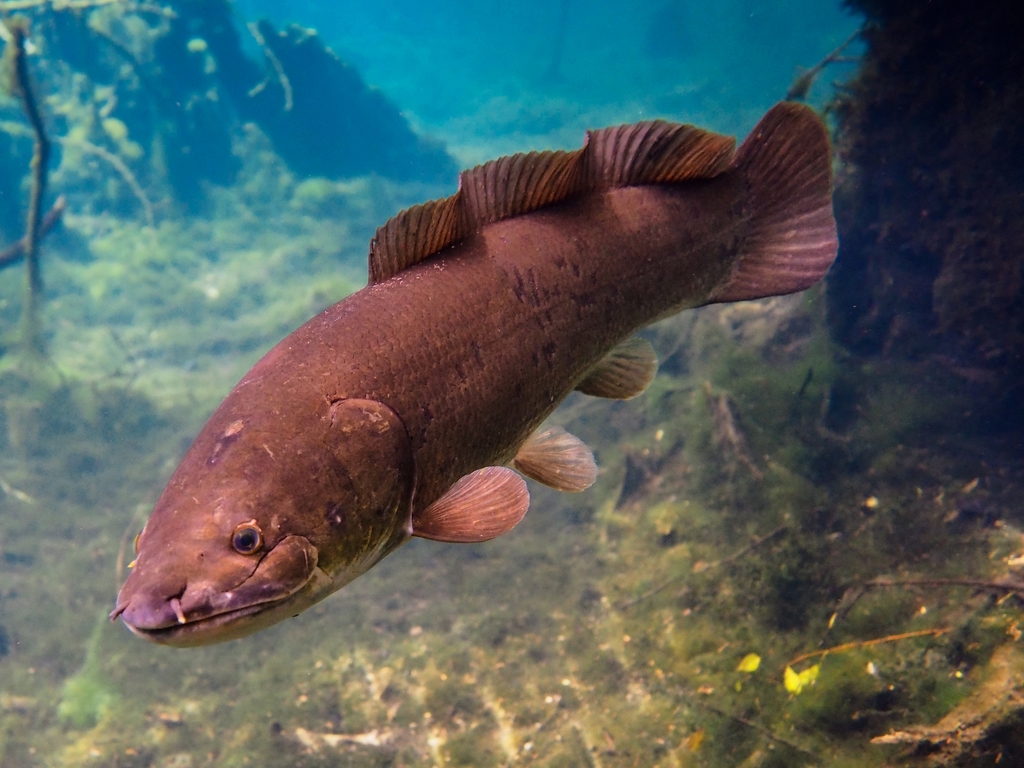
Ruddy bowfin
Amia calva
Also calledBowfin · Choupique (Cajun French) · Mudfish · Grinnel · Dogfish (southern US)
A living fossil from the age of dinosaurs and one of only two surviving species in an order otherwise known from Jurassic and Cretaceous fossils. It can gulp air and lie up in swamp mud, and fathers guard their young fiercely.
The ruddy bowfin is a ray-finned fish native to North America. Common names include mudfish, mud pike, dogfish, grindle, grinnel, swamp trout, and choupique. It is regarded as a relict, being one of only two surviving species of the Halecomorphi, a group of fish that first appeared during the Early Triassic, around 250 million years ago. The bowfin is often considered a "living fossil" because it has retained some morphological characteristics of its early ancestors. It is one of two species in the genus Amia, along with Amia ocellicauda, the eyespot bowfin. The closest living relatives of bowfins are gars, with the two groups being united in the clade Holostei. Wikipedia
What it can do
- iBreathes air through a lung-like swim bladder, so it survives warm, stagnant swamps
- iiCan survive in burrows in drying mud
- iiiMales clear nests, then herd and guard a black ball of fry for weeks
- ivIts order, Amiiformes, dates back to the Jurassic
In the field
Field marks
- aLong, cylindrical body with a very long, wavy dorsal fin running along most of the back
- bBony gular plate between the lower jaws
- cBlack eyespot at the upper tail base, ringed in orange in males
- dShort anal fin; rounded tail; tubular nostrils
- eBreeding males with bright green fins and belly
- Not to be confused with
- Eyetail bowfin (Amia ocellicauda) is almost identical and is separated mainly by range and genetics. Northern snakehead (Channa argus, introduced) has a long anal fin, no gular plate and a scaled head. Burbot has a chin barbel and two dorsal fins.
- Where to see it
- Okefenokee Swamp (Georgia); Florida's St. Johns River; blackwater rivers of the Carolina and Georgia coastal plain
- When
- Resident; spawns in spring (March–May in the south)
Life & habits
- Diet
- Carnivore: fish, crayfish, frogs, insects and other prey
- Habitat
- Swamps, bayous, sloughs and weedy, slow waters
- Size
- Commonly 45–60 cm; up to about 1.1 m
- Lifespan
- Usually 10–12 years; up to about 30
Hunts at night among weeds. In spring the male builds a circular nest in vegetation, attracts females, and then guards eggs and the swarm of fry.
Where it lives
Recorded sightings
—
geo-referenced records in GBIF, from museums, herbaria and field observers.
Native range
Atlantic and Gulf coastal plain of the south-eastern United States (since 2022 the northern and inland bowfins are a separate species, A. ocellicauda)
Drag the globe to turn it. Dots are where records exist, not a range map; darker means more records.
In the old herbals & bestiaries
Woodcuts and engravings matched from the Source Library’s scanned books by name. Plates marked “relative” show a close kin rather than this exact species. Click a plate to read the page it came from, with translation.

In the stacks
Searching the stacks…
Every page naming Amia calva in the Biodiversity Heritage Library →
Marginalia
In Louisiana, bowfins have been sold as choupique (from a Choctaw word) as a cheap food fish for generations. When the Caspian caviar trade collapsed, bowfin roe became a domestic caviar substitute.
Curiosity
The bowfin's order has fossils on several continents, but today only the two North American bowfin species survive.
Kinship

Fact-checked: 1 correction made to this sheet. Photographs: iNaturalist contributors under the licences shown. Records: GBIF.org. Historical plates: Source Library (CC BY-SA 4.0; originals public domain). Summary text: Nature Library editors and Wikipedia (CC BY-SA). Medicinal and edibility notes are historical and educational, not advice. iNaturalist taxon 58611.