On eBird ↗
American Herring Gull
Live sightings near you, the range map, bar charts of when it is seen, and Macaulay Library photos and recordings.
American Herring Gull
Larus smithsonianus
The American herring gull (Larus smithsonianus or Larus argentatus smithsonianus), also known as the Arctic herring gull or Smithsonian gull, is a large gull that breeds in North America, where it is treated by the American Ornithological Society as distinct from the European herring gull (Larus argentatus).
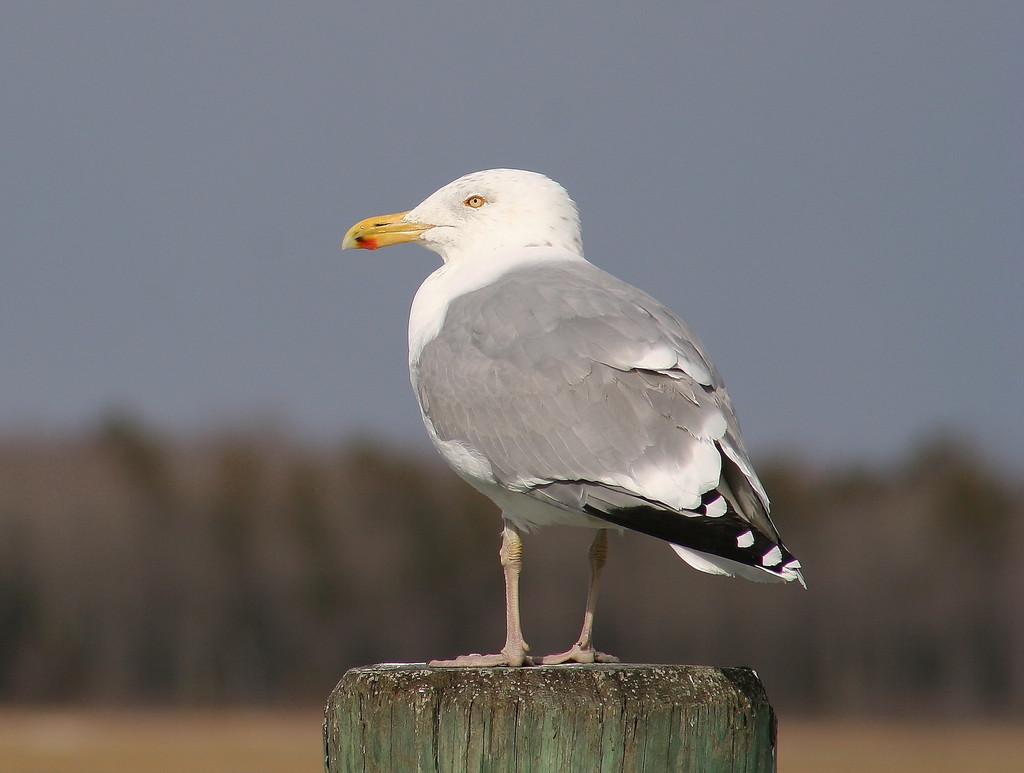
Adults are white with gray back and wings, black wingtips with white spots, and pink legs. Immature birds are gray-brown and are darker and more uniform than European herring gulls, with a darker tail. As is common with other gulls, they are colloquially referred to simply as seagulls.
From the article American herring gull on Wikipedia (CC BY-SA), quoted section by section
Description
The herring gull is a heavily built large gull with a long powerful bill, full chest and sloping forehead. Males are 60–66 cm (24–26 in) long and weigh 1,050–1,650 g (2.31–3.64 lb). Females are 53–62 cm (21–24 in) long and weigh 600–900 g (1.3–2.0 lb). The wingspan is 120 to 155 cm (47 to 61 in). Among standard measurements, the wing chord is 41.2 to 46.8 cm (16.2 to 18.4 in), the bill is 4.4 to 6.2 cm (1.7 to 2.4 in) and the tarsus is 5.5 to 7.6 cm (2.2 to 3.0 in). Breeding adults have a white head, rump, tail, and underparts and a pale gray back and upperwings. The wingtips are black with white spots known as "mirrors" and the trailing edge of the wing is white. The underwing is grayish with dark tips to the outer primary feathers. The legs and feet are normally pink but can have a bluish tinge, or occasionally be yellow. The bill is yellow with a red spot on the lower mandible. The eye is bright, pale to medium yellow, with a bare yellow or orange ring around it. In winter, the head and neck are streaked with brown.
Young birds take four years to reach fully adult plumage. During this time they go through several plumage stages and can be very variable in appearance. First-winter birds are gray-brown with a dark tail, a brown rump with dark bars, dark outer primaries and pale inner primaries, dark eyes, and a dark bill, which usually develops a paler base through the winter. …
Range & habitat
The breeding range extends across the northern part of North America from central and southern Alaska to the Great Lakes and the northeast coast of the United States from Maine south to North Carolina. It breeds over most of Canada apart from the southwest and Arctic regions. Birds are present all year in southern Alaska, the Great Lakes, and the north-east USA, but most birds winter to the south of the breeding range as far as Mexico with small numbers reaching Hawaii, Central America and the West Indies. Vagrants have reached Colombia and Venezuela and there is a report from Ecuador and another from Peru. The first European record was of a bird ringed in New Brunswick which was caught on a boat in Spanish waters in 1937 and there have been a number of additional records from Western Europe since 1990. The first British record was in 1994 in Cheshire. It usually nests in colonies near water on coasts, islands, and cliffs. It also nests on rooftops in some cities. It feeds at sea and on beaches, mudflats, lakes, rivers, fields, and refuse dumps. It roosts in open areas close to feeding sites.
Wikipedia: “Distribution and habitat”
What it does
It has a varied diet, including marine invertebrates such as mussels, crabs, sea urchins, and squid; fish such as capelin, alewife, and smelt; insects; and other birds including their chicks and eggs. It often feeds on carrion and human refuse. Food is plucked from the surface of the shore or sea or is caught by dipping underwater or by shallow plunge-diving. They also feed on clams and mussels by dropping them from a height on hard surfaces such as roads or rocks to break their shells. There is some question about whether this behavior is learned or innate, although it seems to be learned.
Wikipedia: “Feeding”
Listen
Looking for field recordings…
Where it lives
Recorded sightings
—
geo-referenced records in GBIF, from museums, herbaria and field observers.
Drag the globe to turn it. Dots are where records exist, not a range map; darker means more records.
In the stacks
Searching the stacks…
Every page naming Larus smithsonianus in the Biodiversity Heritage Library →
This page is assembled live from iNaturalist, GBIF, Wikipedia, the Source Library and the Internet Archive. It is not yet part of the hand-edited codex. iNaturalist taxon 1578489.