- Plants
- ›Vascular Plants
- ›flowering plants
- ›Dicots
- ›Sunflowers, Bellflowers, Fanflowers, and Allies
- ›Sunflowers, Daisies, Asters, and Allies
- ›Asteroideae
- ›groundsels and allies
- ›Tussilagininae
- ›Tussilago
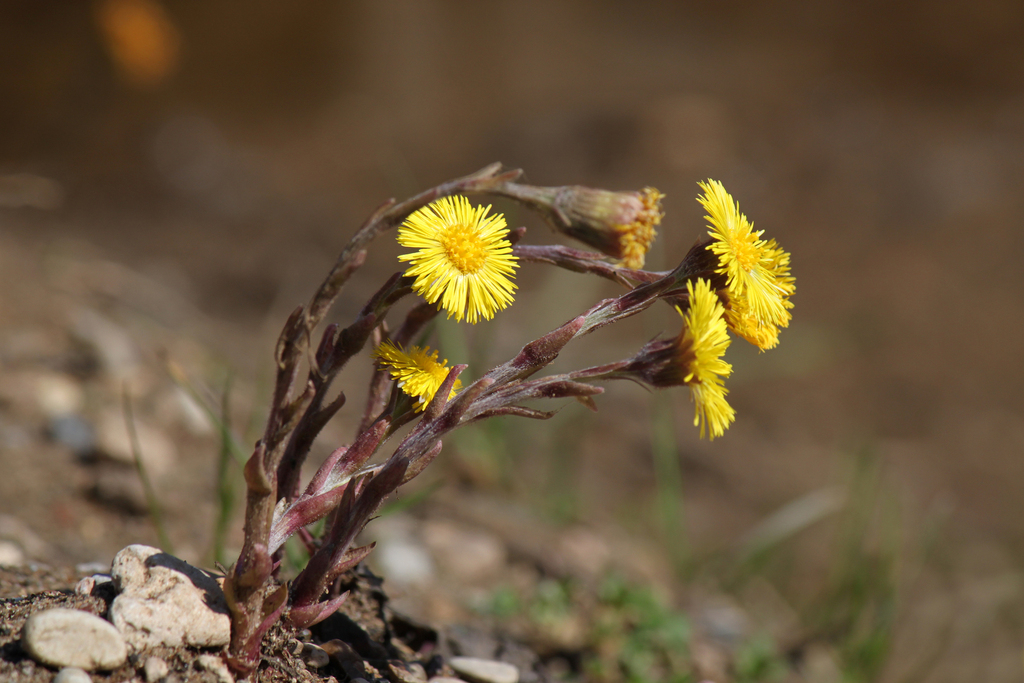
colt's-foot
Tussilago farfara
Tussilago farfara, commonly known as coltsfoot, is a plant in the tribe Senecioneae in the family Asteraceae, native to Europe and parts of western and central Asia. The name "tussilago" is derived from the Latin tussis, meaning cough, and ago, meaning to cast or to act on. It has had uses in traditional medicine, but the discovery of toxic pyrrolizidine alkaloids in the plant has resulted in liver health concerns.
Tussilago farfara is the only accepted species in the genus Tussilago, although more than two dozen other species have at one time or another been considered part of this group. Most of them are now regarded as members of other genera (Chaptalia, Chevreulia, Farfugium, Homogyne, Leibnitzia, Petasites, Senecio).
From the article Tussilago on Wikipedia (CC BY-SA), quoted section by section
Description
Coltsfoot is a perennial herbaceous plant that spreads by seeds and rhizomes. Tussilago is often found in colonies of dozens of plants. The flowers, which superficially resemble dandelions, bear scale-leaves on the long stems in early spring. The leaves of coltsfoot, which appear after the flowers have set seed, wither and die in the early summer. The flower heads are of yellow florets with an outer row of bracts. The plant is typically 5–15 cm (2.0–5.9 in) in height. The leaves have angular teeth on their margins.
Range & habitat
Coltsfoot is widespread across Europe, Asia, and North Africa, from Svalbard to Morocco and eastward to China and the Russian Far East. It is also a common plant in North and South America where it has been introduced, most likely by settlers as a medicinal item, or to provide early blooms for honeybees. The plant is often found in waste and disturbed places and along roadsides and paths. In some areas it is considered an invasive species.
Wikipedia: “Distribution”
At the table
Coltsfoot has been used in herbal medicine and has been consumed as a food product with some confectionery products, such as Coltsfoot Rock. Tussilago farfara leaves have been used in traditional Austrian medicine internally (as tea or syrup) or externally (directly applied) for treatment of disorders of the respiratory tract, skin, locomotor system, viral infections, flu, colds, fever, rheumatism and gout. An extract of the fresh leaves has also been used to make cough drops and hard candy. Coltsfoot is used as a food plant by the larvae of some Lepidoptera species including the Gothic and small angle shades. It is also visited by honeybees, providing pollen and nectar. At the Christian camp for boys Deerfoot Lodge in the Adirondacks, campers use Coltsfoot leaves as "Larry Leaf Bombs" to throw in a game of recreational naval warfare called "Naval Battle" encompasing the entire campsite.
Wikipedia: “Uses”
Toxicity
Tussilago farfara contains tumorigenic pyrrolizidine alkaloids. Senecionine and senkirkine, present in coltsfoot, have the highest mutagenetic activity of any pyrrolozidine alkaloid, tested using Drosophila melanogaster to produce a comparative genotoxicity test. Two cases of supposed liver damage (and death) due to coltsfoot tea have been shown to actually be the result of mistaken identity. In one, coltsfoot tea causing severe liver problems in an infant was actually the result of Adenostyles alliariae (alpendost). In another case, an infant developed liver disease and died because the mother drank tea originally believed to contain coltsfoot during her pregnancy, but which was later shown to be Petasites hybridus (butterbur) or a similar species. In one 27-year-old male, ingesting a multicomponent herbal supplement that included coltsfoot may have caused him to develop non-lethal deep vein thrombosis and pulmonary embolism. In response, the German government banned the sale of coltsfoot. Clonal plants of coltsfoot free of pyrrolizidine alkaloids were then developed in Austria and Germany. This has resulted in the development of the registered variety Tussilago farfara 'Wien', which has no detectable levels of these alkaloids.
Where it lives
Recorded sightings
—
geo-referenced records in GBIF, from museums, herbaria and field observers.
Drag the globe to turn it. Dots are where records exist, not a range map; darker means more records.
In the old herbals & bestiaries

The Book of Health: The Art of Distillation
Brunschwig, Hieronymus · 1505 · p.94

Living Images of Plants
Otto Brunfels · 1532 · p.48

On the Names of Plants
Hieronymus Bock (Tragus) · 1552 · p.490

Six Groups of the History of Plants
Rembert Dodoens · 1583 · p.607

Compendium of Materia Medica
李時珍 · 1596 · p.24

Illustrated Compendium of Materia Medica (Vol. 11)
吳其濬 · 1848 · p.78
In the stacks
Searching the stacks…
Every page naming Tussilago farfara in the Biodiversity Heritage Library →
This page is assembled live from iNaturalist, GBIF, Wikipedia, the Source Library and the Internet Archive. It is not yet part of the hand-edited codex. iNaturalist taxon 56222.