- Plants
- ›Vascular Plants
- ›flowering plants
- ›Dicots
- ›Legumes, Milkworts, and Allies
- ›Legumes
- ›Faboideae
- ›Peas, Vetches, and Allies
- ›Vicia
- ›Vicia
- ›Vicia
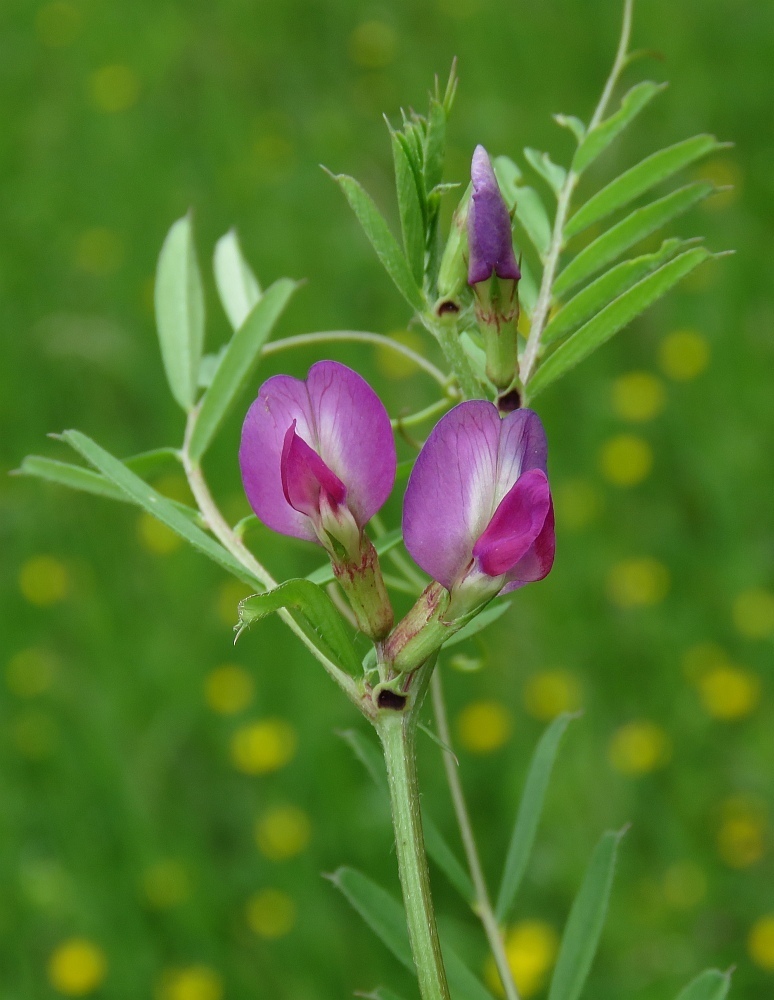
Common Vetch
Vicia sativa
Vicia sativa, known as the common vetch, garden vetch, tare or simply vetch, is a nitrogen-fixing leguminous plant in the family Fabaceae. It is now naturalised throughout the world, being absent only in Antarctica and the Arctic regions. The centre of diversity is thought to be the Fertile Crescent, although gold standard molecular confirmation is currently not available.
Global common vetch cultivation is limited due to anti-nutritional compounds in the seed although it is grown in dryland agricultural zones in Australia, China and Ethiopia due to its drought tolerance and very low nutrient requirements compared to other legumes. In these agricultural zones common vetch is grown as a green manure, livestock fodder or rotation crop. In cultivated grainfields, like lentils, it is often considered a weed due to downgrading of harvested mixed grain, resulting in farmers receiving less financial returns.
From the article Vicia sativa on Wikipedia (CC BY-SA), quoted section by section
Description
Vicia sativa is a sprawling annual herb, with hollow, four-sided, hairless to sparsely hairy stems which can reach two meters in maximum length. The leaves are stipulate, alternate and compound, each made up of 3–8 opposite pairs of linear, lance-shaped, oblong, or wedge-shaped, needle-tipped leaflets up to 35 millimeters (1+1⁄2 in) long. Each compound leaf ends in a branched tendril. The pea-like flowers occur in the leaf axils, solitary or in pairs. The flower corolla is 1–3 centimeters (1⁄2–1+1⁄4 in) long and bright pink-purple in colour, more rarely whitish or yellow. The flowers are mostly visited by bumblebees. The fruit is a legume pod up to 6 or 7 centimeters (2+1⁄4 or 2+3⁄4 in) long, which is hairy when new, smooth later, then brown or black when ripe. It contains 4–12 seeds.
How it is grown
Sown for fodder, the seed is sown densely, up to 250 kilograms per hectare (220 lb/acre). However, when grown for seed, less seed is used so that the crop is not too thick, which reduces flower and seed production. When meant for seed, sowing is done early in the planting season for good returns; but, when for green manure, any time in spring is suitable. Sometimes, a full crop can be obtained even when sown as late as summer, though sowing so late is not recommended. After the seed is sown and the land carefully harrowed, a light roller ought to be drawn across, to smooth the surface and permit the scythe to work without interruption. Also, the field should be watched for several days to prevent pigeons from eating too much of the sown seed. Horses thrive very well on common vetch, even better than on clover and rye grass; the same applies to fattening cattle, which feed faster on vetch than on most grasses or other edible plants. Danger often arises from livestock eating too much vetch, especially when podded; colics and other stomach disorders are apt to be produced by the excessive amounts devoured. Cereal grains can be sown with vetch so it can use their stronger stems for support, attaching via tendrils. When grown with oats or other grasses, the vetch can grow upright; otherwise its weak stems may sprawl along the ground. …
Wikipedia: “Cultivation”
In human culture
Common vetch has long been part of the human diet, as attested by carbonised remains found at early Neolithic sites in Syria, Turkey, Bulgaria, Hungary and Slovakia. It has also been reported from Predynastic sites of ancient Egypt, and several Bronze Age sites in Turkmenia and Slovakia. However, definite evidence for later vetch cultivation is available only for Roman times. Although V. sativa is sometimes known as tare, the "tare" referred to in some English translations of the Bible (as in the "Parable of the Tares") is thought to be darnel ryegrass, Lolium temulentum.
Wikipedia: “History”
Where it lives
Recorded sightings
—
geo-referenced records in GBIF, from museums, herbaria and field observers.
Drag the globe to turn it. Dots are where records exist, not a range map; darker means more records.
In the old herbals & bestiaries

In the stacks
Searching the stacks…
Every page naming Vicia sativa in the Biodiversity Heritage Library →
This page is assembled live from iNaturalist, GBIF, Wikipedia, the Source Library and the Internet Archive. It is not yet part of the hand-edited codex. iNaturalist taxon 53324.