- Plants
- ›Vascular Plants
- ›flowering plants
- ›Dicots
- ›Legumes, Milkworts, and Allies
- ›Legumes
- ›Faboideae
- ›Peas, Vetches, and Allies
- ›Vicia
- ›Vicia
- ›Vicia
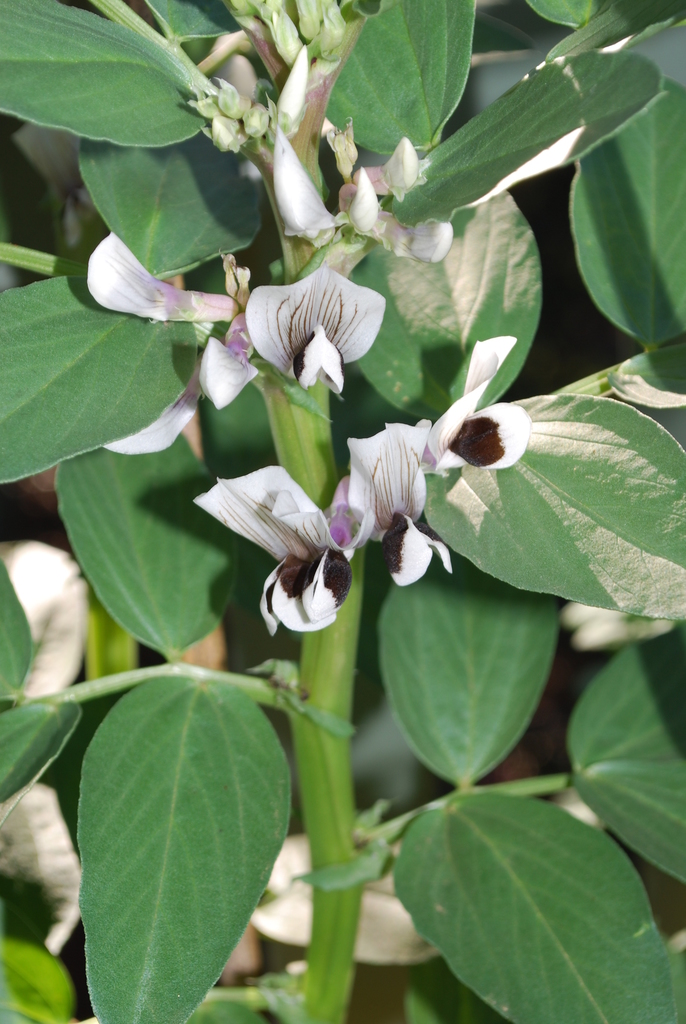
fava bean
Vicia faba
Vicia faba, commonly known as the broad bean, fava bean, or faba bean, is a species of vetch, a flowering plant in the pea and bean family Fabaceae. It is widely cultivated as a crop for human consumption, and also as a cover crop. Varieties with smaller, harder seeds that are fed to horses or other animals are called field bean, tic bean or tick bean. This legume is commonly consumed in many national and regional cuisines.
Some people have favism, a hemolytic response to the consumption of broad beans, a condition linked to a metabolic disorder known as G6PDD. Otherwise the beans, with the outer seed coat removed, can be eaten raw or cooked. With young seed pods, the outer seed coat can be eaten, and in very young pods, the entire seed pod can be eaten.
From the article Vicia faba on Wikipedia (CC BY-SA), quoted section by section
Description
Vicia faba is a stiffly erect, annual plant 0.5 to 1.8 metres (1+1⁄2 to 6 ft) tall, with two to four stems that are square in cross-section. The leaves are 10 to 25 centimetres (4 to 10 in) long, pinnate with 2–7 leaflets, and glaucous (grey-green). Unlike most other vetches, the leaves do not have tendrils for climbing over other vegetation. The flowers are 1 to 2.5 cm (1⁄2 to 1 in) long with five petals; the standard petals are white, the wing petals are white with a black spot (true black, not deep purple or blue as is the case in many "black" markings) and the keel petals are white. Crimson-flowered broad beans also exist, which were recently saved from extinction. The flowers have a strong sweet scent which is attractive to bees and other pollinators. The fruit is a broad, leathery pod that is green, but matures to a dark blackish-brown, with a densely downy surface; the wild species has pods that are 5 to 10 cm (2 to 4 in) long and 1 cm diameter, but many modern cultivars developed for food use have pods 15 to 25 cm (6 to 10 in) long and 2–3 cm thick. Each bean pod contains 3–8 seeds. They are round to oval and have a 5–10 mm diameter in the wild plant, but are usually flattened and up to 20–25 mm long, 15 mm broad and 5–10 mm thick in food cultivars. V. faba has a diploid (2n) chromosome number of 12 (six homologous pairs). …
At the table
Raw mature broad beans are 11% water, 58% carbohydrates, 26% protein, and 2% fat. A 100-gram reference amount supplies 1,425 kJ (341 kcal; 341 Cal) of food energy and numerous essential nutrients in high content (20% or more of the Daily Value, DV). Folate (26% DV), and dietary minerals, such as manganese, phosphorus, magnesium, and iron (range of 52–77% DV), have considerable content. B vitamins have moderate to rich content (19–48% DV). Broad beans present the highest protein-to-carbohydrate ratio among other popular pulse crops, such as chickpea, pea and lentil. Moreover, their consumption is recommended along with cereals as both foods are complementary in supplying all essential amino acids. Broad beans are generally eaten while still young and tender, enabling harvesting to begin as early as the middle of spring for plants started under glass or overwintered in a protected location, but even the main crop sown in early spring will be ready from mid to late summer. Horse beans, left to mature fully, are usually harvested in the late autumn, and are then eaten as a pulse. …
Wikipedia: “Culinary”
Toxicity
Beans generally contain phytohaemagglutinin, a lectin that occurs naturally in plants, animals, and humans. Most of the relatively low toxin concentrations found in V. faba can be destroyed by boiling the beans for 10 minutes. Broad beans are rich in levodopa, and should thus be avoided by those taking irreversible monoamine oxidase inhibitors to prevent a pressor response.
Genetic predisposition. Sufferers of favism must avoid broad beans, as they contain the alkaloid glycoside vicine which may initiate a hemolytic crisis. A low-content vicine-convicine faba bean line was identified in the 1980s and the trait has been introduced into several modern cultivars. Low vicine-convicine faba beans are safe for consumption by G6PD-deficient individuals. As of 2019, a molecular marker may be used for marker-assisted breeding to reduce levels of vicine-convicine in broad beans.
How it is grown
Broad beans have a long tradition of cultivation in Old World agriculture, being among the most ancient plants in cultivation and also among the easiest to grow. While their wild ancestor has not been identified and their origin is unknown, charred legumes of a possible wild-type progenitor have been identified at the Natufian site of the el-Wad Terrace. Carbonised domestic faba bean remains were discovered at three adjacent Neolithic sites in Israel's Lower Galilee (Yiftah'el, Ahi'hud and Nahal Zippori). Based on the radiocarbon dating of these remains, scientists now believe that the domestication of the crop may have begun as early as 8250 BCE. Broad beans are still often grown as a cover crop to prevent erosion because they can overwinter and, as a legume, they fix nitrogen in the soil. The broad bean has high plant hardiness; it can withstand harsh and cold climates. Unlike most legumes, the broad bean can be grown in soils with high salinity, as well as in clay soil. However, it prefers rich loams. In much of the English-speaking world, the name "broad bean" is used for the large-seeded cultivars grown for human food, while "horse bean" and "field bean" refer to cultivars with smaller, harder seeds that are more like the wild species and used for animal feed, though their stronger flavour is preferred in some human food recipes, such as falafel. …
Wikipedia: “Cultivation”
Where it lives
Recorded sightings
—
geo-referenced records in GBIF, from museums, herbaria and field observers.
Drag the globe to turn it. Dots are where records exist, not a range map; darker means more records.
In the old herbals & bestiaries

Ortus sanitatis
1491 · p.178

Ortus sanitatis
1491 · p.177

The Book of Health: The Art of Distillation
Brunschwig, Hieronymus · 1505 · p.95

Commentaries on the Six Books of Dioscorides on Medical Matter
Pietro Andrea Mattioli · 1563 · p.364

Compendium of Materia Medica: Illustrated Volume Middle of Middle
李時珍 · 1596 · p.54

Zhiwu Mingshi Tukao (Vol. 1)
吳其濬 · 1848 · p.91

Complete Treatise on Agricultural Administration
Xu Guangqi · 1909 · p.807

Herbarium Portatile, Oder Behendes Kräuter- und Gewächs-Buch: Darinn nicht allein 1363. so wol Einheimische als Außländndische Kräuter mit Lateinisch und Deutscher Benennung abgebildet, sondern auch die meisten, so in der Medicin gebräuchlich, kürtzlich erkläret werden
Panckow, Thomas · 1656 · p.102
In the stacks
Searching the stacks…
Every page naming Vicia faba in the Biodiversity Heritage Library →
This page is assembled live from iNaturalist, GBIF, Wikipedia, the Source Library and the Internet Archive. It is not yet part of the hand-edited codex. iNaturalist taxon 57309.