- Plants
- ›Vascular Plants
- ›flowering plants
- ›Dicots
- ›Legumes, Milkworts, and Allies
- ›Legumes
- ›Faboideae
- ›Trifolieae
- ›Medicago
- ›Spirocarpos
- ›Spirocarpos
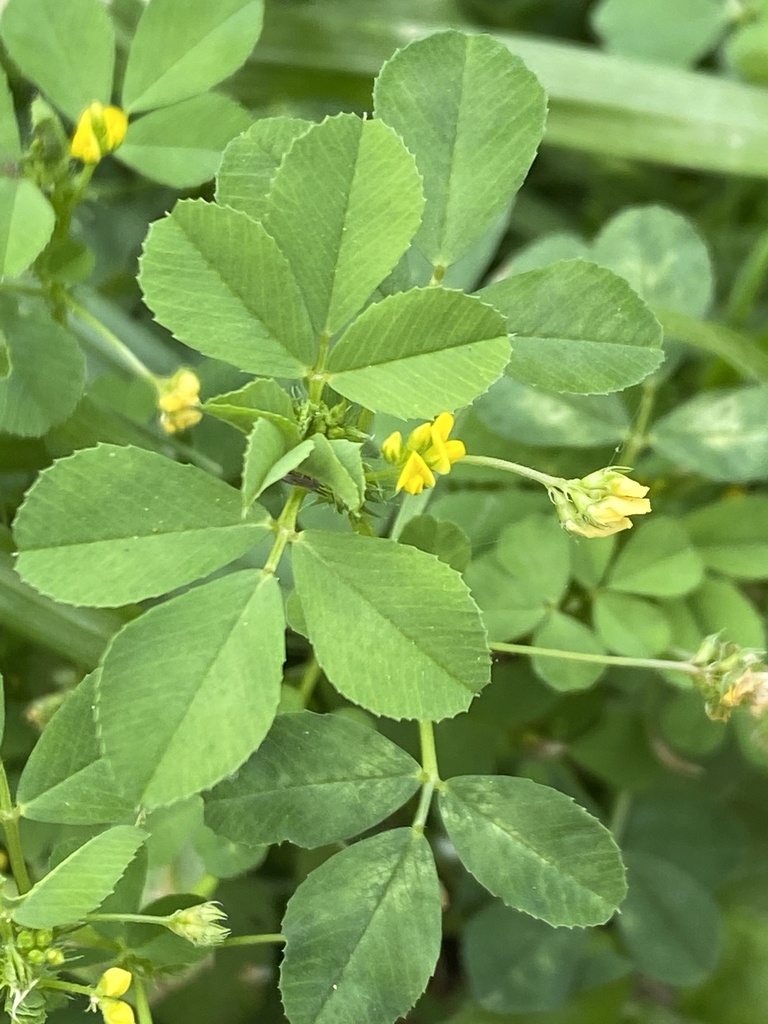
bur clover
Medicago polymorpha
Medicago polymorpha is a plant species of the genus Medicago. It is native to the Mediterranean basin but is found throughout the world. It forms a symbiotic relationship with the bacterium Sinorhizobium medicae, which is capable of nitrogen fixation. Common names include California burclover, toothed bur clover, toothed medick and burr medic.
From the article Medicago polymorpha on Wikipedia (CC BY-SA), quoted section by section
Description
This weedy forb is an annual broadleaf plant. It inhabits agricultural land, roadsides and other disturbed areas. It is found in lawns as well, where its burrs are able to cling to the clothing or fur of any species that pass near it, thus facilitating geographic spread via these seed capsules. It makes a poor lawn in the late summer, when the leaves have yellowed and fruit sets into the 7 mm seed heads that are covered with hooked prickles. New seedlings have seed leaves that are oblong. The first true leaf is rounded. Later leaves will be tripartite, with a characteristic clover-like shape, appearing alternately on the stems. Leaflets have slightly serrated edges. The tiny yellow flowers attract small butterflies and other pollinating insects. Full grown plant stems are up to 60 centimetres (24 in) long, and usually sprawl along and/or under the ground. The stems often root at the nodes; adult plants, and even young plants that have been able to grow for a few weeks undisturbed can be very difficult to pull out, leaving behind tap roots and a network of plant pieces when pulled. Mechanically removing top growth from this plant will not usually eradicate it. If not properly managed, burclover may then become invasive and displace more desirable vegetation. Being a member of the family Fabaceae, the flowers are clover-like, lipped and clustered. …
Range & habitat
It is native to the Mediterranean basin but is found throughout the world. The species forms a symbiotic relationship with the bacterium Sinorhizobium medicae, which is capable of nitrogen fixation. Burclover is a good forage for livestock, but the fruit is prickly. All classes of livestock, except horses and mules, can feed on its leaves.
Wikipedia: “Distribution and ecology”
At the table
The plant is edible and consumed as a vegetable in China, primarily in Jiangsu, Zhejiang and Shanghai. Its Chinese culinary names include 草頭 (Wu tsho-doe, Mandarin Pinyin cǎo tóu), 金花菜 (Wu cin-hau tse, Mandarin Pinyin jīn huā cài), 三叶菜 (sān yè cài) and 秧草 (yāng cǎo), while 南苜蓿 (nán mùxu) is its scientific name. It is also consumed in indigenous Otomanguean communities in Southern Mexico. In the Triqui language it is known as kkweej chakáj, meaning 'edible green (of the) pig.'
Wikipedia: “Culinary uses”
Where it lives
Recorded sightings
—
geo-referenced records in GBIF, from museums, herbaria and field observers.
Drag the globe to turn it. Dots are where records exist, not a range map; darker means more records.
In the stacks
Searching the stacks…
Every page naming Medicago polymorpha in the Biodiversity Heritage Library →
This page is assembled live from iNaturalist, GBIF, Wikipedia, the Source Library and the Internet Archive. It is not yet part of the hand-edited codex. iNaturalist taxon 53151.