 NL·0131
Herbarium of the Nature Library
- Name
- Sorghum bicolor
- Family
- Poaceae
- Native to
- North-east Africa (Sudan, Ethiopia and the eastern Sahel); grown in semi-arid regions worldwide
- Habitat
- Savanna, Semi-arid farmland
Sorghum
Sorghum bicolor
Also calledJowar (Hindi/Marathi) · Dhurah (Arabic) · Gaoliang (Chinese) · Mtama (Swahili) · Oka baba (Yoruba) · Durra (Sudanese Arabic) · Milo (US)
A heat- and drought-hardy grain domesticated in the eastern Sahel of Sudan around 5,000–6,000 years ago, and the fifth most important cereal in the world. It feeds hundreds of millions across Africa and India, and its stalks give sugar syrup, broom straw and fodder.
Sorghum bicolor, commonly called sorghum and also known as broomcorn, great millet, Indian millet, Guinea corn, jowar, or milo, is a species in the grass genus Sorghum. It is typically an annual, but some cultivars are perennial. It grows in clumps that may reach over 4 metres (13 ft) high. The grain is 2 to 4 millimetres in diameter. Wikipedia
What it can do
- iC4 photosynthesis and a waxy leaf bloom let it yield where maize fails in heat and drought
- iiCan go dormant in drought and resume growing when rain returns
- iiiRoots exude sorgoleone, a compound that suppresses nearby weeds
- ivYoung plants and regrowth contain dhurrin, which releases cyanide
At the table
Eatengrain (flour for roti, injera-style flatbreads, porridge, couscous; brewed into beer) · sweet stalk juice (syrup) · popped grain
Grain is safe and gluten-free. Young leaves, shoots and frost- or drought-stressed regrowth contain dhurrin, which can poison grazing livestock with cyanide.
In the medicine cabinet
| Tradition | Use |
|---|---|
| West African folk medicine | Red leaf-sheath extract (from dye sorghum) as a blood tonic for anaemia |
| Ayurveda | Jowar as a light, cooling grain for digestive and urinary complaints |
Weight of evidence
Traditional. Long historical use; little or no modern clinical evidence.
Active compounds
starch, 3-deoxyanthocyanidins, condensed tannins (some varieties), dhurrin (young plants)
Fruit & seed


Fruit
Caryopsis (grain)
Ripens: End of the rainy season / late summer–autumn
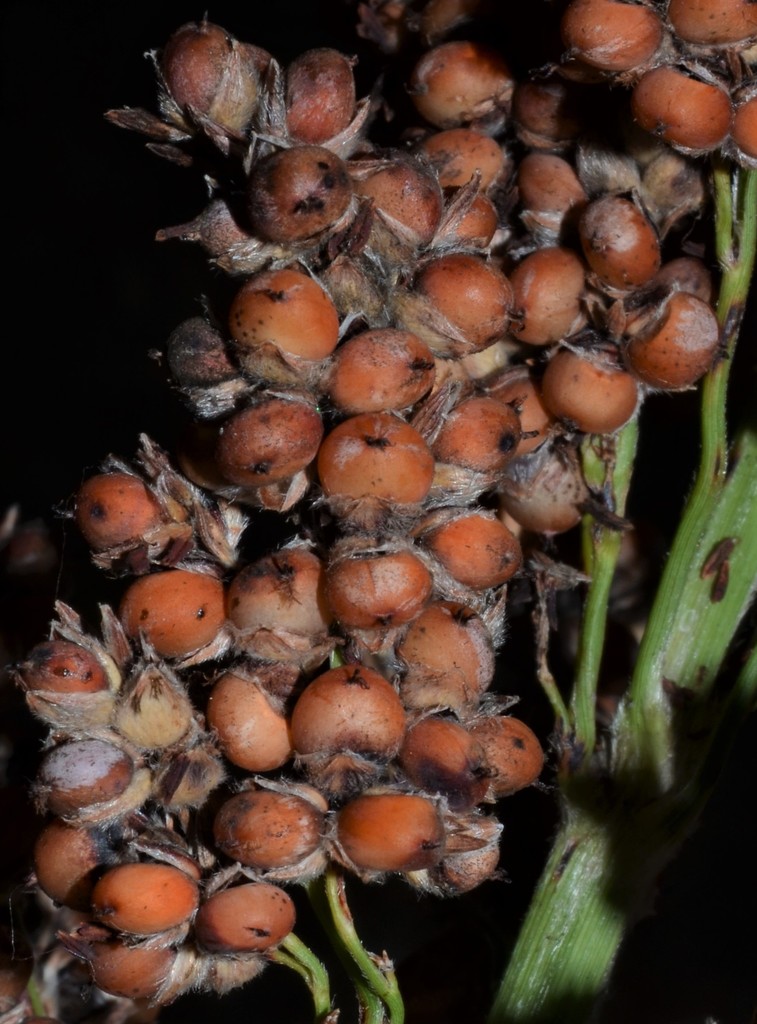
Compact or open panicle (head) at the top of a stalk 1–4 m tall, bearing hundreds of round grains.


Seed
3–5 mm
Round to slightly oval grains 3–5 mm, white, cream, yellow, red, brown or near-black, often partly enclosed in papery glumes
- Dispersal
- Humans and birds
- Germination
- Sow 2–4 cm deep once soil exceeds about 15 °C; emerges in 4–10 days
Photographs from Wikimedia Commons under open licences; hover for the photographer, click for the file.
How to grow it
Hardiness (USDA zones)
Annual warm-season crop (needs 90–120+ hot days). Survives winters down to about undefined °C.
- Light
- Full sun
- Water
- Low–moderate (400–600 mm per season)
- Soil
- Tolerates poor, sandy, clay or slightly saline soils, pH 5.5–8.5
- Propagation
- Seed
- To harvest
- 90–130 days
- Climates
- Semi-arid tropical, Savanna, Warm temperate summer
- 1Sow in warm soil after the rains start or after frost, 2–4 cm deep, 15–20 cm apart in rows 60–75 cm apart.
- 2Thin seedlings and weed in the first month; little care is needed afterwards.
- 3Water only in prolonged drought; avoid grazing animals on young or stressed plants.
- 4Protect ripening heads from birds with netting or paper bags.
- 5Cut heads when the grain is hard and can't be dented with a fingernail, dry them, then thresh by beating.
Can it grow where you are?
Where it lives
Recorded sightings
—
geo-referenced records in GBIF, from museums, herbaria and field observers.
Native range
North-east Africa (Sudan, Ethiopia and the eastern Sahel); grown in semi-arid regions worldwide
Drag the globe to turn it. Dots are where records exist, not a range map; darker means more records.
In Gerard's Herball, 1597

First Booke · Chap. 55 · p. 77 · read the page →
Of Turkie Millet.
John Gerard, The Herball, or Generall Historie of Plantes, London, 1597. What England's best-known herbal said of sorghum, in its own spelling.
- The vertues
- The seed of Turkie Mill is like vnto Panicke in taste and temperature: the countrie people sometimes make bread heerof, but it is brittle and of little nourishment, and for the most part it serueth to fatten hens and pigeons with.
- The place
- It ioieth in a fat and moist ground: it groweth in Italy, Spaine, and other hot regions.
- The time
- This is one of the sommer graines: it is ripe in Autumne.
- The names
- It is called of the Insubers, Melegua, and Melega: in Latine Melica: in Hetruria Saggina: in other places of Italy Sorgho: in Portingale Milium saburrum: in English Turkie Mill or Turkie Hirsse.
Gerard wrote within Galenic humoral medicine, and his opinions, including about the peoples of the Americas and their crops, are those of 1590s London. His “vertues” are history, not advice. Transcription: Source Library (CC BY-SA 4.0). The whole chapter in the Herball Room.
In the old herbals & bestiaries
Woodcuts and engravings matched from the Source Library’s scanned books by name. Plates marked “relative” show a close kin rather than this exact species. Click a plate to read the page it came from, with translation.

Notable Commentaries on the History of Plants
Leonhart Fuchs · 1542 · p.805

De medicinali materia libri sex
Dioscorides · 1552 · p.258

Notable Commentaries on the History of Plants
Leonhart Fuchs · 1549 · p.803

On Medical Materials in Six Books
Dioscorides · 1550 · p.250

Commentaries on the Six Books of Pedanius Dioscorides on Medical Matter
Pietro Andrea Mattioli · 1565 · p.578

A New Herbal, or History of Plants
Rembert Dodoens (trans. Henry Lyte) · 1578 · p.491

Six Groups of the History of Plants
Rembert Dodoens · 1583 · p.520

Compendium of Materia Medica: Illustrated Volume Middle of Middle
李時珍 · 1596 · p.42

Hortus Eystettensis
Basilius Besler · 1640 · p.366

Zhiwu Mingshi Tukao (Vol. 1)
吳其濬 · 1848 · p.62
In the stacks
Searching the stacks…
Every page naming Sorghum bicolor in the Biodiversity Heritage Library →
Marginalia
Sorghum grains impressed into pottery at Kassala in Sudan are among the earliest evidence of its domestication. In China, sorghum is distilled into baijiu spirits such as Moutai, and the novel and film 'Red Sorghum' made its fields an icon of rural China.
Curiosity
Sorghum stalks can also be pressed for sweet juice: 'sorghum molasses' was a staple sweetener in the 19th-century American South.
Kinship



Photographs: iNaturalist contributors under the licences shown. Records: GBIF.org. Historical plates: Source Library (CC BY-SA 4.0; originals public domain). Summary text: Nature Library editors and Wikipedia (CC BY-SA). Medicinal and edibility notes are historical and educational, not advice. iNaturalist taxon 58389.