 NL·0772
Herbarium of the Nature Library
- Name
- Upupa epops
- Family
- Upupidae
- Native to
- Europe, Asia and Africa; European birds winter in sub-Saharan Africa
- Habitat
- Open woodland, Orchards, Savanna, Farmland
On eBird ↗
Common Hoopoe
Live sightings near you, the range map, bar charts of when it is seen, and Macaulay Library photos and recordings.
Eurasian hoopoe
Upupa epops
Also calledHudhud (Arabic/Urdu/Persian) · Dàishèng (Chinese, 戴胜) · Abubilla (Spanish) · Dukhifat (Hebrew) · Huppe (French)
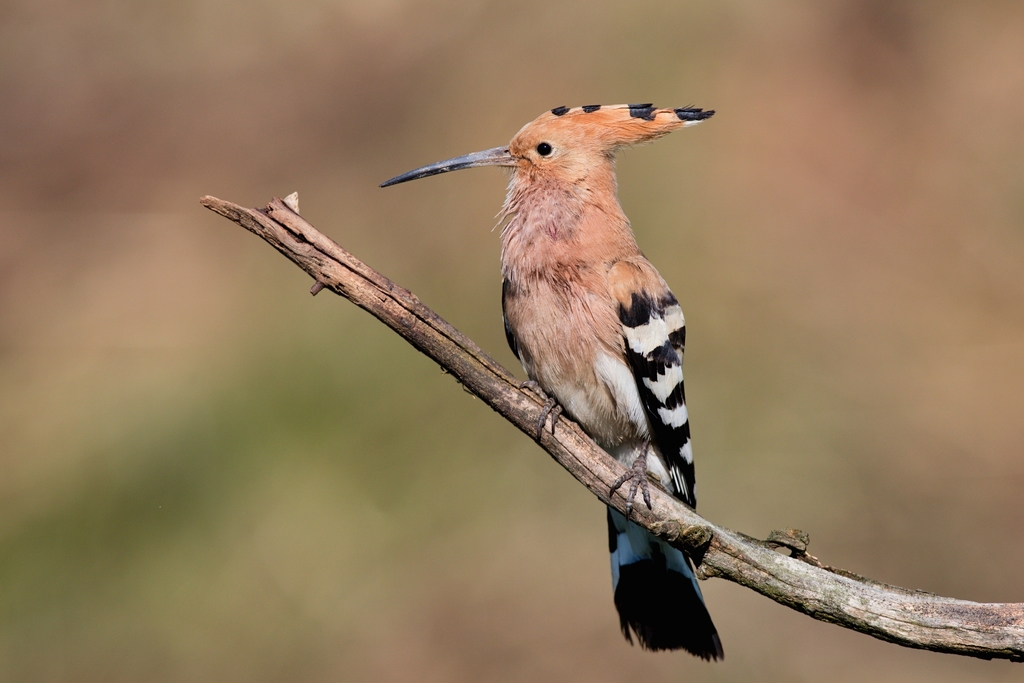
A cinnamon bird with a fan-shaped crest and zebra-striped wings, named for its soft 'oop-oop-oop' call. Nesting females and chicks defend themselves with a foul-smelling secretion produced with help from symbiotic bacteria.
The Eurasian hoopoe or common hoopoe is the most widespread species of hoopoe. It is a distinctive cinnamon coloured bird with black and white wings, a tall erectile crest, a broad white band across a black tail, and a long narrow downcurved bill. Its call is a soft "oop-oop-oop". Wikipedia
What it can do
- iPreen-gland secretion hosts Enterococcus bacteria that produce antimicrobials, protecting eggs
- iiNestlings squirt faeces and hiss like snakes at intruders
- iiiProbes soil with a long curved bill for larvae and mole crickets
- ivRaises and fans its crest in alarm and on landing
In the field
Field marks
- aPinkish-cinnamon bird with a fan-shaped, black-tipped crest
- bBlack and white barred wings and tail
- cLong, thin, down-curved bill
- dFloppy, butterfly-like flight
- Voice
- A soft, hollow 'oop-oop-oop'
- Not to be confused with
- Distinctive; no similar bird in its range.
- Where to see it
- Extremadura (Spain), the Algarve (Portugal) and orchards and villages across southern Europe and South Asia
- When
- Europe: summer visitor Mar–Sep; resident in southern parts of its range
Listen
Looking for field recordings…
Life & habits
- Diet
- Insects and larvae, especially beetle grubs and crickets; small reptiles
- Habitat
- Open ground with scattered trees, orchards and vineyards
- Size
- 25–32 cm; wingspan 44–48 cm
- Lifespan
- Around 10 years
Nests in tree holes or walls, where the female's oily secretion gives the nest a strong stench.
Where it lives
Recorded sightings
—
geo-referenced records in GBIF, from museums, herbaria and field observers.
Native range
Europe, Asia and Africa; European birds winter in sub-Saharan Africa
Drag the globe to turn it. Dots are where records exist, not a range map; darker means more records.
In the old herbals & bestiaries
Woodcuts and engravings matched from the Source Library’s scanned books by name. Plates marked “relative” show a close kin rather than this exact species. Click a plate to read the page it came from, with translation.

Historiae Animalium Liber III: De Avium Natura
Conrad Gesner · 1555 · p.784

François Le Vaillant — Histoire naturelle des promerops et des guêpiers (1807)
François Le Vaillant · 1807 · p.187

François Le Vaillant — Histoire naturelle des promerops et des guêpiers (1807)
François Le Vaillant · 1807 · p.189

Jean Baptiste Audebert — Histoire naturelle des colibris (1802)
Jean Baptiste Audebert · 1802 · p.314

The Secrets of Albertus Magnus on the Nature of Women and the Virtues of Herbs
Albertus, Magnus, Heiliger · 1604 · p.68

Natural Magic (Magia Naturalis)
Wolfgang Hildebrand · 1616 · p.718

History of Animals, Book I: On Viviparous Quadrupeds
Conrad Gessner · 1554 · p.929

Obeliscus Aegyptiacus
Athanasius Kircher · 1666 · p.70

Garden of Health
Jacob Meydenbach · 1491 · p.669

Noah's Ark
Athanasius Kircher · 1675 · p.138
In the stacks
Searching the stacks…
Every page naming Upupa epops in the Biodiversity Heritage Library →
Marginalia
In the Qur'an (Surah An-Naml) the hoopoe brings King Solomon news of the Queen of Sheba, and in Attar's 'Conference of the Birds' (12th c.) it leads the birds on their spiritual journey. It was named Israel's national bird in 2008.
Curiosity
Both Leviticus and Deuteronomy list the hoopoe among birds not to be eaten, yet it became Israel's national bird.
Kinship



Photographs: iNaturalist contributors under the licences shown. Records: GBIF.org. Historical plates: Source Library (CC BY-SA 4.0; originals public domain). Summary text: Nature Library editors and Wikipedia (CC BY-SA). Medicinal and edibility notes are historical and educational, not advice. iNaturalist taxon 20969.