On eBird ↗
New Zealand Scaup
Live sightings near you, the range map, bar charts of when it is seen, and Macaulay Library photos and recordings.
New Zealand Scaup
Aythya novaeseelandiae
The New Zealand scaup (Aythya novaeseelandiae), also known as the black teal (or pāpango and several other names in Māori), is a diving duck species of the genus Aythya endemic to New Zealand. They weigh around 650 grams (23 oz) and measure around 40 centimetres (16 in), and have dark-coloured plumage. They are found throughout New Zealand in deep natural and man-made lakes and ponds.
New Zealand scaup lay around 7 eggs and the ducklings are immediately capable of diving to feed. Adult scaups can dive to at least 3 metres and for as long as a minute for aquatic plants and invertebrates. Scaups started declining in the late 1800s until they were fully protected in 1934, and their population is now increasing thanks to predator control and new habitat.
From the article New Zealand scaup on Wikipedia (CC BY-SA), quoted section by section
Description
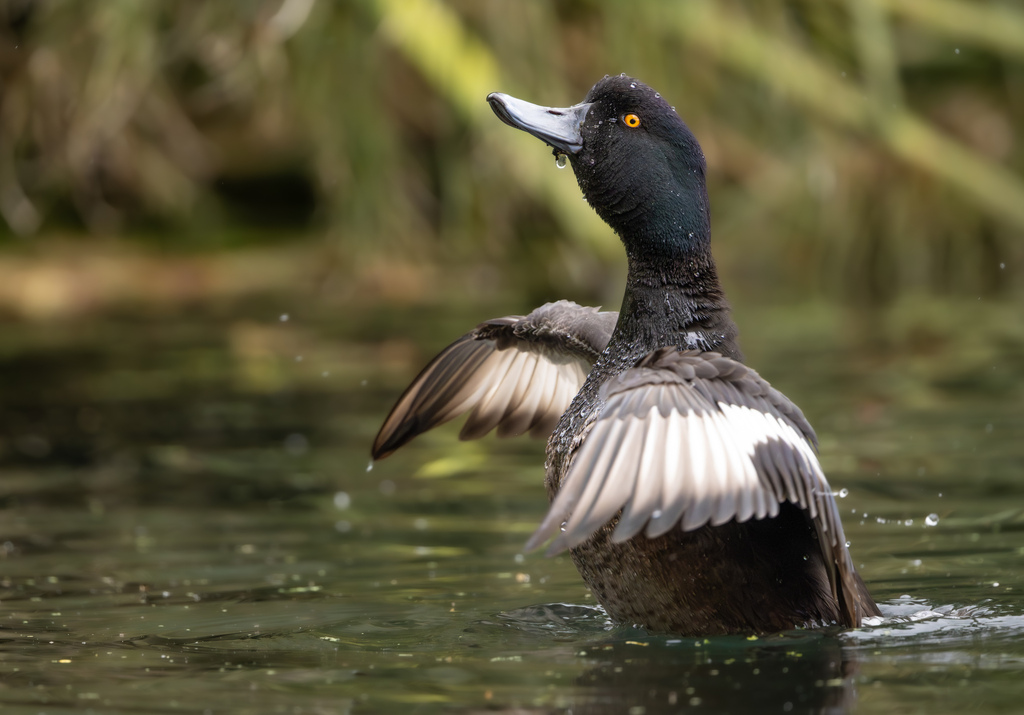
The New Zealand scaup is a small, round-bodied diving duck that have dark plumage, but both sexes are easily distinguished. They have black legs and webbed feet for swimming, and they spend a lot of time underwater, where they can also travel considerable distances. They measure around 40 centimetres (16 in) in length and weigh around 695 grams (24.5 oz) for males, and around 610 grams (22 oz) for females. The male has dark black-brown plumage with a striking yellow eye and a dark coloured (greenish) head. The female has duller chocolate brown plumage, brown eyes and has a white face patch during breeding season. A white wing bar can be seen in both sexes when in flight, and both sexes have a grey bill. The young are initially covered in pale brown and white down, and juveniles look like the female, except with no white at the base of the bill. The males have a high pitched whistle call and the females 'quack'.
Range & habitat
They are found throughout both the North and South Island of New Zealand in deep freshwater lakes and ponds, and recently, hydroelectric lakes and oxidation ponds. Despite being widespread, they have a patchy distribution, and most scaups are on suitable habitat areas in Northland, the upper Waikato, Rotorua, Taupō, Hawke's Bay, West Coast, North Canterbury, and the Southern Alps. Unlike other members of this genus, the scaup is not migratory, although it does move to open water from high country lakes if they become frozen in winter. A recent population expansion has happened in Christchurch thanks to predator control and suitable habitat.
Wikipedia: “Distribution and habitat”
What it does
New Zealand scaups are usually seen in flocks during autumn in winter, with flocks of over 200 birds seen at traditional moulting and wintering sites such as Lake Rotorua, Lake Taupō, Lake Tūtira, the Bromley sewage ponds, and the Ashburton Lakes.
Breeding. New Zealand scaups typically leave their wintering flocks by September, and the males become territorial. The nest is a bowl of grass, sedges and other similar plants, lined with down, and in dense cover close to water. Sometimes scaups breed in loose colonies if suitable breeding habitat is scarce. Egg laying mostly occurs from late October to December, but some late or replacement clutches are laid until February. The clutch of can contain 2–15 creamy-white coloured eggs, although the typical range is 6–8 eggs, and clutches of 12 eggs or more are probably laid by multiple female scaups. The eggs are around 65mm x 45mm (2.56in x 1.77in) in size, and weigh around 71 grams (2.5 oz). The eggs are laid in an interval of 1.2–1.4 days, and are incubated by the female for around 30 days. The female broods the ducklings on the nest for up to 24 hours before leading the ducklings to water. The ducklings are immediately capable of diving to feed. The female guards the brood during the fledging period of around 75 days. …
Wikipedia: “Behaviour and ecology”
Listen
Looking for field recordings…
Where it lives
Recorded sightings
—
geo-referenced records in GBIF, from museums, herbaria and field observers.
Drag the globe to turn it. Dots are where records exist, not a range map; darker means more records.
In the stacks
Searching the stacks…
Every page naming Aythya novaeseelandiae in the Biodiversity Heritage Library →
This page is assembled live from iNaturalist, GBIF, Wikipedia, the Source Library and the Internet Archive. It is not yet part of the hand-edited codex. iNaturalist taxon 7058.